

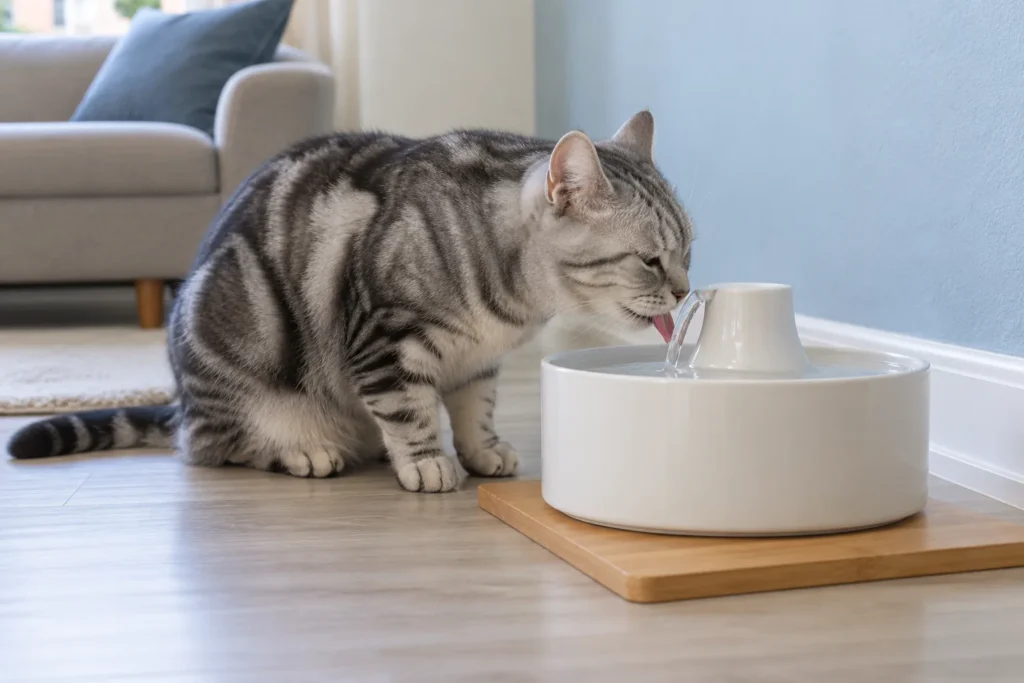
Cat water fountains are sold on one promise: moving water gets a cat drinking. The studies are smaller and more cautious than the packaging, and the running costs are mostly filters and your time. Here is what is known, and what each fountain asks of you once it is on the floor.
The one fountain guide live today is cordless and battery fountains, which matters in a small home where the outlet is rarely where the water should go.
What is your fountain question?
No outlet near the water spot
A battery fountain can stand away from the counter and the cat’s food. Check how long a charge lasts at the flow setting you plan to use.
Start with cordless fountains compared
Is a fountain worth it at all?
For a healthy cat, the studies found no group-wide rise in drinking, so a fountain is a preference test. Buy one if your cat seems drawn to running taps, and budget for filters and a weekly wash.
A cat with a urinary condition
For a cat with urinary disease, International Cat Care’s 2025 guidelines name a fountain as one option for getting more water in. Whether it suits your cat is a question for your vet.
What studies found about cat water fountains
Three small studies, published in 2010, 2010 and 2019, compared fountains or flowing water with a still bowl in healthy cats: 12, 9 and 14 cats were analyzed. None found that the cats as a group drank significantly more from the fountain. Some individual cats did prefer one source or the other, so a fountain can still suit your cat; it is simply not a health tool that anyone has measured working.
International Cat Care’s 2025 urinary guidelines list a fountain among the ways to encourage drinking in cats with urinary disease. That is a decision for you and your vet, about one cat, and not a reason to expect the same in a healthy one.
The upkeep, by the makers’ own numbers
| Job | What the makers and vets say |
|---|---|
| Filter | It depends on the model, so go by the manual that came with yours. Catit says every 30 days for its Flower fountain filters; two PETLIBRO blog posts disagree with each other, one saying 2 to 4 weeks and the other 1 to 3 months. |
| Pump and parts | Warm water and mild dish soap. Catit says take the pump apart every 2 weeks and avoid harsh detergents and abrasive sponges; PETLIBRO suggests a deep clean weekly. |
| Whole fountain | PETLIBRO suggests replacing it every 2 to 3 years. That is maker advice; no vet source sets a lifespan. |
| Material | VCA says plastic bowls may be linked to chin acne in some cats, though neither that link nor the cause of chin acne is proven. |
| Placement | Apart from the food bowl and well away from the litter box (AAFP and ISFM). No source gives a distance. |
The electricity is the cheap part. Multiply the pump’s listed wattage by 8.76 to get kilowatt-hours a year; at the July 2026 US average of 18.31 cents per kWh from the Energy Information Administration, each watt of pump costs about $1.60 a year. Filters are the running cost to price before you buy.
Fountain guides
The guides set capacities, footprints, filter costs per year and published noise figures side by side, and say where a maker publishes no figure at all.
-

Cordless and battery cat water fountains: what changes
Five battery fountains compared on what their makers publish: run time and what it assumes, charging, where the battery sits and filter schedules.
13 min readUpdated
To size the tank to your home, our water calculator works out what your cats drink after the water in their food, and how many days each full tank in our picks would last.
Fountain questions
Is a steel or ceramic fountain better than a plastic one?
Possibly, for some cats. VCA says plastic dishes may be tied to chin acne, while stressing that the tie is unproven and so is the cause of the acne itself, and it suggests glass or stainless steel washed every day. A clean plastic fountain remains a fair choice.
Does a cordless fountain need less cleaning?
The power source changes nothing about the water. The makers we read ask for parts washed in warm, soapy water and the pump taken apart every week or two, and the filter changed on the maker’s own schedule, whether the pump runs on a cord or a battery.
Back to the feeding and water hub
Sources
- Grant, study of water intake from a bowl and a fountain in 12 healthy cats (abstract), Journal of Feline Medicine and Surgery, 2010. Read Oct 16, 2026.
- Pachel and Neilson, pilot study of still and flowing water with 9 shelter cats, Journal of Veterinary Behavior, 2010. Read Oct 16, 2026.
- Robbins and others, crossover study of still, circulating and free-falling water bowls in 14 cats (abstract), 2019. Read Oct 16, 2026.
- International Cat Care, consensus guidelines on feline lower urinary tract diseases, 2025. Read Oct 16, 2026.
- Catit, Triple action fountain filters. Read Oct 16, 2026.
- Catit, Catit Flower fountain cleaning guide. Read Oct 16, 2026.
- PETLIBRO, Cat water fountain maintenance 101. Read Oct 16, 2026.
- PETLIBRO, How often to replace your cat fountain filter. Read Oct 16, 2026.
- VCA Animal Hospitals, Chin acne in cats. Read Oct 16, 2026.
- AAFP and ISFM, Feline Environmental Needs Guidelines, 2013. Read Oct 16, 2026.
- US Energy Information Administration, Electric Power Monthly: end-use prices, July 2026 data. Read Oct 16, 2026.