


An automatic cat feeder, a water fountain and two bowls can claim a surprising share of a small kitchen floor. These guides compare their footprints and running costs from makers’ specs, and they keep to what the research actually shows about how cats eat and drink.
Start with how cats eat and drink
- Many small meals. Left to themselves, cats eat several small meals across the day, and they prefer to eat alone. How much goes into each meal is a question for your vet and the food label.
- Bowls apart. Put food and water in different places, and the litter box well away from both. No source gives a distance, so use what your floor plan allows.
- A fountain is a preference, not a fix. Three small studies found that cats as a group did not drink significantly more from a fountain than from a still bowl. Some individual cats preferred one or the other.
The guide most readers here need first is the automatic feeder guide: it sorts feeders by footprint, power and what happens when the Wi-Fi drops.
What are you setting up?
Pick the closest match. Each answer sticks to equipment and placement; portions are always your vet’s call.
Meals while I am at work
Cats naturally eat many small meals across the day, so a timed feeder suits the way they eat. Set the amounts with your vet and the food label, then check the feeder against the counter or floor spot you have.
Start with choosing an automatic cat feeder
Two cats, and one eats both meals
The AAFP feeding statement advises separate stations with distance and a visual break between them. Microchip feeders, baby gates or size-limiting entrances can keep the areas apart; then watch that each cat really eats.
Start with the feeder guide, for microchip and timed options
No outlet near the water spot
A cordless fountain runs on a battery, so it can sit far from the kitchen counter and the cat’s food. You trade that for charging and a smaller tank.
Start with cordless and battery fountains
Deciding whether to get a fountain
Across three small studies, flowing water brought no group-wide rise in drinking over a still bowl. A fountain is a preference some cats show, plus a weekly cleaning job for you.
See every fountain guide, with filter costs
Picking bowls
VCA notes a possible link between plastic bowls and chin acne, though neither the link nor the cause is proven. Smooth glass or stainless steel, washed daily, may help some cats.
Automatic cat feeder guides
Timed, gravity, wet-food, camera and microchip feeders, compared on footprint, hopper capacity, power source and what each one does when the power or the Wi-Fi drops. The two-cat and microchip guides deal with the cat that eats its sibling’s share. In a galley kitchen, depth often matters more than width: the feeder has to sit against the wall without blocking a cabinet door or the path to the sink.
-
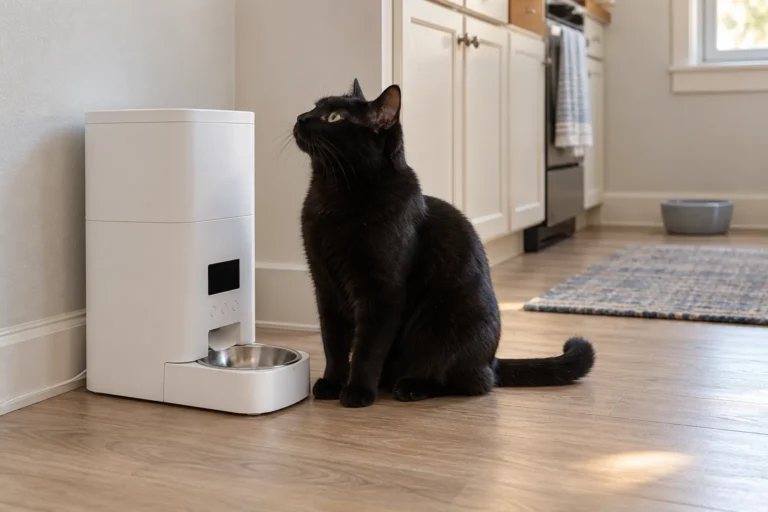
How to choose an automatic cat feeder for a small apartment
Five timed feeders compared on what their makers publish: footprint and height, hopper size, battery backup, buttons or an app, kibble range and cleaning.
15 min readUpdated
-
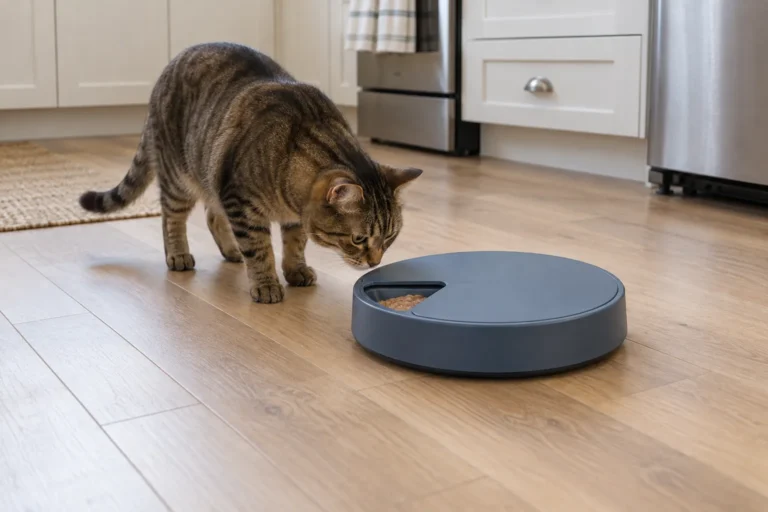
Automatic cat feeders for wet food: what the specs mean
Ice packs fade within hours and no feeder here holds fridge temperature. Choose by meals per day, power and cleanup: the Cat Mate C500, C200, Catit PIXI or Polar.
11 min readUpdated
All the feeder guides together
Before you program one, the cat food calculator works out how much of your food the day holds, from your cat’s weight and the label, and which feeder setting matches it.
Water fountains
Sizes, pumps, materials and the yearly cost of replacement filters. Filter intervals differ from model to model, so each guide quotes the maker’s own manual; Catit, for one, says every 30 days for its Flower fountain filters. Makers also ask for the pump to come apart for cleaning every week or two. A corded fountain also needs an outlet within reach of its cable, which in many older apartments decides where it can go before anything else does.
-

Cordless and battery cat water fountains: what changes
Five battery fountains compared on what their makers publish: run time and what it assumes, charging, where the battery sits and filter schedules.
13 min readUpdated
Every fountain guide on one page
How much should be in the bowl at all? The cat water calculator takes the water already in your cat’s food off a rough daily range, so a cat on wet food that drinks little is easy to put in context.
Bowls, mats and storage
Ceramic, stainless steel and glass bowls, raised stands, mats, food bins that fit a narrow cabinet, and ways to keep ants out. Whisker fatigue gets its own guide because the idea is everywhere and the evidence is thin: in a 2020 study of 38 cats, a wide, shallow dish did not change how long cats spent eating or how much they left behind.
Vet note. A cat that starts eating less, eating slowly or walking away from food it used to finish needs a vet visit. Mouth pain and illness show up this way, and a new bowl will not fix either.
Feeding and water questions
Does a cat need a special bowl for whisker fatigue?
Probably not. The idea is unproven: in one study of 38 cats, switching to a wide, shallow dish changed neither eating time, the amount eaten nor spillage. If eating habits change, book the vet rather than a trip down the bowl aisle.
How often does a water fountain need cleaning?
Every week or two, according to Catit and PETLIBRO: take the pump apart and wash the parts in warm water with a little mild dish soap. Unplug a corded model first, and rinse well so no soap is left in the tank. Filters follow each maker’s own schedule, printed in the manual.
Where do bowls go in a studio kitchen?
Somewhere the cat can eat alone and undisturbed, since cats prefer to eat by themselves. For a feeder, check that its lid can open fully under any shelf above it. No source gives a set distance from the counter or the door, so use what the room allows.
Should the water sit next to the food?
Feline guidelines keep food and water in separate spots, and the box far from both. In a studio that can mean water in the living area and food in the kitchen; a cordless fountain helps when the water spot has no outlet.
Sources
- Sadek and others, Feline feeding programs, Journal of Feline Medicine and Surgery, 2018. Read Oct 16, 2026.
- AAFP and ISFM, Feline Environmental Needs Guidelines, Journal of Feline Medicine and Surgery, 2013. Read Oct 16, 2026.
- Grant, water intake from a fountain and a bowl, Journal of Feline Medicine and Surgery, 2010; Robbins and others, water source and intake study, Journal of Feline Medicine and Surgery, 2019. Read Oct 16, 2026.
- Catit, Triple Action fountain filters, and Catit Flower fountain cleaning guide. Read Oct 16, 2026.
- Whisker stress study, Journal of Feline Medicine and Surgery, 2020. Read Oct 16, 2026.
- VCA Animal Hospitals, Chin acne in cats. Read Oct 16, 2026.
- PETLIBRO, Cat water fountain maintenance 101. Read Oct 16, 2026.