

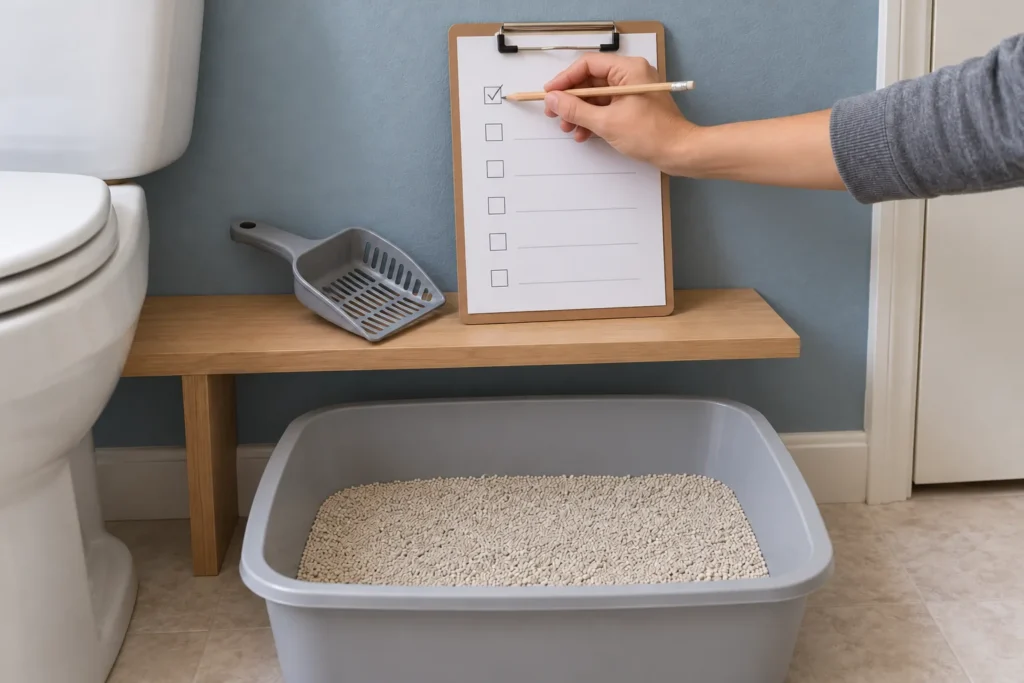
This litter box cleaning tracker is one landscape page for a whole month. Tick the morning and evening scoop for two boxes, fresh water, clean bowls and play each day, write the number of urine clumps in the red row, and note every full litter change, fountain filter and bag of litter in the boxes below the grid.

One page, about 230 KB, no sign-up. Free to print and share.
The schedule behind the litter box cleaning tracker
- Scoop at least once a day, twice if you can, which is why the grid has a morning and an evening row (AAFP and ISFM; International Cat Care; Cornell).
- Empty and wash clumping litter boxes every 1 to 2 weeks, the window where several guidelines overlap; non-clumping litter needs it every 2 to 3 days, by San Diego Humane Society’s count.
- Fountain filters and pumps follow your own fountain’s manual. Catit gives 30 days for its Flower filters and a pump clean every 2 weeks; other makers differ.
How to use it
Print a fresh sheet on the first of the month and pin it near the litter box or inside the cleaning cupboard, with a pen tied to it. In a home with two people, the grid settles the “did you scoop?” question at a glance. Cross out the box 2 rows if you have one cat and one box.
Keep last month’s sheet for a while. If your cat ever starts avoiding the box, a vet will ask what changed, and a record of scooping, litter changes and a new fountain filter makes that conversation shorter. For the reasoning behind each task, the smell and cleaning guides go step by step.
Sources
- AAFP and ISFM, Guidelines for Diagnosing and Solving House-Soiling Behavior in Cats, 2014. Read Oct 16, 2026.
- International Cat Care, consensus guidelines on feline lower urinary tract diseases, 2025. Read Oct 16, 2026.
- San Diego Humane Society, Litter boxes 101. Read Oct 16, 2026.
- Catit, Triple action fountain filters and Flower fountain cleaning guide. Read Oct 16, 2026.
Related: smell and cleaning, water fountains and the cat-sitter instruction sheet.