

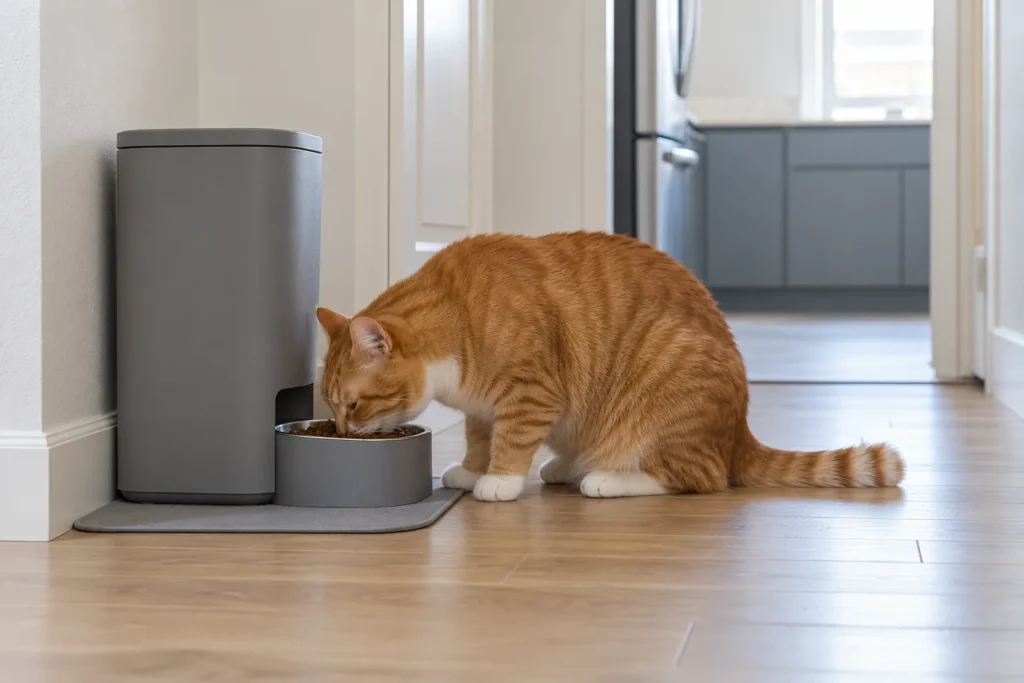
Automatic cat feeders solve an apartment problem more than a cat problem: long shifts, a cat that yells for breakfast at 5 a.m., a weekend away. Which kind fits depends on what you need the machine to do while you are not there, and on how your cat eats.
Read the guide to choosing an automatic feeder before you buy: it covers footprint, power and what each type does when the Wi-Fi drops.
What should the feeder handle?
Choose the job, and see which type of feeder suits it. Amounts are always for your vet and the food label to set.
The 5 a.m. wake-up call
A timed feeder that opens before your alarm moves breakfast off your schedule. Cats eat several small meals a day by nature, so a feeder that splits the day’s food suits them.
Start with choosing a timed feeder
Two cats eating at different speeds
A microchip feeder opens only for the cat it knows. Set the two stations apart, out of each other’s sight, and check that both cats really eat.
Start with the feeder guide, microchip section
A weekend away
A feeder handles meals, not the cat. Someone still has to visit, scoop and see that the food is going down.
Start with the weekend-away checklist
A cat that gulps its food
A puzzle slows each bite for far less money than a machine. Start with one barely harder than a bowl.
Start with puzzle feeders compared
How cats eat, and what automatic cat feeders can copy
A free-ranging cat catches somewhere between 10 and 20 small prey a day and can spend half of every 24 hours finding food, according to the AAFP’s 2018 feeding guidelines, which favor several small meals for pet cats too. Cornell’s Feline Health Center is less strict and says feeding once or twice a day suits most adult cats. The guidelines also note that cats prefer to eat alone. How much food goes into those meals is a question for the food label and your vet, never for a feeder’s default setting.
| Feeder type | How it works, and what to check |
|---|---|
| Timed (programmable) | Drops a set portion at set times from a hopper. Check how many meals a day it allows, the smallest portion it can deliver, and whether it keeps the schedule through a power cut on batteries. |
| Gravity | Refills the bowl from a hopper as the cat eats, so it does not portion anything. Check whether that matches the feeding plan your vet suggested. |
| Wet food | Covered trays that open on a timer. Check the number of trays, how they are sealed and how the maker says to clean them. |
| Microchip | Opens only for a cat whose microchip or collar tag is registered to it. Check which chip types the maker lists as compatible. |
Two cats who eat at different speeds are the classic case for a microchip feeder: the fast eater cannot finish the slow eater’s bowl. For one cat in a studio, a timed feeder covers most needs, and the footprint of its base usually decides where it can go.
Feeder guides
Every guide works from the makers’ manuals and spec pages: hopper size, power source, app requirements and the footprint you need to clear on the counter or floor.
-
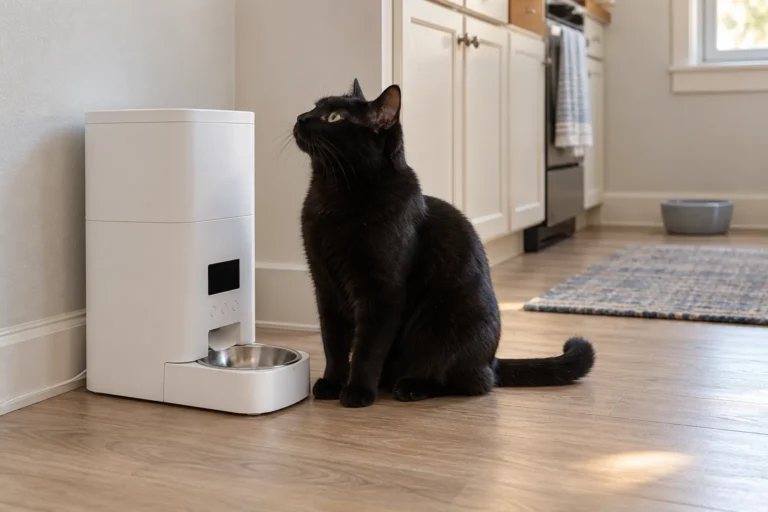
How to choose an automatic cat feeder for a small apartment
Five timed feeders compared on what their makers publish: footprint and height, hopper size, battery backup, buttons or an app, kibble range and cleaning.
15 min readUpdated
-
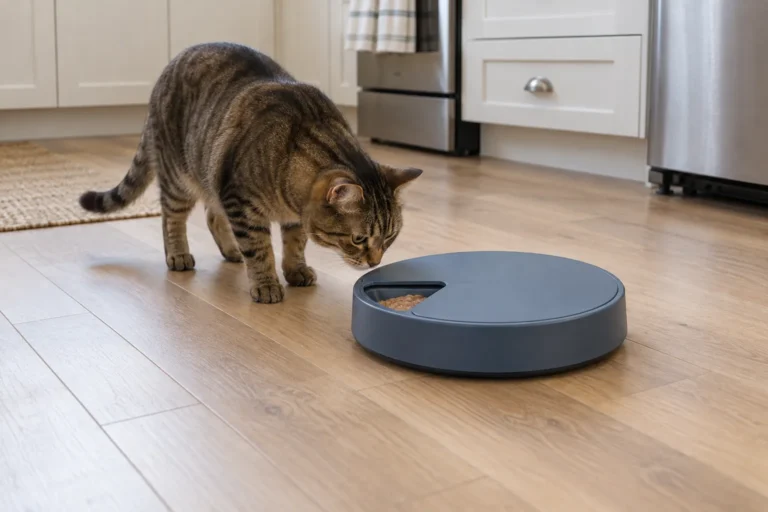
Automatic cat feeders for wet food: what the specs mean
Ice packs fade within hours and no feeder here holds fridge temperature. Choose by meals per day, power and cleanup: the Cat Mate C500, C200, Catit PIXI or Polar.
11 min readUpdated
Counting portions comes after counting calories. The cat food calculator starts from your cat’s weight and the kcal on your bag, then gives the portions per meal for your feeder and warns when a meal will not come out in whole portions.
A cheaper way to slow a fast eater
Food puzzles make a cat work for each bite, the way hunting would. A 2016 review in the Journal of Feline Medicine and Surgery suggests starting with one as easy as a bowl. Put it down beside the usual dish when the cat is hungry, and make it harder slowly. In multi-cat homes, give each cat its own. In one shelter study, 23 of 27 cats housed together used a puzzle without any rise in fighting. The benefits reported so far come from case examples rather than trials, so treat a puzzle as enrichment, not as a weight plan.
Vet note. A feeder keeps serving on schedule whether or not anyone eats, so it can hide a cat that has stopped eating. Look at what is left in the bowl each evening, and call your vet if your cat skips meals.
Feeder questions
Can an automatic feeder stand in for a cat sitter?
Only for the meals. Someone still needs to scoop, refresh the water and see that the cat is eating, and Cats Protection recommends sitter visits at least twice a day. A feeder that keeps serving can also hide a cat that has stopped eating.
Where should a feeder go in a studio?
Somewhere the cat can eat without company, since cats prefer to eat alone, with water in another spot and the litter box well clear of both. Measure the base and the height its lid needs before you clear a counter for it.
Back to all the feeding and water guides
Sources
- Sadek and others, Feline feeding programs: addressing behavioural needs to improve feline health and wellbeing, AAFP, 2018. Read Oct 16, 2026.
- Cornell Feline Health Center, How often should you feed your cat? Read Oct 16, 2026.
- AAFP and ISFM, Feline Environmental Needs Guidelines, 2013. Read Oct 16, 2026.
- Dantas and others, Food puzzles for cats: feeding for physical and emotional wellbeing, Journal of Feline Medicine and Surgery, 2016. Read Oct 16, 2026.
- Cats Protection, Going on holiday. Read Oct 16, 2026.