


Litter box sizes on store shelves are set by what fits a shelf and a shipping carton. Veterinary guidelines size the box from the cat instead, and the gap between the two is the most common reason a box ends up too small. This page puts the evidence on length, lids, entry height and self-cleaning units in one place, then lists every litter box guide on the site.
Two clicks answer most box questions: the cat measuring tool gives the length your cat needs, and the large litter box guide lists the boxes that reach it, with their footprints.
Which box suits your cat and your spot?
Choose the cat or the problem closest to yours.
An average-size adult cat
An open tray at least one and a half times the cat’s length covers the guidelines. If no store box is long enough, the AAFP and ISFM point to under-bed storage boxes.
Start with the cat measuring tool
A big cat
In the data from the one controlled study on lids, cats heavier than roughly 13 lb leaned toward the open box. Most covered boxes on sale are too short for them anyway.
Start with the guide to big boxes
Litter flies everywhere
Makers sell high sides, hoods and top entries against scatter. The ASPCA notes that a hood can put some cats off, and International Cat Care’s 2025 guidelines say to avoid top-entry boxes, so try a mat and higher sides first.
Start with litter mats compared
An older cat
The AAFP’s senior care guidelines call for a low-entry box that is easy to get into, and for a cat with cognitive decline they advise leaving boxes where they are. Trouble stepping in is also worth telling your vet about.
A new kitten
VCA advises low sides it can climb over, a quiet spot it can reach away from its bed and bowls, and one more box than the number of cats. Keep the kitten and its box in one room until it never misses.
A self-cleaning unit
Neither the vet guidelines nor any study we found backs or rejects them, and many units are enclosed and shorter than the length rule. Compare inside length, not the outer box size.
Start with Litter-Robot 3 vs 4
Litter box sizes start with a tape measure
Measure your cat from nose to tail base and multiply by 1.5: that is the minimum box length in the 2014 AAFP and ISFM guidelines. The 2021 AAHA and AAFP guidelines measure to the tip of the tail instead, which gives a much longer box, so check which version a guide quotes before comparing numbers.
Bigger wins in the studies too. Adult cats in a 2014 study preferred a 34 x 15 in (86 x 39 cm) box over a 22 in (56 cm) one. In a 2025 study, 78 cat cafe cats split 231 visits between three test lengths and the cafes’ usual box: the 15.7 in (40 cm) box got 16.9% of them, the 19.7 in (50 cm) box 35.5% and the 23.6 in (60 cm) box 35.9%. Its lead author works for the company that made the test litters. For the arithmetic, use the litter box check on the home page, which also draws the result to scale.
| Box style | What the sources say |
|---|---|
| Open tray | The AAFP and ISFM recommend open boxes, mostly because waste is easier to see and scoop. Cornell says most cats prefer them, without citing a study. |
| Covered | In the one controlled study (28 cats, 2 weeks, scooped daily), cats used covered and open boxes about equally. Its boxes measured about 32.5 x 19.75 x 19 in (83 x 50 x 48 cm); a common large covered box sold in stores is 19.5 x 15.25 x 17 in (50 x 39 x 43 cm). |
| Top-entry | International Cat Care’s 2025 guidelines say to avoid them. |
| Self-cleaning | No veterinary guideline or study takes a position. Many units are enclosed and shorter than the 1.5 times guidance; only 2 of 462 UK homes surveyed in 2025 had one. |
| Storage box or mixing tray | Named by the AAFP and ISFM as cheap ways to get enough length: under-bed storage boxes, sweater boxes, or a 24 x 36 x 8 in (61 x 91 x 20 cm) concrete mixing tray. |
| Low entry | Young kittens, elderly cats and cats with mobility problems need low sides (Cornell; AAHA and AAFP). |
How many boxes, and how far apart
The usual rule is one box per cat plus one, so a single cat gets two. The AAFP and ISFM call it a rule of thumb rather than a requirement, and two boxes pushed together count as one. Few homes follow it: in the 2025 UK survey, only 16.9% had more boxes than cats.
In a one-bedroom, two separate spots might be the bathroom and a hallway nook. When the floor plan forces both boxes into one room, the AAFP and ISFM suggest setting the openings at right angles. And once a box works, Nebraska Humane Society’s advice is simple: leave it where it is.
Every litter box guide
The guides compare footprints, entry heights and inside lengths from each maker’s published dimensions, so you can check a box against your cat and your floor before ordering.
-

Large and extra-large litter boxes for big cats
Five large litter boxes compared by length and floor space, which cat each one fits by the 1.5 times rule, and longer DIY options.
13 min readUpdated
-
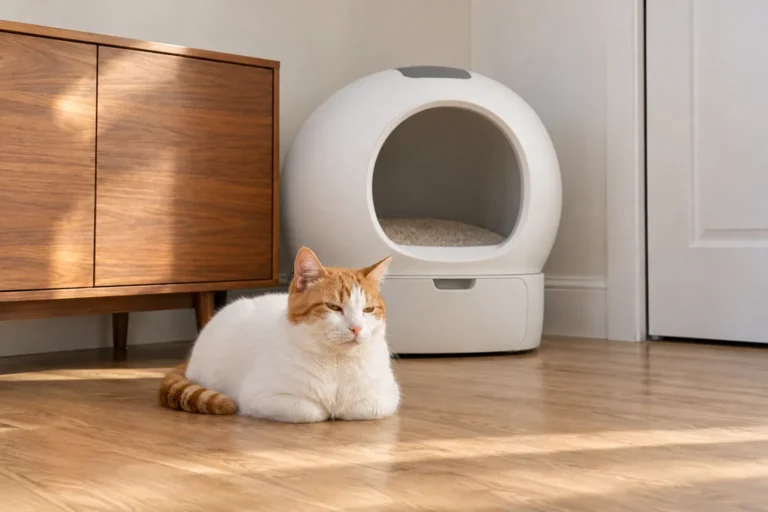
Litter-Robot 3 vs 4 vs 5: specs compared for small homes
The Litter-Robot 3 Connect and 4 side by side, with the EVO and 5: size, cat weights, Wi-Fi, outages and fit in a small home.
12 min readUpdated
A note on self-cleaning boxes
Shelters disagree here. San Diego Humane Society lists real uses, such as multi-cat homes and owners who struggle to scoop, and suggests letting the cat explore the unit unplugged while the old box stays available. A behaviorist writing for the American Veterinary Society of Animal Behavior advises against robot and top-entry boxes altogether. We compare these units on size and clearance and leave the verdict to your cat.
Litter box size questions
Can a plastic storage tote work as a litter box?
It can, and the AAFP and ISFM name under-bed and sweater boxes for exactly this reason: they are long and cheap. Pick one that is half again as long as your cat. For a kitten or an older cat, the sides have to be low enough to step over.
Is a covered litter box unkind to a cat?
Not on the evidence so far. Twenty-eight cats in the only controlled trial used large covered and open boxes about evenly, with both scooped daily. Behavior consultants still lean against hoods, mainly because most covered boxes on sale are small and tend to get scooped less often.
Sources
- AAFP and ISFM, Guidelines for Diagnosing and Solving House-Soiling Behavior in Cats, Journal of Feline Medicine and Surgery, 2014. Read Oct 16, 2026.
- AAHA and AAFP, 2021 Feline Life Stage Guidelines: general litter box considerations. Read Oct 16, 2026.
- Iwabuchi-Inoue and others, litter box size and litter type preference in cats, Journal of Veterinary Medical Science, 2025. Read Oct 16, 2026.
- Grigg, Pick and Nibblett, covered versus uncovered litter box preference, 2013. Read Oct 16, 2026.
- American Veterinary Society of Animal Behavior, What does the science say about cats and covered litter boxes? Read Oct 16, 2026.
- Cornell Feline Health Center, Feline behavior problems: house soiling. Read Oct 16, 2026.
- International Cat Care, consensus guidelines on feline lower urinary tract diseases, 2025. Read Oct 16, 2026.
- Nebraska Humane Society, Litter box set-up. Read Oct 16, 2026.
- San Diego Humane Society, Litter boxes 101. Read Oct 16, 2026.
- Veterinary Record, feline management practices and resource provision in the UK, 2025. Read Oct 16, 2026.
- AAFP, Feline Senior Care Guidelines, Journal of Feline Medicine and Surgery, 2021. Read Oct 16, 2026.
- VCA Animal Hospitals, How to litter train a kitten. Read Oct 16, 2026.
- ASPCA, Litter box problems. Read Oct 16, 2026.