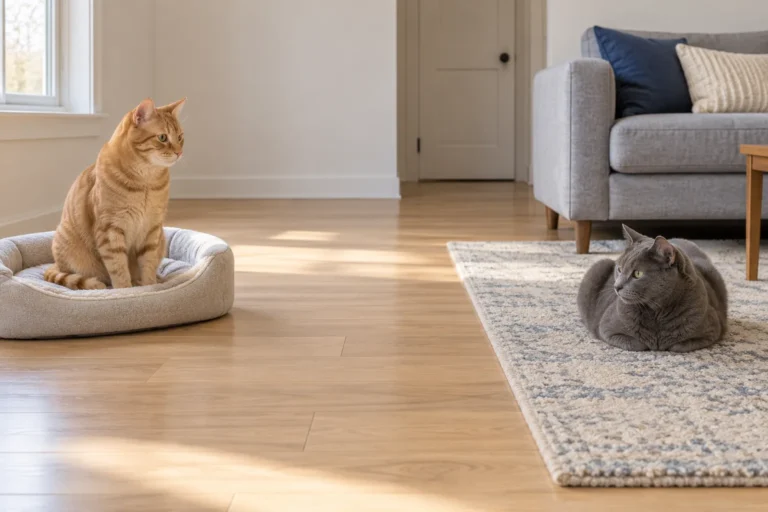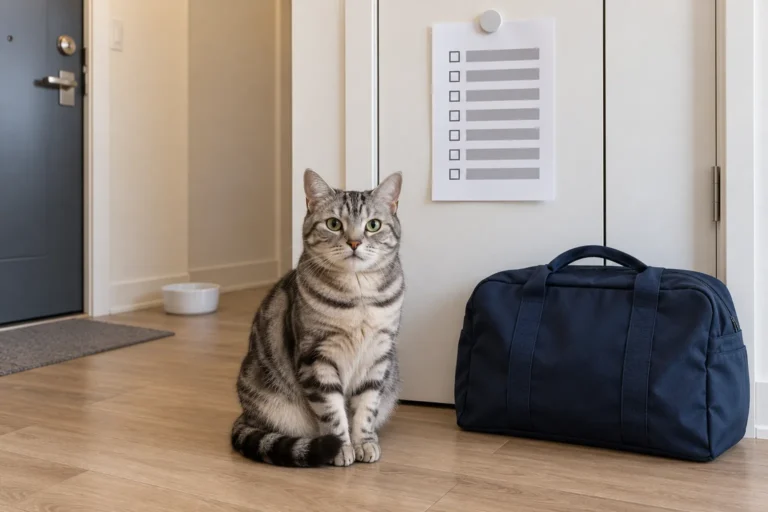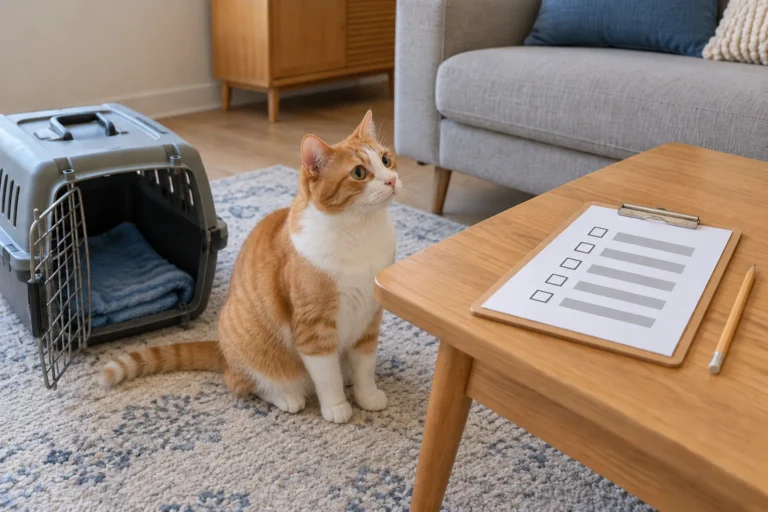

No veterinary body or welfare charity we read sets a limit on how long you can leave a cat alone, in hours or in days, even for a healthy adult. What they agree on is a routine: play before you leave and after you get back, something to do in between, and, once you travel, a visitor at least twice a day.
Away for a weekend? The weekend-away checklist puts the plan on one printable page.
What you need before a trip
- A sitter who can come at least twice a day, and a backup.
- The cat-sitter instruction sheet, filled in.
- Food and litter for the trip, with some to spare.
- Water in two or more bowls, away from the food.
- A spare key with a neighbor, and any fob your building needs.
- Optional: an automatic feeder already run at home, a fountain (charge a cordless water fountain the night before), a camera.
How long can you leave a cat alone? What the sources say
On Google’s first page for these questions, read on Oct 15, 2026, most answers come with a number: 48 hours, two or three days, even three to five. We could not find a veterinary source behind any of them. The guidelines, shelter pages and charities we read write about the cat and the plan, never the clock.
They do separate two situations. Workdays get a play routine. Nights away get visits.
| Situation | What the sources we read support |
|---|---|
| Your workday | Play before you leave and when you get home, with puzzles and safe toys in between (San Francisco SPCA). |
| A trip, even one night | Visits at least twice a day, every day you are gone (Cats Protection). |
| A kitten | One small room or a large crate while you are out (San Diego Humane Society). No hours by age. |
| An older or unwell cat | More frequent visits (Cats Protection). |
Our recommendation: if you will sleep anywhere but home, someone comes in every morning and evening. Only a person in the room can see what was eaten, check the litter box and get the cat to a vet.
Key takeaways
- None of the vet bodies or charities we read gives an hour or day limit for time alone, even for a healthy adult cat. → what the sources say
- Play before work and after, says the SF SPCA, and AAHA advises 10 to 15 minutes at a time, two or three times daily. → the workday
- Even one night away calls for a visitor at least twice a day, a routine from Cats Protection, a UK charity, not a vet rule. → visits while away
- Have the sitter call your vet over untouched food or an unused box between visits, and at once for straining with little or no urine. → the vet note
- Keep every window your cat can reach shut or behind a secure screen or barrier, and do not rely on an ordinary insect screen. → windows first
A workday alone: play before and after
The San Francisco SPCA writes its play advice around this exact day: a session before work, food and puzzle toys for the solo hours, and another when you get home, which it calls extremely important after a day of napping. AAHA puts it at 10 to 15 minutes, two or three times a day. If the long days are wearing on your cat, the bored cat signs guide shows what that can look like.
Run each one as a hunt. The toy flees, the cat stalks and rushes it, the session ends on a real catch, and only then does food appear, the order the AAFP and ISFM guidelines describe. Use a toy, never fingers.
Between sessions, food puzzles hand over some of a hunt’s work. Dantas and colleagues’ 2016 paper advises starting with one your cat solves at once, offered when it is hungry beside the usual bowl, then making it harder in small steps. Leave one out alone only after your cat empties it unaided.
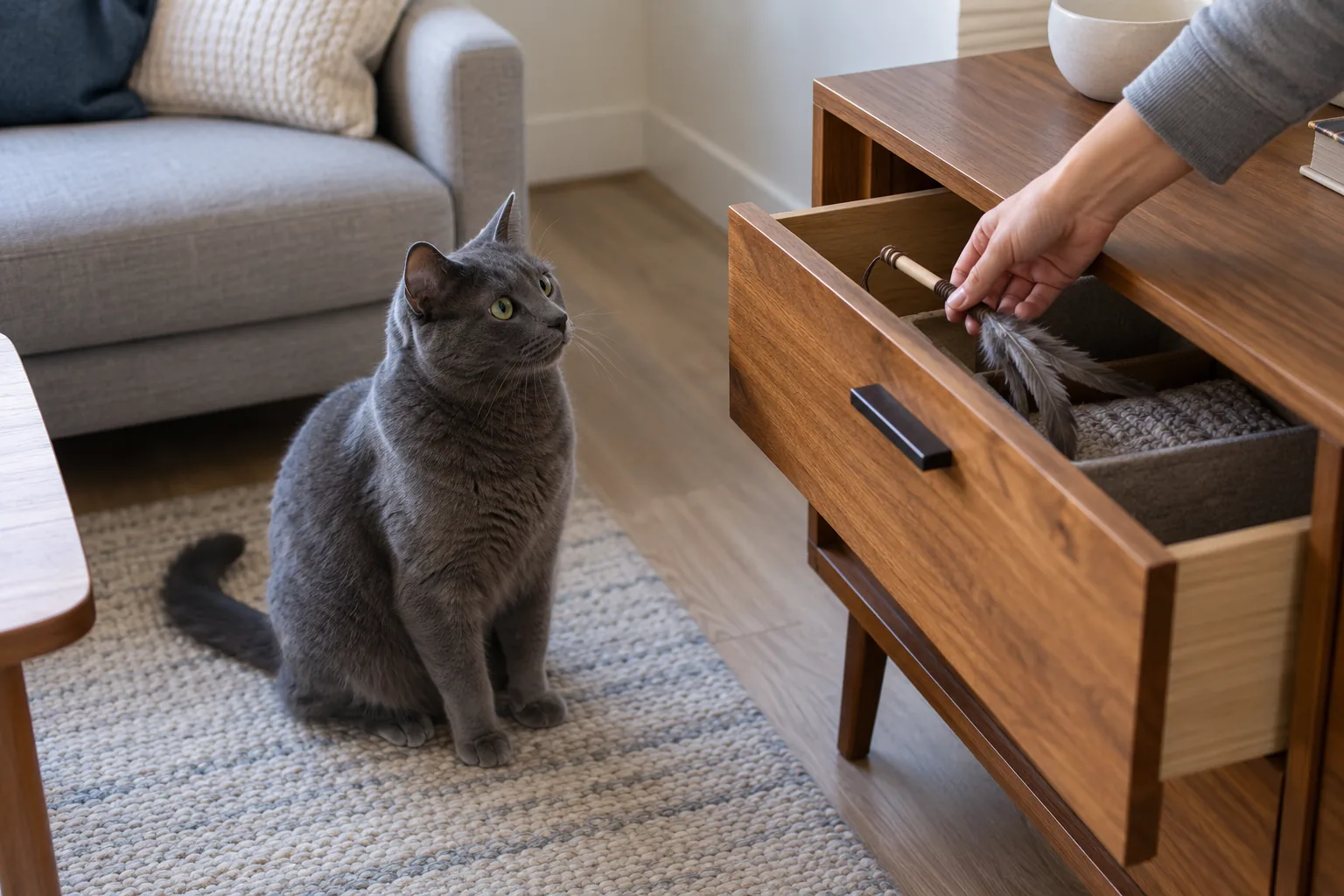
A few soft toys can stay out. Rotate them, since the SF SPCA notes that too many at once soon lose their appeal. Wand toys go into a closed drawer after play. More solo ideas: the cat enrichment activities guide.
Nights away: a sitter at least twice a day
Cats Protection, a UK cat welfare charity, calls keeping your cat at home during a trip “the safest and least unsettling option,” with a friend, neighbor or paid sitter coming in at least twice a day. It is the only source we found that puts a figure on visits, and it is a charity’s routine, not a veterinary rule. We follow it anyway. Twice a day is also the scooping schedule International Cat Care calls ideal.
Each visit covers the same round:
- fresh water, and food on your schedule
- a look at what is left of the last meal
- every box scooped, noting whether there was urine
- play, with the wand toy put away after
- a walk around the room, then a line in the log
For a paid sitter, the charity suggests checking references, reviews and insurance, meeting at your home a few days ahead, and keeping a backup name.
It also says to test the doors together. In an apartment building that means every door from the street to your cat, the elevator fob included. Give the front desk or the super the sitter’s name, and leave a spare key with a neighbor you trust, so one lost key does not cost the cat a visit.
The cat-sitter instruction sheet puts the routine on paper, from your vet’s number to a visit log. Show the sitter where the carrier lives.
When the sitter should call the vet. Ask for a call to your vet if the cat has not eaten, or has not used the box, since the previous visit. A cat that strains in the box and passes little or no urine needs a vet right away. Cornell’s Feline Health Center calls a urethral blockage an absolute emergency, and it happens nearly always in male cats. International Cat Care warns that owners can mistake it for constipation.
Kittens, older cats and cats with health conditions
Kittens get the most confident numbers online; we found no veterinary or shelter source behind them. San Diego Humane Society’s advice is about space, not time: keep a kitten in one small room, or a large crate, whenever you go out, so you know where it is and its litter habits stay on track. In a studio, the bathroom usually serves, with the counter cleared and the sink cabinet latched.
Cats Protection asks for more frequent visits for very young or old cats and for those with certain health conditions; how many is a question for your vet. A cat on daily pills or injections needs a sitter who has given them before. And a cat in its first weeks with you is still learning your routine, the middle stage of the 3-3-3 rule, so ask the sitter to keep your times exactly. Between visits, an older cat still needs play it can manage, and toys for senior cats lists the gentle kinds.
How long can a kitten be left alone?
No source we found sets hours by age, so how long a kitten can be left alone comes down to what it needs while you are out, including an 8-hour workday. Cornell’s Feline Health Center says kittens usually do best on three meals a day until six months old, then two until about a year. That puts a meal in the middle of a long workday: a lunchtime visit, or an automatic feeder set for noon. For a kitten on canned food, our guide to wet food feeders and their cooling specs shows what a timer can and cannot hold.
Where it waits matters as much as the hours. Foster groups such as Colorado Animal Rescue use a spare bathroom, a small uncarpeted room or a kitten playpen, and VCA advises one room with a low-sided box until the kitten uses it reliably.
Leave toys it can bat around on its own, never string, ribbon, yarn or pipe cleaners: International Cat Care keeps those for games you run, put away afterward. Kittens play in short bursts and tire quickly, so a game before you go and another when you get back suits them better than one long session.
Ask your vet about the gaps. How long your kitten can go between meals and visits depends on its age, size and health, so check with your vet, above all for a very young kitten or one on medicine.
Food, water and litter while you are out
An automatic feeder serves meals on time but does not check that the cat ate; that stays the sitter’s job. Run a new one for several days while you are home, and set portions from the food label and your vet. To pick one, our guide to choosing an automatic cat feeder weighs battery backup and hopper size for a small apartment, and the automatic feeder types page covers the rest. A camera can show you the cat and the sitter, but it cannot refill a bowl or carry a cat to the vet.
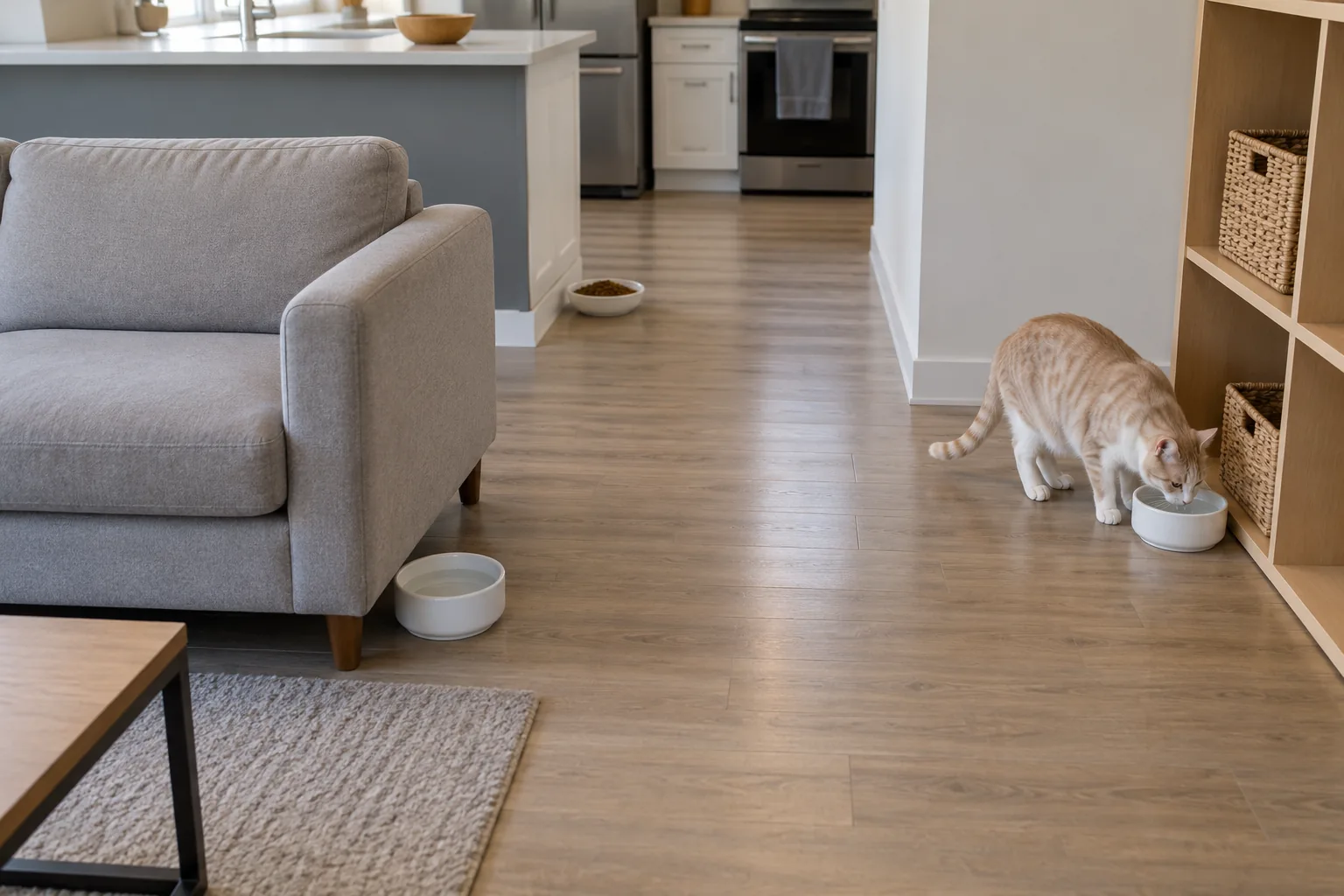
Set water out in at least two bowls in different spots, apart from the food. The AAFP and ISFM guidelines want more than one of every key resource, and a single bowl is one knocked-over bowl from none. A fountain is optional (the fountain page explains why); if one runs, keep a still bowl down too, in case the pump stops.
Scoop just before you leave. A box nobody has touched since Friday announces itself at the front door.
Make the apartment safe before you lock the door
A studio has no spare room to shut things away in, so whatever a cat could knock down, chew or climb out of gets dealt with where it stands. Walk through the evening before, once at eye level and once from the floor.
Windows come first. Cats fall from windows and balconies often enough that vets call it high-rise syndrome, and a 2025 study of 1,125 cases counted falls from about the second floor up. Close every window the cat can reach, or keep it behind a secure screen or barrier; an ordinary insect screen is not something to rely on. Leave a blind up on a closed window instead, so the cat keeps the outdoor view the AAFP and ISFM guidelines ask for.
The rest of the room:
- String toys. Wand toys, yarn, ribbon and thread go in a closed drawer. Swallowed string can be deadly, and string showing in a cat’s mouth means a call to the vet, never a tug (VCA Animal Hospitals).
- Lilies. None in the home, and no delivered bouquets carried in. Keep every lily out: per the FDA, true lilies and daylilies, down to their pollen and vase water, can cause deadly kidney failure in cats.
- Houseplants. Check each by scientific name on the ASPCA’s toxic and non-toxic list. Toxic ones, such as pothos (Epipremnum aureum), monstera and peace lily, belong out of the home, or at least at a friend’s for the trip.
- Diffusers. Unplug them. The Merck Veterinary Manual says to keep pets out of any room where one runs, and in a studio that is the whole home.
- Heat and air conditioning. Leave them on the settings you live with.
Sitter, boarding or a friend?
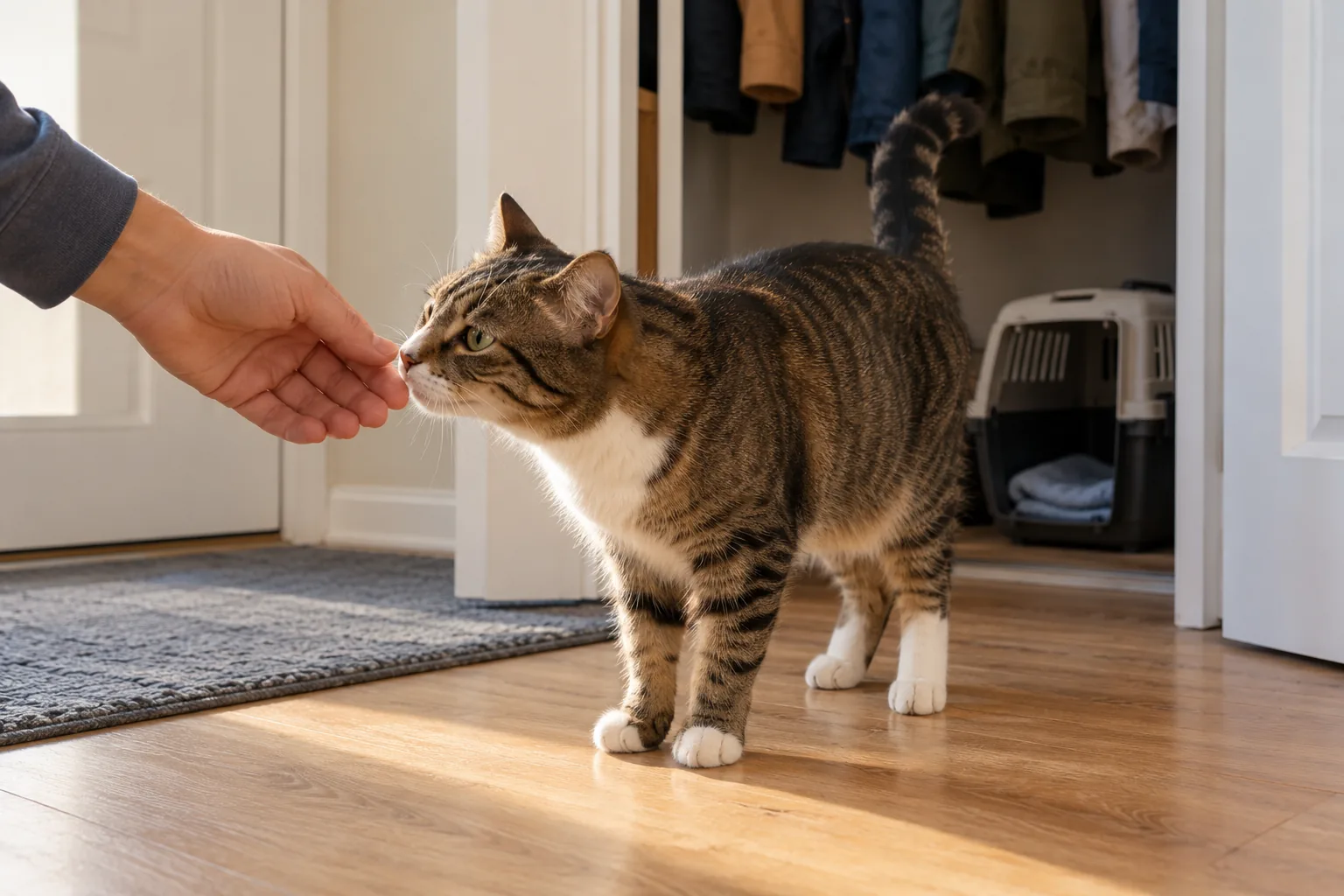
Start with a sitter at home for most cats. Cats Protection’s reasoning is that a cat is less stressed in its own territory, nervous ones above all; boarding, which the charity calls a cattery, suits cats comfortable away from home and around strangers.
| Option | Best for | Check before you book |
|---|---|---|
| Paid sitter at home | Most cats, and nervous ones in particular | References, reviews, insurance; a meeting at your place; a backup |
| A friend or neighbor | Short trips, if they can come twice a day without fail | The sheet, working keys, your vet’s number, the vet note above |
| Boarding | Confident cats at ease away from home and with strangers | A license where required; vaccinations up to date; cats housed apart; double doors; booking well ahead |
Prices vary too much by city for a national average to help, so the weekend-away cost calculator works from your own quotes and sets the totals side by side.
Questions about leaving a cat alone
Can I leave a cat alone for 2 days or a weekend?
Many articles say yes, given food and water. None of the veterinary or welfare sources we read calls two days, or any stretch, safe for a cat on its own. Cats Protection plans even short trips around visits, so a weekend means a visitor every morning and evening.
Can you leave a cat alone for 3 days or a week?
Cats Protection, the one source we read that covers trips, treats a long one like a short one: a visitor at least twice a day, from the day you leave until you return. A week changes the bill, not the plan, so price a sitter against boarding before you book.
Can you leave a cat alone for 8 hours?
A workday is the case shelter advice already assumes, and the San Francisco SPCA plans around it: play before work, puzzles and safe toys for the day, another session in the evening. No source we read caps the hours, though a kitten should spend them in one cleared room.
Is a studio apartment too small to leave a cat alone all day?
None of the sources we read sets a minimum floor area, or a limit on hours alone. What the AAFP and ISFM guidelines look for is separate key resources, and a studio can supply them: food and water apart, the litter box across the room from both, a raised spot by a shut window, and a puzzle.
Can you leave a newly adopted cat alone while you work?
Plan the workday around one room. San Diego Humane Society starts a new cat in a small room with a door, such as a bathroom: bowls and bed at one end, the litter box as far off as the room allows. The cat stays there, workdays included, until it eats, uses the box, grooms and seeks you out.
How long can two cats be left alone?
The same as one cat: no source we read sets a number for either. Two cats share the apartment, not the checks. Each needs its own feeding spot and puzzle, the litter count rises to three boxes (the two-cat litter box guide explains why), and the sitter logs each cat by name.
Do cats get lonely?
Whether cats get lonely the way people do is not something our sources measure. Feline vets do list friendly, predictable contact with people among the five needs of a healthy home, and the play sessions above supply it. A second cat is no quick cure, since whether a resident cat will accept a newcomer is hard to predict.
Will a cat miss you if you leave for 2 days?
Cats do bond with the people who care for them. Vitale’s 2019 study found secure attachment to the caregiver in about two thirds of the kittens and adult cats it tested, close to the share in human infants. Whether a cat misses you as people do, no study we found has measured.
Next step. If meals have to happen on time while you are out, read how to choose an automatic cat feeder.
Sources
- Cats Protection, “Going on holiday,” cats.org.uk, read Oct 16, 2026.
- San Francisco SPCA, “Playing with your cat,” sfspca.org, read Oct 16, 2026.
- San Diego Humane Society, “Adopting: Cat Confinement in a New Home,” sdhumane.org, read Oct 16, 2026.
- AAHA, “How often should you play with your cat?,” aaha.org, read Oct 16, 2026.
- AAFP and ISFM, “Feline Environmental Needs Guidelines,” Journal of Feline Medicine and Surgery, 2013, journals.sagepub.com, read Oct 16, 2026.
- Dantas and others, “Food puzzles for cats: feeding for physical and emotional wellbeing,” Journal of Feline Medicine and Surgery, 2016, journals.sagepub.com, read Oct 16, 2026.
- International Cat Care, “2025 iCatCare consensus guidelines on the diagnosis and management of lower urinary tract diseases in cats,” PubMed Central, read Oct 16, 2026.
- Cornell Feline Health Center, “Feline lower urinary tract disease,” vet.cornell.edu, read Oct 16, 2026.
- Candela Andrade and others, “High-rise syndrome in cats (part 2): injury patterns and survival rate,” Journal of Feline Medicine and Surgery, 2025, journals.sagepub.com, read Oct 16, 2026.
- VCA Animal Hospitals, “Linear foreign body in cats,” vcahospitals.com, read Oct 16, 2026.
- US Food and Drug Administration, “Lovely lilies and curious cats: a dangerous combination,” fda.gov, read Oct 16, 2026.
- ASPCA Animal Poison Control, “Toxic and non-toxic plant list: cats,” aspca.org, read Oct 16, 2026.
- Merck Veterinary Manual, “Toxicoses from essential oils in animals,” merckvetmanual.com, read Oct 16, 2026.
- Vitale and others, “Attachment bonds between domestic cats and humans,” Current Biology, 2019, PubMed, read Oct 16, 2026.
- Cornell Feline Health Center, “How often should you feed your cat?,” vet.cornell.edu, read Oct 16, 2026.
- Colorado Animal Rescue, “Preparing for foster kittens,” coloradoanimalrescue.org, read Oct 16, 2026.
- VCA Animal Hospitals, “How to litter train a kitten,” vcahospitals.com, read Oct 16, 2026.
- International Cat Care, “Playing with your cat,” icatcare.org, read Oct 16, 2026.