

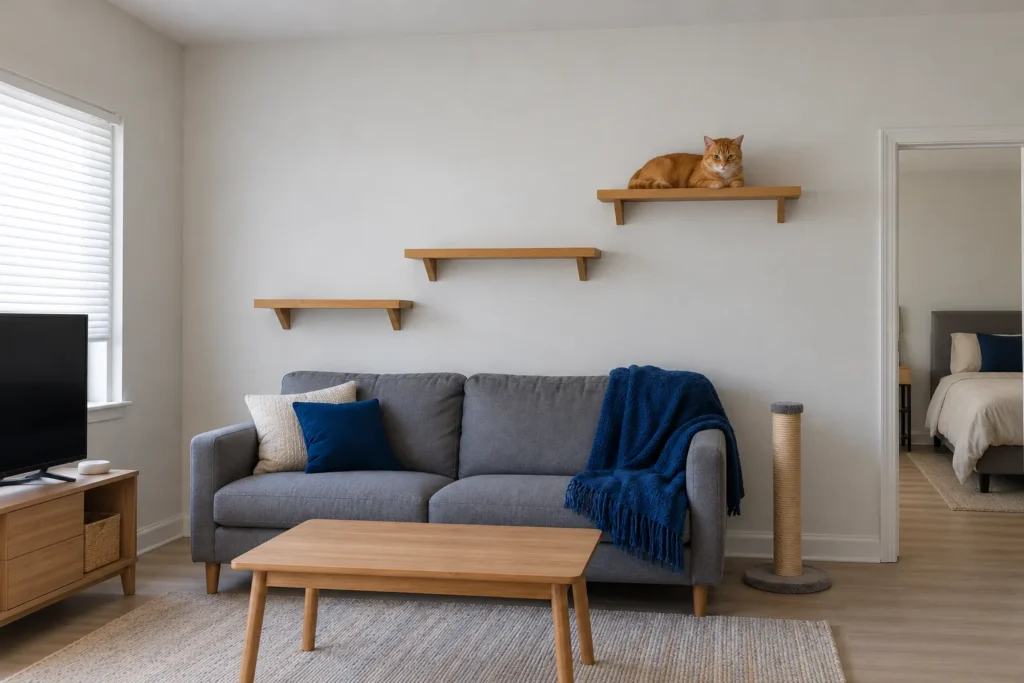
Cat furniture for small apartments has one job the big-house versions can skip: give a cat height and hiding places without taking the floor you live on. These guides measure trees, shelves, perches and scratchers against real rooms and real leases.
Start with what a cat needs from a room
- Height. A raised spot lets a cat watch the room while it feels hidden. Make each perch long and wide enough for a full stretch.
- A place of its own. Feline vets ask for at least one safe resting place per cat, used by that cat alone (AAFP and ISFM, 2013).
- Somewhere it is allowed to scratch. Scratching keeps claws in shape, stretches the body and leaves scent marks. In a 2016 survey of 4,105 owners, cats used sisal rope most when it was on offer.
The guide to open first is the furniture layouts for studios and one-bedrooms. It places the tree, the box and the bowls together, which is where a small room usually runs out.
What are you trying to fit?
Pick the closest match for a short answer and the guide to open next.
A cat tree in a studio
Compare base sizes before heights: the base is the part that takes your floor. Then check the tree against the actual spot, door swing included.
Start with small cat trees compared by footprint and height
- Space-fit planner, to test a base size on your floor
The lease says no drilling
Shelves and perches can hang on suction cups or tension rods, or on a few small screws you patch at move-out. Read the weight each maker rates its unit for before a cat jumps on it.
Start with no-drill cat shelves for renters
- Renting with a cat, every renter guide gathered on one page
- Interior cat doors for apartments, no-cut latches and doors you swap back at move-out
The cat goes for the couch
Watch how it scratches first. Cornell suggests matching the direction: upright with paws stretched overhead, or flat along the floor. Then set the scratcher right beside the spot it targets.
Start with scratching posts by height, base and material
- How to stop a cat scratching furniture, from placing the post to a rental’s doorframes
Planning the whole room
Sketch it once with every piece at its real size: tree, two boxes, bowls and the bed the cat will actually use. The layouts guide works through studio and one-bedroom plans.
Start with cat furniture layouts
- Space-fit planner, drawn to scale
- Cat-proofing an apartment, a room-by-room pass from window screens to the washer
An older cat that jumps less
Jumping less is a common, easily missed sign of joint disease, so mention it to your vet. At home, the AAFP’s senior care guidelines list ramps or steps to favorite spots and resting places at more than one level.
Start with small cat trees, looking for low first platforms
Cat trees and scratchers
Footprint first, height second. The guides compare base sizes, heights and post materials from makers’ listings, including floor-to-ceiling poles that stay up by tension instead of screws, and say which ones suit large cats, senior cats and two cats sharing.
-
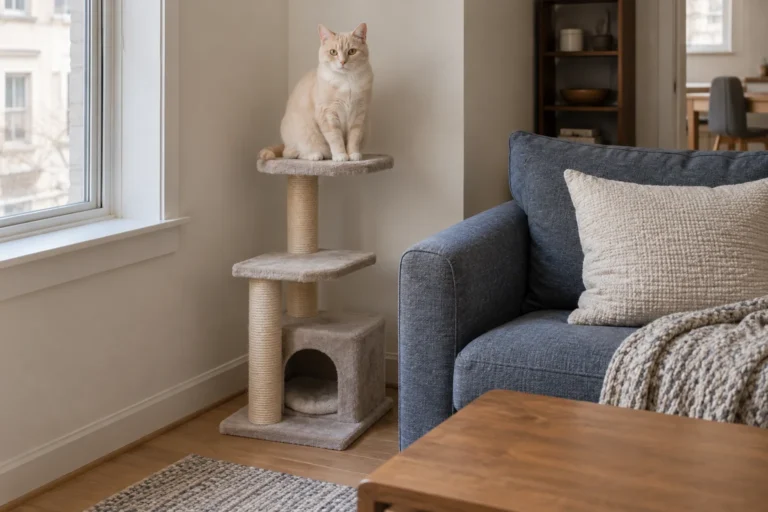
Small cat trees and scratching posts compared: footprint and height
Five trees and posts compared by the floor they cover and the height they reach, with the wall anchor each one needs.
15 min readUpdated
-
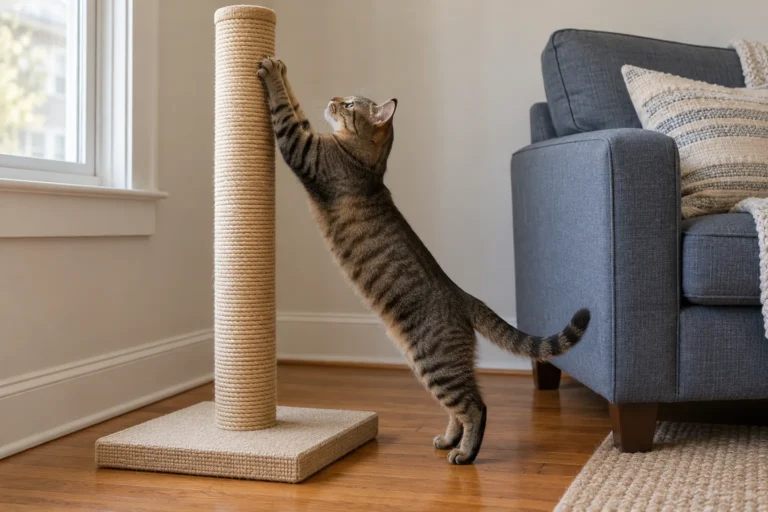
Scratching posts: height, base and material
Six scratching posts and pads compared by scratching height, base size, weight and surface, and the one tall sisal post worth its floor space.
15 min readUpdated
All cat tree and scratcher guides
Walls, shelves and windows
Wall shelves and window perches add climbing room without touching the floor at all. For renters the real questions are how each one attaches (suction cups, tension rods, or a few small screws you patch when you move out) and what weight its maker rates it for.
-

Renter-friendly cat shelves: no-drill options
No-drill ways to give a cat height in a rental, from tension-pole trees to window perches that hook on or hold by suction.
11 min readUpdated
Catios and enclosures
Window boxes, indoor enclosures and netted balconies let a cat sit in fresh air without leaving the apartment. The guides cover how each type mounts, the space it takes, and what a landlord is likely to notice.
Safety. Cats fall from open windows and balconies so often that the injuries have their own veterinary name, high-rise syndrome. Young cats fall most: more than half of the 119 cats in one clinic study were under a year old. Fit secure screens before a cat goes near an open window, and keep it off any balcony that is not fully enclosed.
Protecting your furniture
A couch survives a cat when there is a better scratching spot right beside it. These guides compare scratch guards, covers and upholstery fabrics. Declawing is not on the list: the American Association of Feline Practitioners strongly opposes it as an elective surgery.
-

How to stop a cat scratching furniture
Six steps that move a cat’s scratching from the sofa to a post it likes better, plus what to do about a rental’s doorframes.
10 min readUpdated
Layout, warmth and safety
Bringing a plant home? The houseplant safety checker looks it up on the ASPCA’s lists of plants toxic and non-toxic to cats, by common or scientific name.
Where the tree, the box and the bowls go in a studio or a one-bedroom. Also here: heated beds and what they draw from the outlet, tunnels, cat doors for interior doors, and a room-by-room check of cords, blinds and gaps before a cat moves in.
-
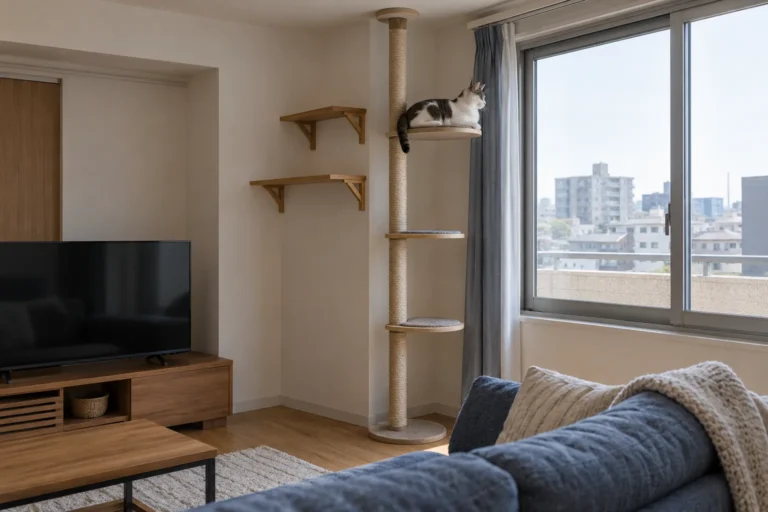
Cat furniture layouts for studio and one-bedroom apartments
Where the litter boxes, bowls, scratching post, climbing spot and hiding place go in a studio or a one-bedroom, and what to keep apart.
11 min readUpdated
-
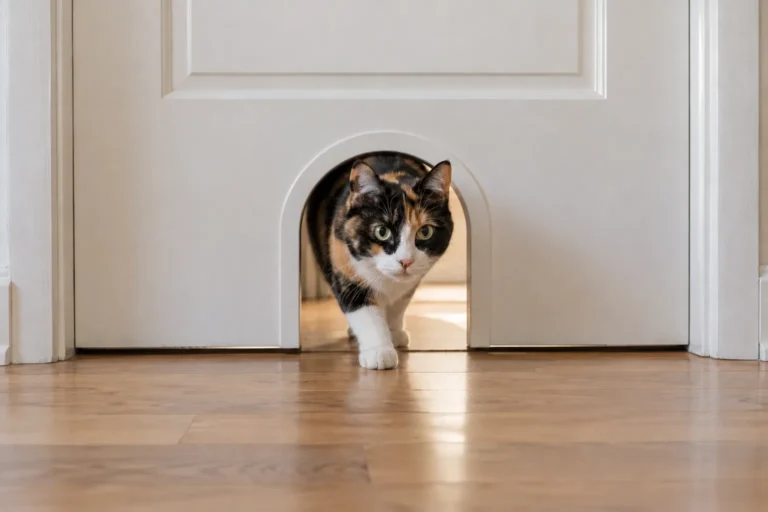
Interior cat doors for apartments
No-cut door props, straps and knob latches for renters, plus cut-in cat doors, the door thickness each fits, and how to rehang the original door.
14 min readUpdated
-
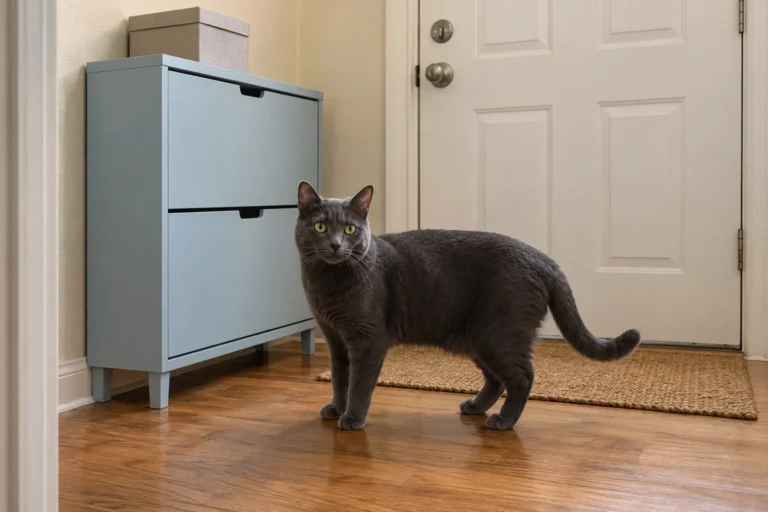
Cat-proofing an apartment: a room-by-room checklist
Walk your rental room by room: screens and tilt windows, cables, medicines, the washer and dryer, and lilies, then share one routine with roommates.
11 min readUpdated
Cat furniture questions from renters
Do floor-to-ceiling cat trees work in a rental?
Many do, because they stay up by pressure against the ceiling instead of screws. Each maker sets a ceiling height range and most set a cat weight limit, for example about 10 to 11 lb for PawHut’s two poles, so check both against your room and your cat before you order.
Is declawing an option if I am worried about my security deposit?
Not one feline vets back: the AAFP strongly opposes elective declawing and says vets must offer alternatives. Regular claw trims, or glue-on nail caps for a cat that accepts paw handling, limit damage while it learns where to scratch, but neither stands in for a scratching post next to the couch.
Where should the cat tree go in a one-bedroom?
Somewhere the cat can watch the room it shares with you, since a raised spot lets it see while feeling hidden. If the tree doubles as a scratcher, near the place the cat sleeps works well. Keep perches away from blind cords and their loops.
Does a cat tree count as a scratching post?
Only if your cat scratches the way the tree is built. A tree’s sisal posts stand upright, which suits a cat that stretches up to scratch. Some cats, the ASPCA says, would rather scratch flat or slanted surfaces, and those cats need a horizontal scratcher too.
Sources
- AAFP and ISFM, Feline Environmental Needs Guidelines, Journal of Feline Medicine and Surgery, 2013. Read Oct 16, 2026.
- Wilson and others, Owner observations regarding cat scratching behavior, Journal of Feline Medicine and Surgery, 2016. Read Oct 16, 2026.
- AAFP, Position statement: declawing, Journal of Feline Medicine and Surgery, 2017. Read Oct 16, 2026.
- Vnuk and others, Feline high-rise syndrome: 119 cases, Journal of Feline Medicine and Surgery, 2004. Read Oct 16, 2026.
- Cornell Feline Health Center, Feline behavior problems: destructive behavior. Read Oct 16, 2026.
- Cornell Feline Health Center, Your cat slowing down. Read Oct 16, 2026.
- AAFP, Feline Senior Care Guidelines, Journal of Feline Medicine and Surgery, 2021. Read Oct 16, 2026.
- Feline Veterinary Medical Association, Alternatives to declawing. Read Oct 16, 2026.
- PawHut (Aosom), floor-to-ceiling cat tree product page. Read Oct 16, 2026.