

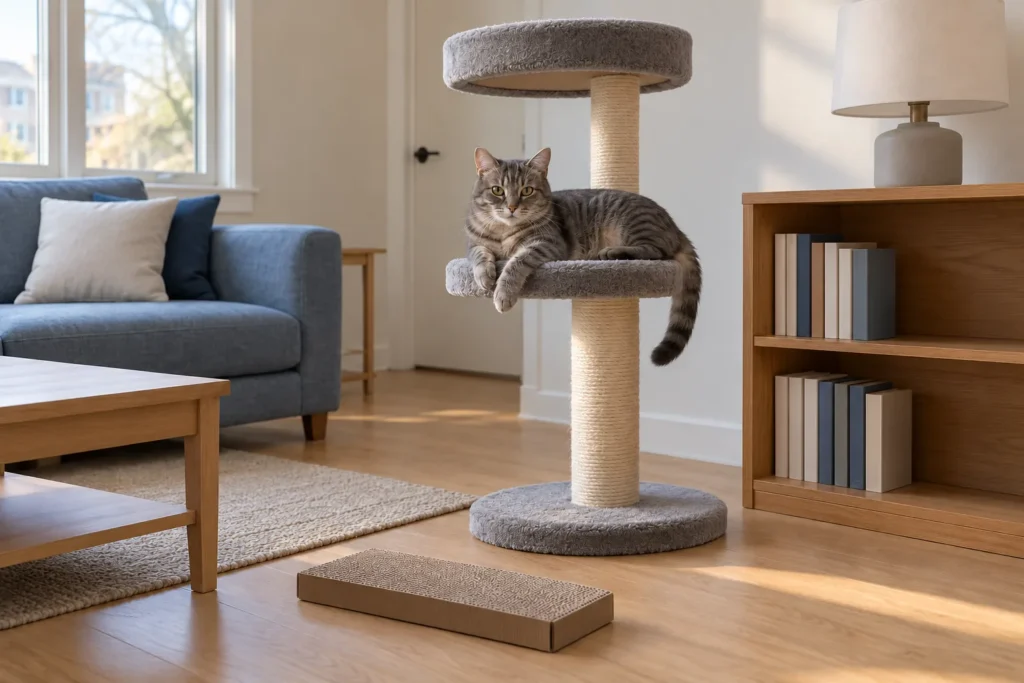
Cat trees for small apartments have to earn their floor space twice: once as a lookout and once as the thing your cat scratches instead of the couch. The evidence on both jobs is thin on numbers but clear on direction, and most of it fits in the table below.
Open small cat trees compared first: it lines up base sizes and heights, the two numbers that decide whether a tree fits a studio.
What should the tree do for your cat?
Pick the main job and see what to look for.
Give it a lookout
A raised perch roomy enough for the cat to stretch out fully, set where the household spends its time. VCA suggests keeping it off the wall so the cat can hop on from several sides.
Start with small cat trees by footprint and height
Save the couch
In the 2016 owner survey, sisal posts over 3 ft (91 cm) went with less furniture scratching. Put the tree right beside the couch arm the cat already uses.
Start with scratching posts by height and material
Fit almost no floor
Shelves add height without a base, but they do not replace a scratcher: in the same survey, wall-mounted scratchers got the least use. Pair shelves with one upright post.
Start with no-drill shelves for renters
- Space-fit planner for the post’s base
Suit a kitten or a stiff older cat
Low first platforms or a ramp to the raised spots, as the AAFP and ISFM suggest. An older cat that has stopped jumping should see the vet first.
Start with trees with low first levels
What makes cat trees work in small apartments
Height gives a cat two things at once, a view of the room and a place to feel out of reach. The AAFP and ISFM environmental guidelines treat raised resting spots and hiding places as a core need, and they ask for at least one safe spot sized for a single cat per cat in the home. They give no figure for height or number of levels, and neither does any other veterinary source we found.
| What to check | What the sources say |
|---|---|
| Perch size | Wide and long enough for a full stretch (AAFP and ISFM, 2013). |
| Placement | Where the household spends time, and away from a wall so the cat can hop on from several sides (VCA Animal Hospitals). |
| Scratching surface | In a survey of 4,105 owners, cats used sisal rope most when it was offered. |
| Post height | Posts over 3 ft (91 cm) were linked to less furniture scratching: 55.2% of homes against 64.7% with shorter posts (same survey). |
| Shape | Trees with two or more levels and plain upright posts got the most use. Wall-mounted scratchers got the least, and homes that had them reported the most furniture scratching, 74.1%. |
| Kittens and stiff cats | Low or ramped access to raised spots (AAFP and ISFM, 2013). |
The survey numbers are associations reported by owners who chose to answer, not results of a trial, so read them as a direction. Still, the direction is useful in a studio. A tall sisal post beside the couch takes a little floor. A scratcher screwed to the wall saves that floor and, on this evidence, protects the couch least.
Cat tree and scratcher guides
Each guide compares footprints, heights and base sizes from the makers’ published dimensions, because in a small room the base matters as much as the top perch.
-
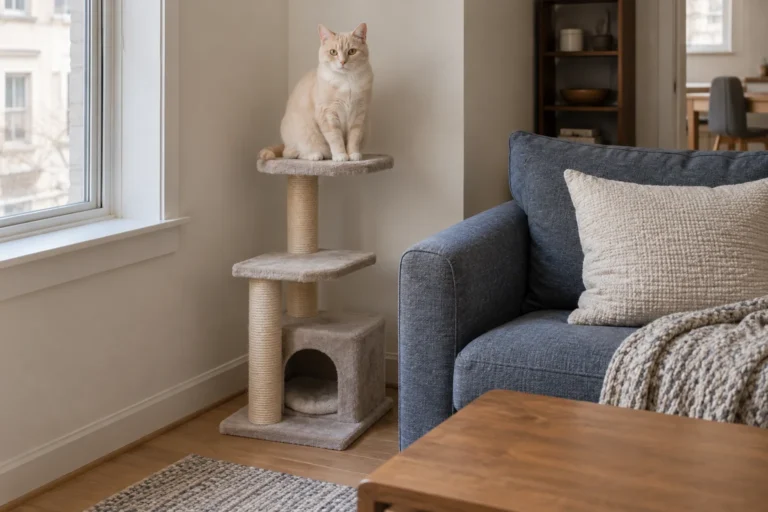
Small cat trees and scratching posts compared: footprint and height
Five trees and posts compared by the floor they cover and the height they reach, with the wall anchor each one needs.
15 min readUpdated
-
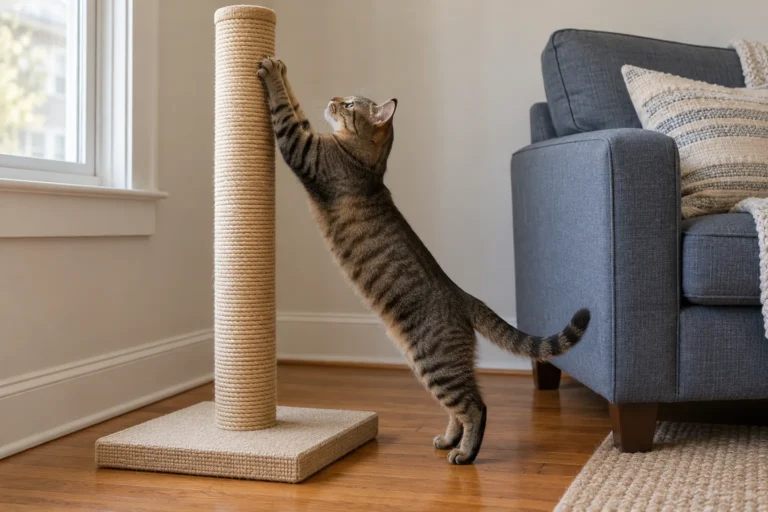
Scratching posts: height, base and material
Six scratching posts and pads compared by scratching height, base size, weight and surface, and the one tall sisal post worth its floor space.
15 min readUpdated
Scratching is a need, not a habit to stop
A cat scratches to maintain its claws, to stretch and to mark a spot with scent from its paws, so one with no approved place to do it will choose its own. In the same survey, 52% of owners had seen their cat scratch furniture. Owners who rewarded their cat for using the post also reported more daily use of it, 80.4% against 67.7%. Declawing is not the answer: the AAFP’s 2017 position statement opposes it as an elective surgery and expects vets to offer alternatives, and a good post in the right spot is the first of them.
Vet note. When a cat that used to leap to the top perch starts stopping halfway, or stays on the floor, have a vet look at it before you buy a lower tree. Stiffness and a reluctance to jump are easy to put down to age and worth having checked.
Cat tree questions
Sisal, carpet or cardboard: which surface should the tree have?
Sisal rope for most cats. In the 2016 survey, cats aged 9 or under most often preferred rope, then carpet and cardboard, while cats over 10 leaned toward carpet. Watch how your own cat scratches, upright or flat, and match that first.
How many perches does one cat need?
At least one safe spot of its own, sized for one cat, say the AAFP and ISFM environmental guidelines; more cats mean more spots. In a studio a single tree with two levels and a shelf by the window can cover that.
Back to all the small space guides
Sources
- AAFP and ISFM, Feline Environmental Needs Guidelines, Journal of Feline Medicine and Surgery, 2013. Read Oct 16, 2026.
- VCA Animal Hospitals, Cat behavior and training: play and play toys. Read Oct 16, 2026.
- Wilson and others, owner observations regarding cat scratching behavior, 2016. Read Oct 16, 2026.
- American Association of Feline Practitioners, Position statement: declawing, 2017. Read Oct 16, 2026.