


In a 500 square foot apartment, litter box smell reaches the front door, the couch and the guests. Products sold against it fill a whole aisle, but the guidelines put most of the fix in two habits: scooping often and washing the box on a schedule.
The guide to read first is the litter box smell guide; it turns the schedule below into a routine for a small apartment, step by step.
Where is the smell coming from?
Trace it first; the fix depends on the source.
The box, even after scooping
Old litter holds odor once clumps break up. With clumping litter, the whole box gets emptied and washed about every 1 to 2 weeks, and Cornell says to replace any box whose smell survives a good scrub.
Start with the cleaning tracker to keep the dates
The kitchen trash
Used litter goes in the trash, never down the toilet, and a bin with a tight seal holds a week of clumps without filling the kitchen.
Start with litter disposal bins and systems
Litter tracked across the floor
Scattered grains carry the box smell across the room. A mat at the exit catches most of what falls off the paws.
Start with litter mats by size and material
A covered box
Cornell’s Feline Health Center notes that a hood keeps odor inside, where the cat breathes it, while you smell less. Try the lid off for a week and scoop more often.
Start with the smell guide
Urine outside the box
That is a vet question before it is a cleaning one. Pain and illness often show up as accidents, and sick cats can look perfectly well.
The cleaning schedule that controls litter box smell
Cats use the box about three to five times a day, according to the AAFP and ISFM, so a box scooped every other day holds a lot of waste. Here is what the sources ask for, and where they disagree.
| Task | How often, and who says it |
|---|---|
| Scoop | At least once a day, twice if you can (AAFP and ISFM; International Cat Care; Cornell). In a 2025 UK survey, 80.1% of owners scooped daily or more. |
| Empty and wash, clumping litter | Every 1 to 2 weeks is where the guidelines overlap. The AAFP and ISFM give 1 to 4 weeks, International Cat Care 1 to 2, Nebraska Humane Society about 2, San Diego Humane Society about once a month. |
| Empty and wash, non-clumping litter | Every 2 to 3 days (San Diego Humane Society). |
| Wash with | Hot water. The sources split on soap: AAHA says skip it, the AAFP and ISFM say soap and hot water, Cornell and International Cat Care a mild detergent. All of them rule out bleach, ammonia, citrus and other strong scents. |
| Replace the box | When it still smells after washing, or cracks (Cornell; Nebraska Humane Society). San Diego Humane Society puts the average life of a box at six months to two years. |
What the guidelines tell you not to add
Scented litter, deodorizing powders and plastic liners are sold as odor fixes, and the veterinary guidelines advise against all three, because many cats dislike the smell or the feel. A study cited in a 2025 paper found that cats on scented litter were more likely to soil outside the box. If you still want to try a liner, fit it tightly, cover it with a full layer of litter and try it in one box only.
A lid is the other common answer. It hides the box from you more than from the cat, and an older study cited by the American Veterinary Society of Animal Behavior found that covered boxes got cleaned only about every five days. Out of sight turned into out of mind.
Keep these away from the box. Bleach and ammonia cleaners should not go near the litter or the bowls, and essential-oil diffusers have no place in a room your cat uses: the Merck Veterinary Manual explains that cats clear some oil compounds poorly. If your cat may have licked a cleaner or an oil, call a vet or the ASPCA Animal Poison Control Center (888-426-4435) right away.
Smell and cleaning guides
These cover each part of the routine, from the daily scoop to mats that catch tracked litter and bins that hold a week of clumps in a kitchen with no space to spare.
-
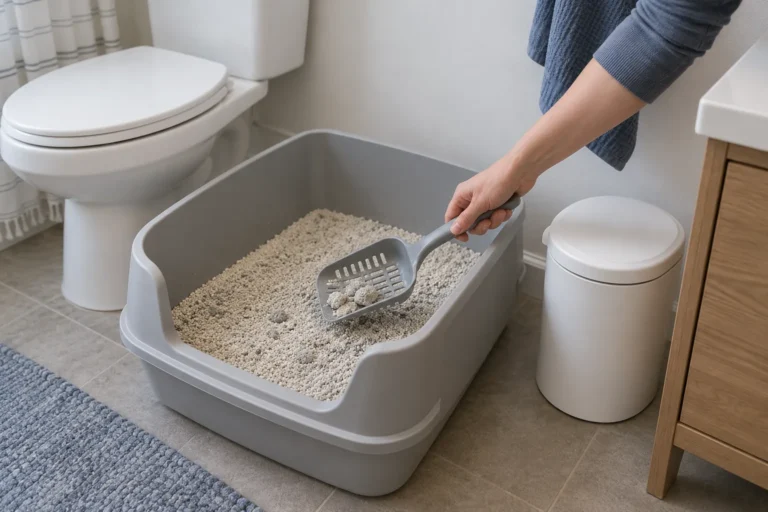
How to keep a litter box from smelling in a small apartment
The daily and weekly routine that holds litter smell down in a studio, what to wash the box with, and which odor products cats dislike.
14 min readUpdated
-
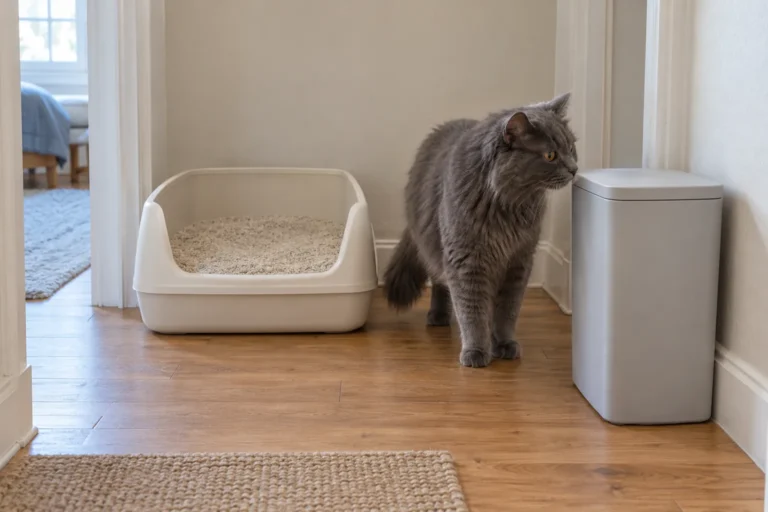
Litter disposal in an apartment: bins and systems
Seven litter disposal bins compared for small homes: how much floor each takes, how many days a bag holds, and how long each refill lasts.
13 min readUpdated
-
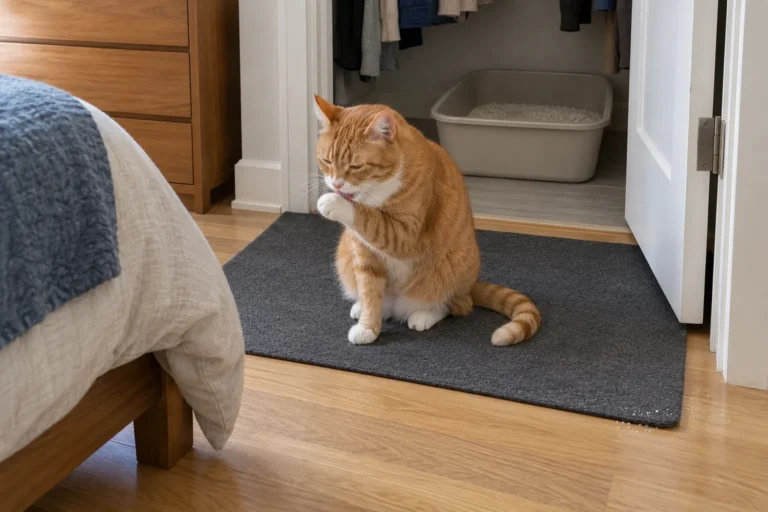
Litter mats compared: sizes and materials
Five litter mats from four makers compared by size, material and thickness, with how to wash each one in an apartment without a laundry room.
13 min readUpdated
-
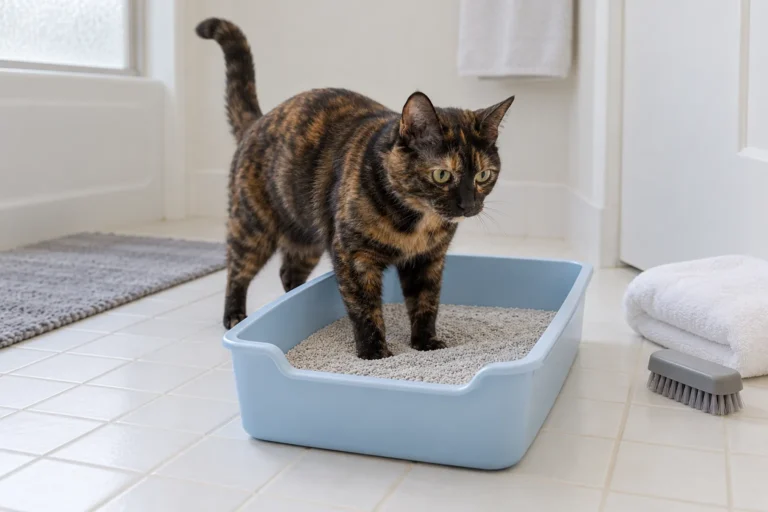
How to clean a litter box, and how often
The daily scoop and the full wash, done in an apartment with no yard or hose, plus what never to wash a litter box with.
9 min readUpdated
If you are pregnant
Ask someone else to scoop. If nobody can, wear gloves and wash your hands afterward. Daily scooping helps here as well: Cornell’s Feline Health Center explains that the toxoplasma parasite’s eggs need at least 24 hours in the box before they can infect anyone. Your own doctor or midwife is the right person for anything beyond that.
Smell and cleaning questions
Do deodorizing powders or sprays help with litter box smell?
Deodorizers sit on the avoid list in the feline guidelines we read, together with scented litter, because many cats dislike the smell and may stop using the box. Scooping at least once a day and washing the box on schedule do the job without the risk.
Where do I wash a litter box with no yard or laundry room?
In the bathtub, then clean the tub afterward; San Diego Humane Society names a laundry sink or the tub, never anywhere food is prepared. Hot water with a drop of mild dish soap is enough. Dry the box before you refill it.
Sources
- AAFP and ISFM, Guidelines for Diagnosing and Solving House-Soiling Behavior in Cats, Journal of Feline Medicine and Surgery, 2014. Read Oct 16, 2026.
- International Cat Care, consensus guidelines on feline lower urinary tract diseases, 2025. Read Oct 16, 2026.
- Cornell Feline Health Center, Feline behavior problems: house soiling. Read Oct 16, 2026.
- AAHA and AAFP, 2021 Feline Life Stage Guidelines: general litter box considerations. Read Oct 16, 2026.
- Nebraska Humane Society, Litter box set-up. Read Oct 16, 2026.
- San Diego Humane Society, Litter boxes 101. Read Oct 16, 2026.
- Veterinary Record, feline management practices and resource provision in the UK, 2025. Read Oct 16, 2026.
- Iwabuchi-Inoue and others, litter box size and litter type preference in cats, Journal of Veterinary Medical Science, 2025 (citing Horwitz on scented litter). Read Oct 16, 2026.
- American Veterinary Society of Animal Behavior, What does the science say about cats and covered litter boxes? Read Oct 16, 2026.
- Merck Veterinary Manual, Toxicoses from essential oils in animals. Read Oct 16, 2026.
- Cornell Feline Health Center, Toxoplasmosis in cats. Read Oct 16, 2026.
- US Food and Drug Administration, Lovely lilies and curious cats (lists the pet poison control lines). Read Oct 16, 2026.