
The best toys for bored cats let an indoor cat finish a hunt: something to stalk from cover, something that runs, something to grab and kick, and food at the end. A bored apartment cat usually owns toys already. What it lacks is one step of that sequence, or a person to make the toy move like prey.
What you need
- One wand toy, plus a drawer that shuts
- Two light chase toys, such as a ping pong ball
- A kicker your cat can hug while it kicks
- One food puzzle
- A cardboard box or fabric tunnel
- Treats, or some of the day’s food
Key takeaways
- Spot the hunt step your cat is missing, from search and stalk to catch and food, and pick toys that supply it. → toys by hunt step
- Sudden changes in moving, eating or litter habits mean a vet visit before any new toy. → bored or vet first
- Buy a wand first: you supply the movement for every hunt step, and its line counts as string, so it lives in a drawer. → wand play
- Anything left out while you work should pass the AAFP and ISFM rule: no small swallowable parts, bells included. → toys that stay out
- Rotate weekly: VCA suggests owning about 20 toys and leaving four or five out at a time. → the weekly rotation
Cat toys for bored cats, matched to the hunt
AAHA gives the sequence play should copy as stare, stalk or chase, pounce, grab and kill, then a treat; International Cat Care adds searching at the start. Find the step your cat never gets to finish.
| Step | Toys that supply it | Left out alone? |
|---|---|---|
| Search and stalk | Boxes, tunnels, food hidden around the room | Yes |
| Chase | A wand on the floor, light balls, motion toys, a laser dot | Balls only |
| Pounce | A wand lure landing after a swoop, a toy twitching under a blanket | No |
| Catch | Kickers, fur mice, the wand’s lure | Kickers and mice |
| Eat | A treat after play, food puzzles | Puzzles |
Timing matters too. International Cat Care reports that adult cats play harder and longer with toys that look like real prey, and harder still when hungry, so play just before a meal and the eat step arrives on its own. The 30 cat enrichment activities add free games for each step.
Bored, or time to see the vet?
Boredom tends to look like a habit; illness looks like a change. The guide to signs a cat is bored covers which signs call for the vet first. AAHA describes chronically bored cats as either sleeping all day with no interest in toys, or destructive, aggressive and noisy. The San Francisco SPCA adds that play aggression is the kind owners report most from young indoor cats, and that long days alone can make it worse. In an older cat, a slowdown can itself be that change; toys for senior cats walks through gentler play and when a vet should look first.
| What you see | First step |
|---|---|
| Ankle ambushes from a young, otherwise healthy cat | More wand play, before work and bed |
| Months of sofa scratching or yowling in an otherwise healthy cat | Add the missing hunt step and a scratching post |
| New: sleeping more, ignoring toys, skipping jumps | Vet visit before any new toy |
| Eating more or less, or going outside the box | Vet visit |
| Hiding in the first weeks home | Read the 3-3-3 rule guide |
Cats with a medical problem may not act sick, Cornell’s Feline Health Center notes. And no toy fixes a behavior problem: AAHA says play alone is no cure-all and suggests a fuller plan made with your vet.
Vet first, toys second. A sudden change in how much your cat moves, eats or uses the litter box is a vet question before it is a toy question. A cat straining in the box with little or no urine needs care now; Cornell calls it an absolute emergency.
Wand toys: the whole hunt, with you on the rod
If you buy one toy for a bored cat, make it a wand: it covers every step, because you supply the movement. The AAFP and ISFM guidelines describe two styles: a swooping bird, or prey running fast and straight along the floor away from the cat. Let the cat catch the lure, then give the treat.

A hallway and a sofa back are terrain enough. Pull the lure out of sight around a corner and let it twitch back; never dangle it in the cat’s face, the San Francisco SPCA says, since no prey does that. AAHA, VCA and the SF SPCA suggest two or three sessions a day of 10 to 15 minutes.
Wands live in a drawer. A wand’s line counts as string, and swallowed string can kill a cat. VCA Animal Hospitals warns against ever leaving a cat alone with wand toys. If a strand shows in your cat’s mouth, leave it and phone a vet: the Merck Veterinary Manual warns that pulling an anchored strand can cause a perforation.
Kickers, balls and springs: toys that can stay out
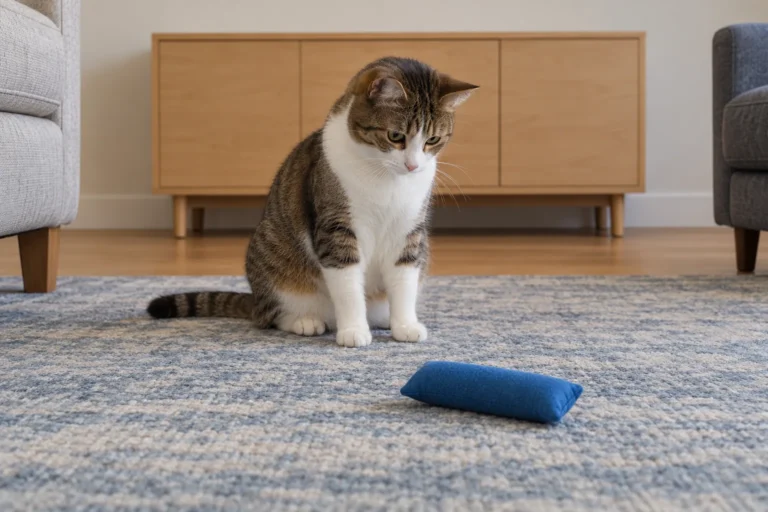
These cover the chase and the catch while you are at work. The AAFP and ISFM recommend large, soft toys to rake and bite; International Cat Care’s kick toy is one big enough to clutch with the front legs and kick with the back. Fur mice lose their pull once “killed,” the charity notes, so offer two or three in turn. Kickers often come filled with catnip or silvervine, and catnip vs silvervine explains which of the two more cats respond to.
For the chase, International Cat Care singles out the ping pong ball, light and paw-sized, and VCA lists crinkle balls and balls that run in a track. The track wins in an apartment. Its ball never ends up under the fridge.
No veterinary page we read mentions plastic springs, so judge them, like every solo toy, by the AAFP and ISFM rule against small swallowable parts, bells included. International Cat Care is warmer about a bell sealed inside a ball; for toys left out alone, we side with the stricter rule. The DIY cat toys guide knots a sock kicker with no thread at all.
Toys to keep cats busy while you are at work
Toys to keep cats busy for a whole workday need sorting into two piles before you leave. The ones that can stay out: kickers big enough to clutch and rake, a ball in a track, a stationary food puzzle filled from the day’s food, and a box or tunnel to hide in. The ones that go in a drawer: wands, anything on a string, ribbon or yarn, and any toy with a part that could come off.
VCA warns that swallowed string or ribbon can be deadly, which is why the wand only comes out while you hold it. Leave two or three of the safe toys out each morning and swap them the next day, so the pile still feels new by the end of the week.
Toys fill the hours; they do not set how many there can be. For the routine around a working day, from play before you go to a sitter on longer trips, see our guide to leaving a cat alone for a workday.
Food puzzles and treat balls
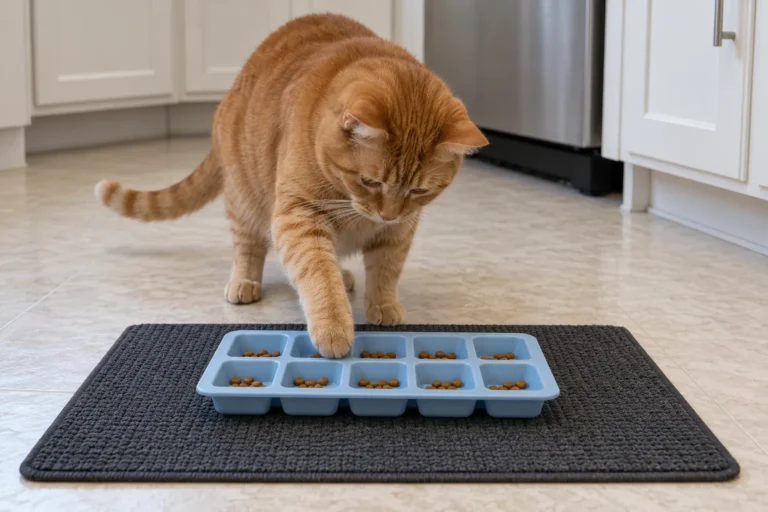
Food puzzles hand the cat the last step. Dantas and colleagues sort them into mobile ones (balls, eggs and tubes rolled by paw or nose, mostly for dry food) and stationary ones with holes, cups or wells, the wells taking wet food. Start a new puzzle as easy as a bowl, set it beside the usual dish at mealtime, and fill it from the day’s food. One per cat.
Noise is the apartment catch. A hard treat ball rattling over floorboards at 2 a.m. is exactly what the neighbor below hears. The same paper’s answer for owners bothered at night: stationary puzzles overnight, rolling ones far from the bedroom. Our puzzle feeders compared page sorts store-bought puzzles the same way, with each maker’s difficulty level.
Motion toys and laser pointers: what the sources say
Several page-one results (read Oct 15, 2026) push battery toys for the hours you are out. The vet sources say less. VCA lists motorized chase toys among toys cats enjoy and suggests a battery toy for when you cannot play. International Cat Care says small objects jerking about on a wire appeal to most cats, and the San Francisco SPCA keeps timid cats away from large or noisy toys.

None compares a motion toy with a person on a wand or gives noise or run-time figures. The authors of a 2025 UK owner survey suggest cats tire of toys that never change, and that this may matter less for a wand a person moves. Treat a motion toy as an extra for solo time, and check that nothing on it comes off.
Are laser pointers OK for cats?
Used as a warm-up, yes, though the sources disagree on how far to go. VCA lists laser pointers among the toys a cat on a weight-loss plan can chase. International Cat Care says the dot gives the stalk, chase and pounce but never the catch, so switch to a wand toy to finish. Cats Protection goes further and says to avoid toys that can never be caught, laser pens among them.
So run the cat laser pointer for a minute or two across the floor, steer the dot onto a kicker or the wand’s lure, switch it off and let the cat grab something real, then give the treat. No source we read covers the beam itself or the color of the dot, red or green, so keep it low and never near anyone’s eyes, the cat’s included.
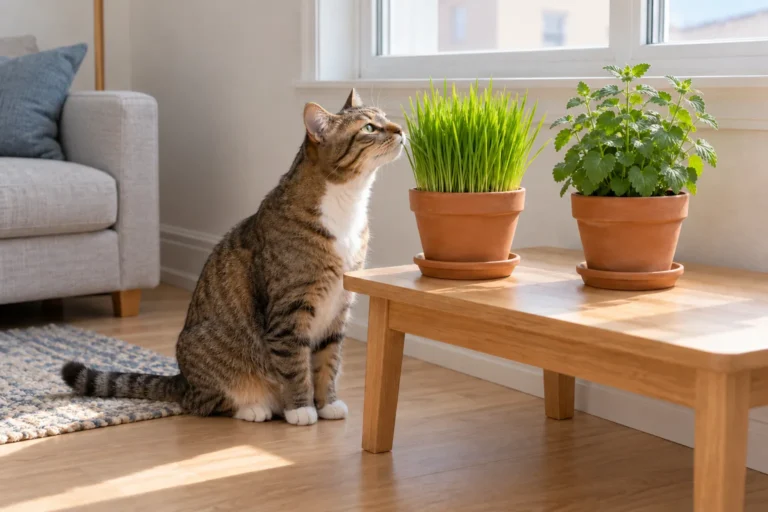
Catnip and silvervine toys
Scent can revive a forgotten toy, for most cats. Bol and colleagues offered four plants to 100 cats in 2017: 79% reacted to silvervine and 68% to catnip, and 22 of the 31 that ignored catnip (71%) reacted to silvervine. Silvervine (Actinidia polygama) comes as dried fruit galls, and the gall powder drew far more reactions than the wood, so look for powder-filled toys.
Catnip carries a toxic rating for cats from the ASPCA: a cat that eats it can vomit or get diarrhea. Keep scented toys occasional, bagged between uses. Silvervine is missing from the ASPCA’s plant list, yet Bol and colleagues note there are no cat-specific safety data for any plant they tested. Kittens under about three months rarely react, says International Cat Care. Vomiting more than once after a scented toy is a reason to phone a pet poison helpline or your vet.
Scratchers, tunnels and boxes
A scratcher is not a toy in the guidelines’ sense, but it belongs on the list. The AAFP and ISFM count a scratching area as a key resource, and AAHA names furniture scratching as one way frustrated hunting shows. For the right post height, measure your cat with the cat measuring tool.
Boxes and tunnels give cover for the search and stalk. International Cat Care notes that cats like to play among obstacles they can hide behind, and that a new box two or three times a week delights most. With two cats, choose one with two openings: the AAFP and ISFM want shared hiding spots to have more than one way in.
A weekly toy rotation for a small apartment
The AAFP and ISFM put it in one line: “Use the cat’s toys on a rotating basis to prevent habituation and boredom.” VCA suggests about 20 toys with four or five out at once, swapped weekly. Many owners skip it: in a 2025 UK survey, 279 of the 503 who offered prey-like toys did not rotate them even weekly.

- Sort what you own by hunt step, using the table above.
- Put out four or five, mixing catch, chase and food toys.
- Shut the rest in a bin with a pinch of catnip, as International Cat Care suggests, so they come back smelling new.
- Swap on a fixed day, such as recycling day, and bin anything frayed or cracked.
Wands and the laser stay out of the rotation and out of reach. The 7-day enrichment plan builder lays out a week of hunt-shaped sessions from the toys you tick.
Buying checklist for a small apartment
Run each toy past these before it goes in the cart; the toy guides go deeper on each type.
- Who lives below you. No source we read gives noise figures for cat toys, so go by material: fur and felt land softer on bare floors than hard plastic.
- Where it rests: a wand that fits a drawer, a tunnel that folds flat.
- Nothing that comes off. Bells, glued eyes, loose feathers, thread tails, a battery cover with no screw.
- Kitten-sized for kittens, as the AAFP and ISFM ask. International Cat Care also rules out pipe cleaners, ribbon and wool for them.
- One per cat for puzzles and solo toys, in separate spots, which the AAFP and ISFM advise.
Questions about toys for bored cats
What toys are good for bored cats?
Start with a wand toy you move yourself, then add a kicker, two small chase toys and one food puzzle. Together they cover every step of a hunt, from the stalk to the meal. Rotate them weekly and put the wand away after each session.
How do you tell if a cat is bored?
Look for a long-running pattern rather than one bad day: ankle ambushes, sofa scratching, yowling, or long sleeps and no interest in toys. AAHA and the San Francisco SPCA link these to unmet play needs. Anything sudden, or paired with a change in appetite or litter habits, needs a vet first.
How do I keep a bored indoor cat busy while I work?
Play before work and again when you get home, the San Francisco SPCA advises, and leave puzzles and safe toys out for the hours between. The sources we read give no safe maximum for hours alone, so no pile of toys makes a long day fine.
What toys can a cat be left alone with?
Ones with nothing to swallow or tangle in: large kickers, a ball that runs in a track, a stationary food puzzle, a box or a tunnel. Put wands and anything with string, ribbon, yarn or small parts away before you go: VCA calls a swallowed string an emergency.
Are laser pointers bad for cats?
Not as a short opener, but on their own they leave the hunt unfinished: International Cat Care and Cats Protection both point out the dot can never be caught. End every laser game on a toy your cat can grab, and keep the beam on the floor, away from faces.
Where can a bored cat run in a studio with no hallway?
Short runs are enough, since International Cat Care describes cats as sprinters. Drag a wand lure around the sofa and under the bed skirt, use the room’s diagonal as the longest straight chase, and drop a ping pong ball into a dry bathtub, whose curved sides keep sending it back.
What are the most stimulating cat toys for indoor cats?
Toys that look, feel and move like small prey and can actually be caught: a wand lure, a fur mouse, a ball that skitters off. Food puzzles add a problem to solve, and catnip or silvervine adds scent for cats that respond. Weekly swaps keep each one new.
How can a bored cat climb in a rental that bans wall shelves?
Go freestanding: a cat tree, a cleared bookcase top with a non-slip mat, or pet steps up to the sill of a closed window. The AAFP and ISFM guidelines value height because it lets a cat watch the room, and want each perch long enough for a full stretch. The renter-friendly shelves guide lists no-drill options.
Next step. To cover the eating step on its own, puzzle feeders compared sorts rolling and stationary kinds.
Sources
- AAHA, “How Often Should You Play with Your Cat?” aaha.org, read Oct 16, 2026.
- International Cat Care, “Playing with your cat,” icatcare.org, read Oct 16, 2026.
- International Cat Care, article on the hunting behavior of cats, icatcare.org, read Oct 16, 2026.
- San Francisco SPCA, “Playing with Your Cat,” sfspca.org, read Oct 16, 2026.
- Cornell Feline Health Center, “Feline Behavior Problems: House Soiling,” vet.cornell.edu, read Oct 16, 2026.
- Cornell Feline Health Center, “Feline Lower Urinary Tract Disease,” vet.cornell.edu, read Oct 16, 2026.
- AAFP and ISFM, “Feline Environmental Needs Guidelines,” Journal of Feline Medicine and Surgery, 2013, journals.sagepub.com, read Oct 16, 2026.
- VCA Animal Hospitals, “Cat Behavior and Training: Play and Play Toys,” vcahospitals.com, read Oct 16, 2026.
- Merck Veterinary Manual, “Gastrointestinal Obstruction in Small Animals,” merckvetmanual.com, read Oct 16, 2026.
- Dantas and others, “Food puzzles for cats,” Journal of Feline Medicine and Surgery, 2016, journals.sagepub.com, read Oct 16, 2026.
- Taylor and others, “Feline management practices and resource provision in the UK,” Veterinary Record, 2025, PubMed Central, read Oct 16, 2026.
- Bol and others, “Responsiveness of cats to silver vine, Tatarian honeysuckle, valerian and catnip,” BMC Veterinary Research, 2017, PubMed Central, read Oct 16, 2026.
- ASPCA Animal Poison Control, “Toxic and Non-toxic Plants: Catnip,” aspca.org, read Oct 16, 2026.
- Cats Protection, “Cat boredom busters,” cats.org.uk, read Oct 22, 2026.
- VCA Animal Hospitals, “Creating a weight reduction plan for cats,” vcahospitals.com, read Oct 22, 2026.
- VCA Animal Hospitals, “Linear foreign body in cats,” vcahospitals.com, read Oct 16, 2026.