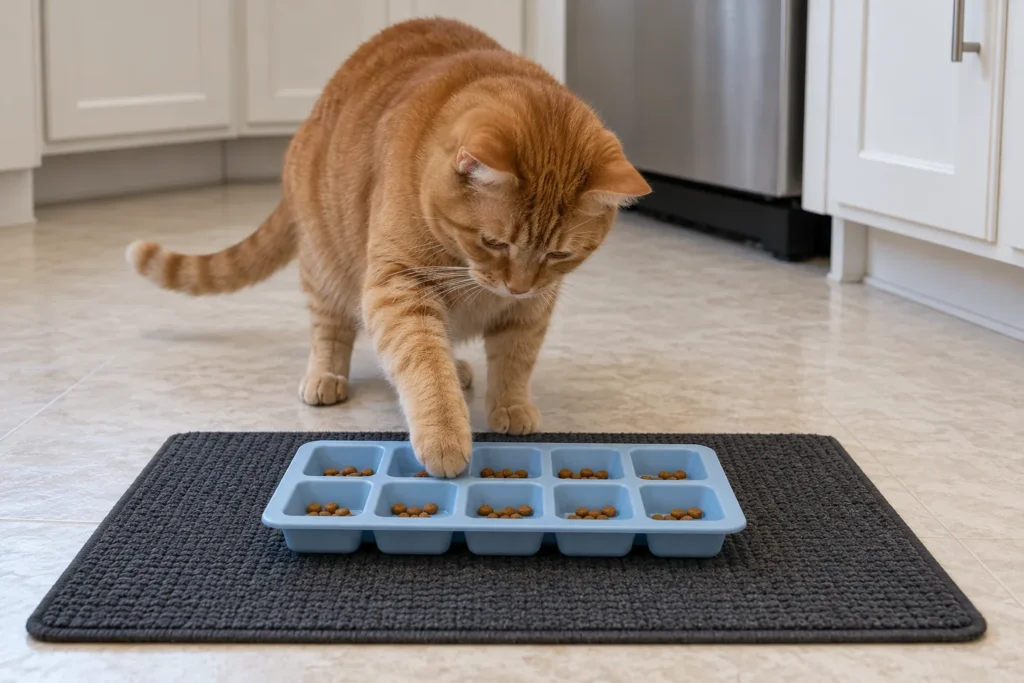
The easiest DIY cat puzzle is an ice cube tray or an open egg carton with some of your cat’s usual dry food in each pocket. Make the first one as easy as eating from the bowl, show your cat how it works, and move up to a toilet-roll pyramid once the simple version clicks.
What you need
- A clean ice cube tray kept for the cat only, or a clean cardboard egg carton.
- For the tube pyramid: at least six cardboard toilet rolls, clear tape and a flat piece of cardboard for a base.
- Part of your cat’s usual daily food, not extra on top of it.
- A spot on the floor away from the water bowl and out of the walkway.
- Dish soap and hot water for the tray, and the recycling bin for worn cardboard.
Pick the tray if washing and storage are your limits, the carton if you want nothing to assemble, and the tubes once your cat already paws food out of a pocket. These projects change how food is served, not how much. If a ready-made version suits you better, compare ready-made puzzle formats; for play without food, see the guide to toys for bored cats.
Key takeaways
- Make the first puzzle as easy as the bowl and fill it generously, as the 2016 food-puzzle review advises. → introduce it gently
- Start the carton with its lid open and dry food in the egg cups. → make the carton
- Tape the tube pyramid at the front and back, on a cardboard base. → build the tubes
- Wash the tray like a food bowl after every session; recycle cardboard once it is worn. → reset and store
Find a project: Ice cube tray · Egg carton · Tube pyramid · First attempt · Cleaning · Questions
1. Start a DIY cat puzzle with an ice cube tray
Atlanta Humane Society’s food-toy guide fills an ice cube tray with kibble or wet food. The wells are shallow and open, so your cat can see and smell every piece. That makes it the gentlest first puzzle on this page.
- Check the empty tray for cracks, sharp edges or loose pieces.
- Fill the wells generously with your cat’s usual dry food, or put a little wet food in a few of them.
- Leave every well open for the first sessions.
- Set it flat on a mat and press one corner to make sure it does not tip.
- Stay in the room while your cat investigates.
Wet food adds one rule. The FDA says to promptly refrigerate or throw out leftover canned and pouched pet food, so pick the tray up when your cat walks away instead of leaving it out for later.
Give the tray to the cat for good. FDA storage advice keeps scoops and measuring utensils for pet food only; treat the puzzle tray the same way and store it with the cat’s things, not back in the freezer.
In a studio, put it where the bathroom door cannot swing into it, and away from the water bowl. Cats Protection notes that cats prefer to eat and drink in different locations.
2. Make an open egg-carton food puzzle
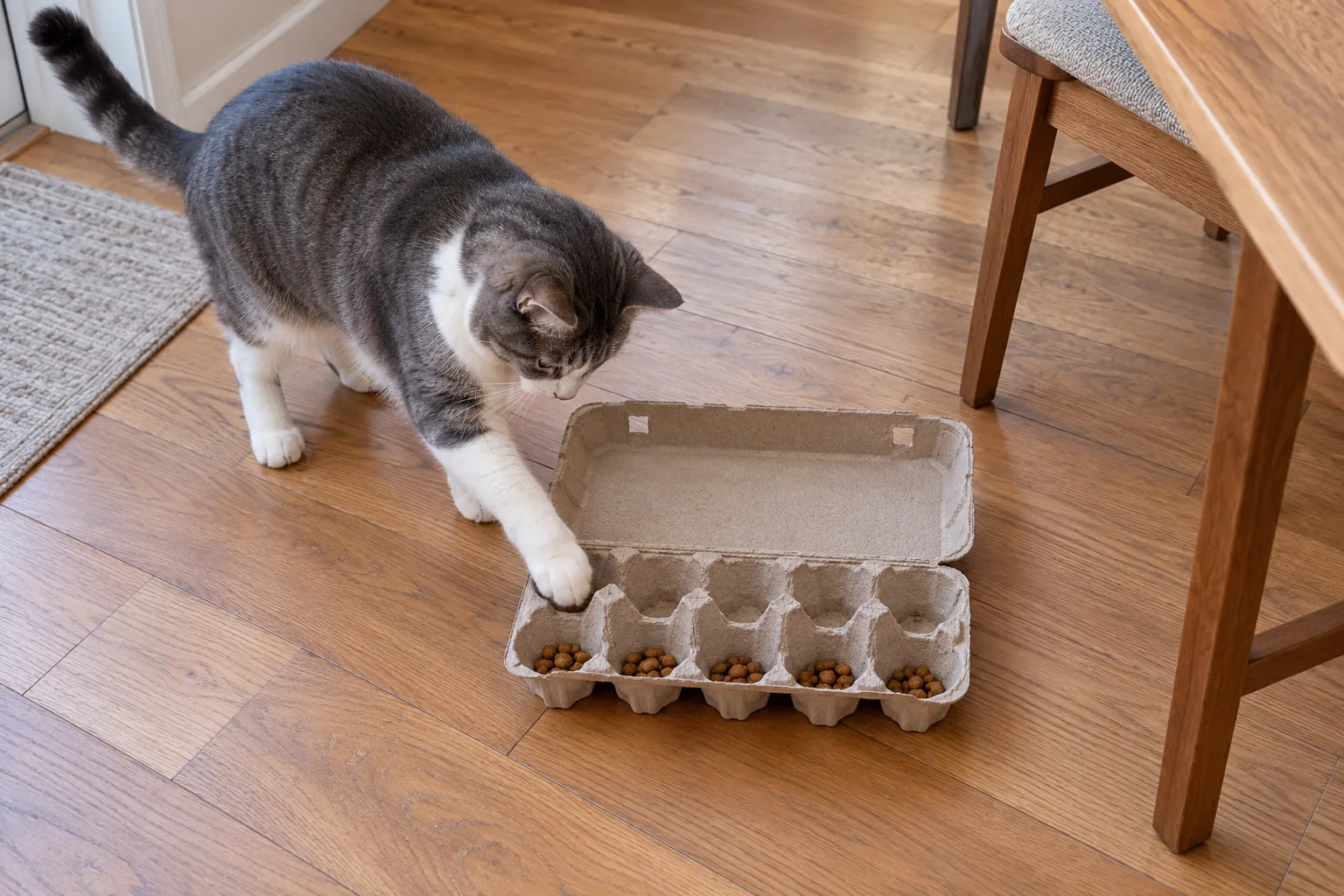
An egg carton gives you fixed food pockets with no cutting. Cats Protection’s feeding-enrichment instructions start with an open cardboard egg box and some of your cat’s daily allowance of dry food in the egg compartments, for your cat to paw out. Only after that works does it suggest building up, very gradually, to a half-closed lid or food tucked into loosely scrunched paper.
- Choose a clean, dry, intact carton without loose labels or fasteners.
- Fold the lid fully back so it cannot drop across the food.
- Put the food into the front pockets first, where a paw reaches easily.
- Place the carton on a flat surface with the open side facing your cat.
- Watch for two things: food coming out, and teeth going into the carton itself.
Use an unused carton if you are unsure where a saved one has been. Do not tape over a stain or patch a chewed pocket; replace the carton instead. If the shape tips under a paw, switch to the tray.
Choose this over the tube pyramid when you want something you can put down without assembly, with the food in plain view. For crafts without food, the household toy projects cover a different kind of play.
3. Build a low cardboard-tube pyramid
For a cat that already fishes visible food out with a paw, try a fixed cluster of tubes. The Cats Protection tube-feeder sheet calls for a minimum of six toilet roll tubes, built into a pyramid and taped together at the front and back. Its blog version adds a cardboard base to make the stack extra stable, which also lets you lift the whole thing to put it away.
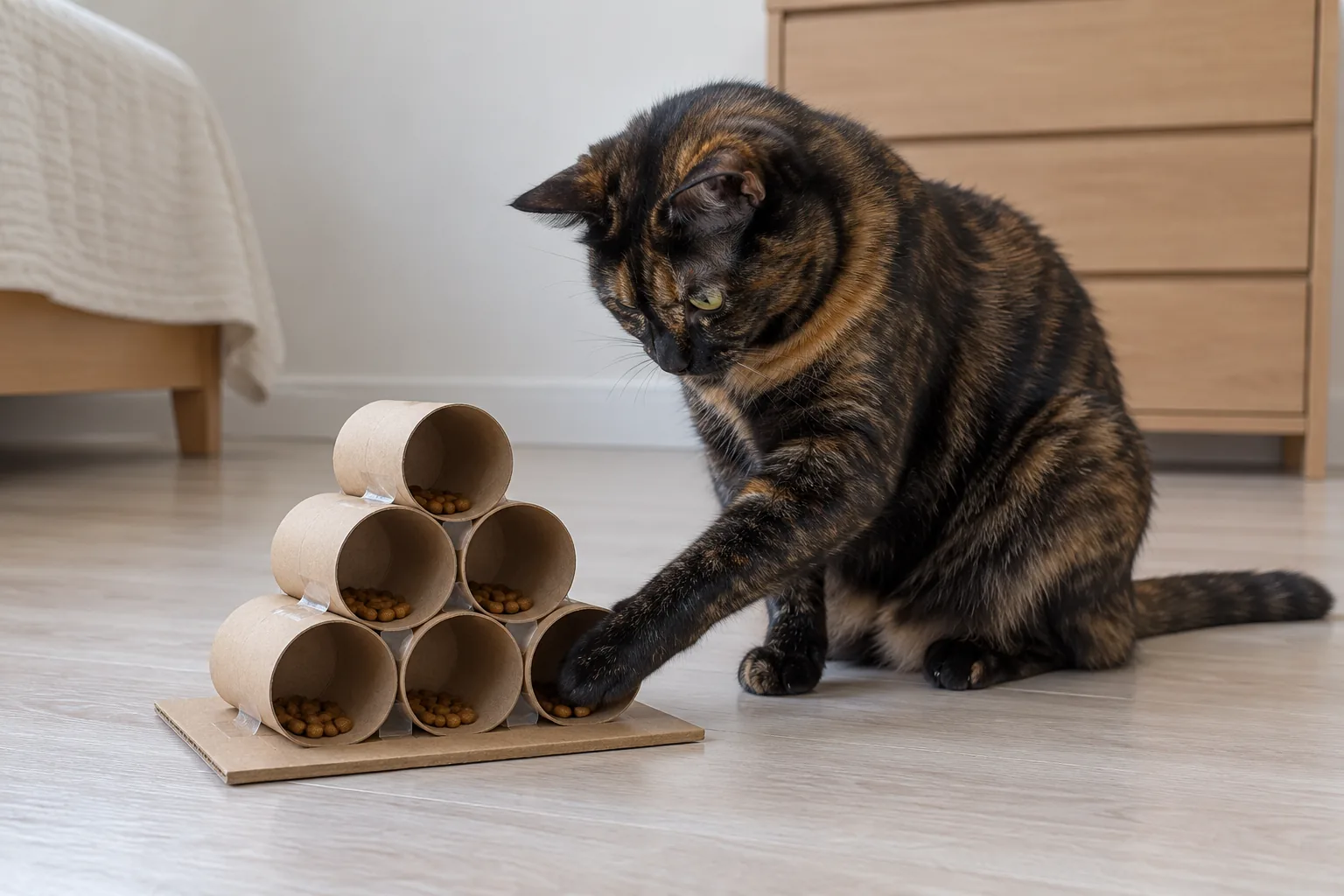
- Check each roll inside and out; reject torn or damp cardboard.
- Lay 3 tubes side by side on the base, open ends facing the same way.
- Set 2 rolls on top of that row and the last roll on top of those.
- Tape neighboring rolls together and to the base, at the front and the back, pressing every tab flat.
- Nudge the finished stack from the side; it should not shift.
- Drop dry food just inside the lowest openings.
Leave the top tube empty at first. The sheet says to show your cat how it works for a couple of minutes before letting them have a go, so paw a piece out yourself and let it drop where your cat can see it. If you cannot reach a piece with a fingertip, it sits too deep.
Inspect the materials: Put the pyramid away if your cat pulls at the tape or starts eating cardboard. Atlanta Humane warns that swallowed inedible objects can cause an intestinal obstruction and says to switch to a different toy if your cat tries to eat one. For a cardboard chewer, Cats Protection suggests a commercially made puzzle instead.
Skip this project if the joins will not lie flat or the stack wobbles; a shallow tray beats a collapsing tower. For manufactured formats and their trade-offs, see the food-puzzle buying guide.
4. Show the first step without withholding the usual option
The 2016 feline food-puzzle review says that at first, getting food from a puzzle should be as easy as getting it from the bowl, with very little work for the cat. It also says to fill a new puzzle as much as possible, with the cups of a stationary one overflowing.
Put it down as a choice next to the usual feeding spot at mealtime, with the usual food in it. The authors note that some cats treat their food container as a safety signal. A nervous cat may do better with the puzzle in a corner away from household traffic, where it can explore undisturbed.
Demonstrate, then step back. A Cats Protection behavior article advises showing the cat little and often, every few minutes, rather than playing with the puzzle yourself for ages; a cat that follows you and eats whatever falls out has already worked it out. Never hold your cat in place or move its paw for it.
Keep the food familiar and take it from the day’s usual amount. This guide gives no cups or calories; the food label and your vet set those.
If your cat walks away, make it easier: uncover the food or go back to the tray. The review found that cats differ, with some preferring puzzles they can push or roll and others doing better with stationary ones. A cat that ignores the tubes may simply want a different kind.
Keep diet questions separate: Ask your veterinarian before changing the food or a prescribed feeding routine, including for a cat on a special diet. The FDA says questions about your pet’s health or the specific use of a pet food should always go to your vet; a homemade puzzle does not change that.
5. Clean, inspect and store the project
Pick up the pieces when the session ends and check them for damage. FDA handling advice is to wash pet food bowls and scooping utensils with soap and hot water after each use. Treat the tray as a bowl, within its own care instructions.
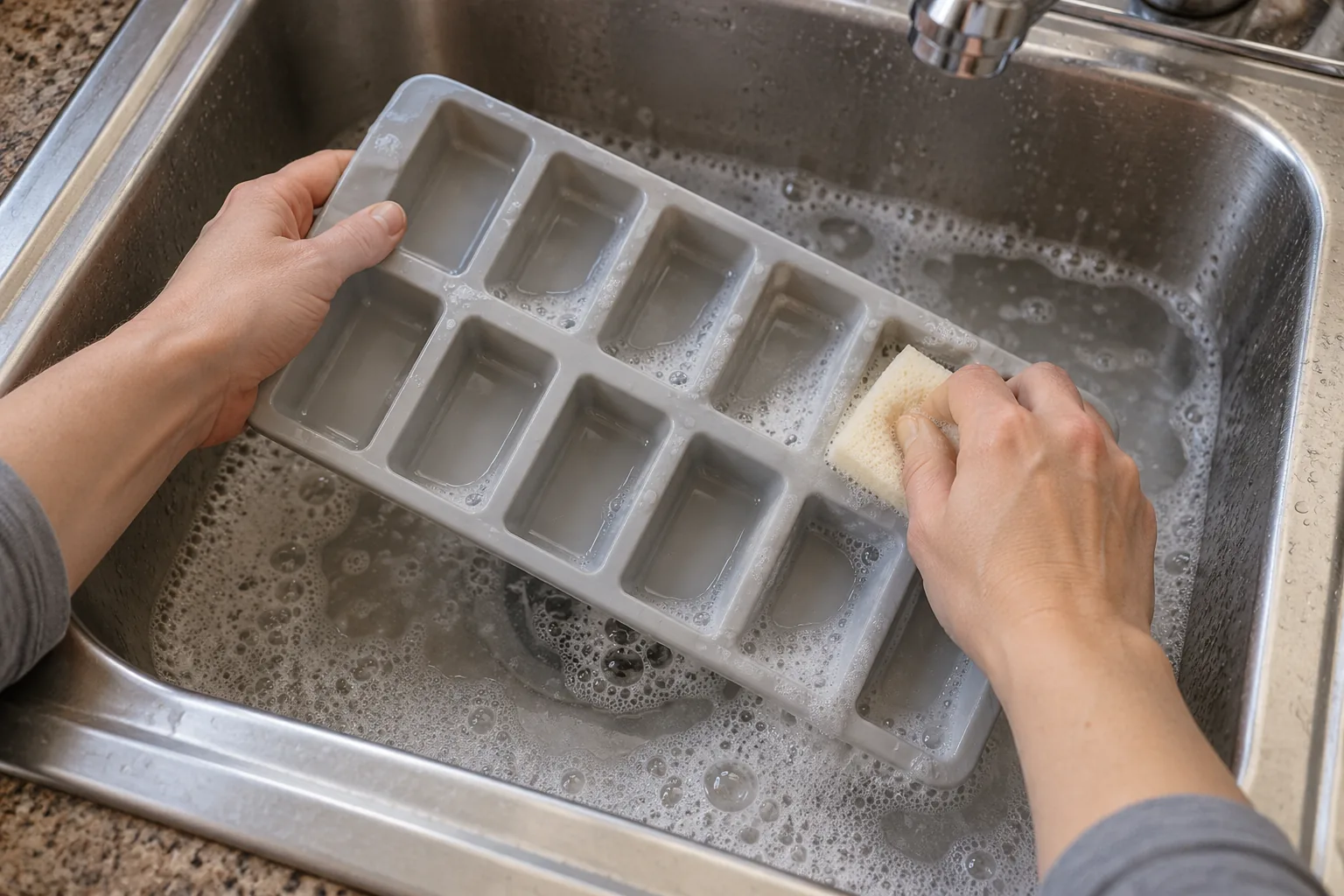
Dry it before you put it away. Cardboard works differently: Cats Protection says homemade feeders can simply be disposed of when they are worse for wear, so recycle a carton or tube stack once it is damp, soiled, torn or chewed rather than trying to wash it.
In a small sink, a flat tray is easier to handle than an assembled cardboard structure, so decide where washing will happen before you choose a project. Keep the food itself in its bag or bin, not stored inside a toy; the FDA storage page wants dry food kept cool and dry.
Use the activity plan builder to note the format offered and whether the food stayed reachable. For shared care, tell the next person that the puzzle food came from the existing plan, and store the empty project where nobody mistakes it for a meal still to serve.
DIY food-puzzle questions
How do you do a puzzle with a cat?
Fill an easy puzzle generously with your cat’s usual food, set it beside the regular bowl at mealtime, and show how a piece comes out. Then step back. If your cat struggles, make the food more visible or go back to an open tray before you add any lid, paper or depth.
Do cats enjoy puzzles?
Many do, but not all in the same way. The 2016 veterinary review describes cats that prefer rolling puzzles, others that prefer fixed ones, and cats that use a paw versus a nose. An ignored carton usually calls for a different format or an easier start, not a harder task.
Which project fits an apartment with one tiny sink?
Start with a shallow reusable tray that fits the sink you actually have. Check its care instructions before using it for food. A cardboard carton avoids assembly, but worn or soiled cardboard needs replacement. Plan the cleanup and drying spot before deciding how much project storage you can spare.
How can roommates avoid adding a second helping through the puzzle?
Take the puzzle food from the amount already agreed for your cat, then note on a shared list that it went into the puzzle. Tell the next caregiver where the empty project is stored. The food label and your vet set the daily amount; the puzzle only changes how part of it is served.
Sources
- Atlanta Humane Society, Enrichment & Training: Feline Food Toys, read Oct 22, 2026.
- Cats Protection, Cat food puzzles, read Oct 22, 2026.
- Dantas, Delgado, Johnson and Buffington, Food puzzles for cats: feeding for physical and emotional wellbeing, JFMS 2016, read Oct 21, 2026.
- Cats Protection, How to: Make a feeding enrichment toy (PDF), read Oct 22, 2026.
- FDA, Tips for Safe Handling of Pet Food and Treats, read Oct 22, 2026.
- Cats Protection, Playing with their food (The Cat, Spring 2015, PDF), read Oct 22, 2026.
- FDA, Proper Storage of Pet Food & Treats, read Oct 22, 2026.
- US Food and Drug Administration, Pet Food, read Oct 22, 2026.