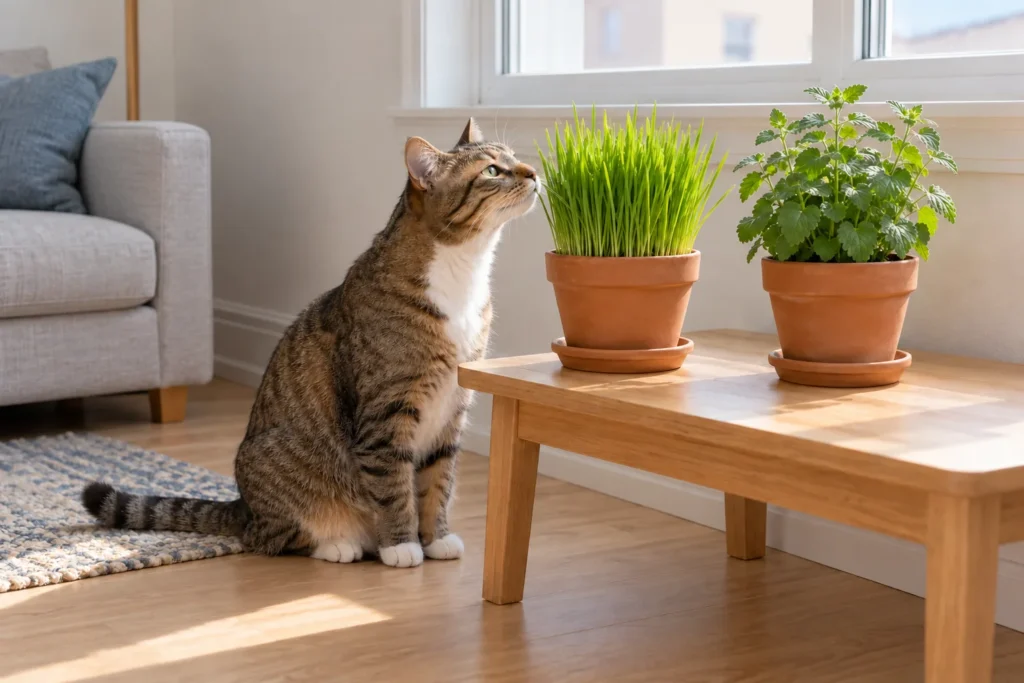
There is no single plant called catnip grass. Seed racks sell two crops under that name: catnip (Nepeta cataria), a leafy herb of the mint family, and cat grass, which is young oats or a mix of oats, wheat and rye. Both grow in pots on an apartment windowsill, and neither needs a balcony or a yard.
Cat grass is a crop you sow again and again; Iowa State University’s extension service has it in a 6 to 8 inch (15 to 20 cm) pot and in front of the cat at about 2 inches (5.1 cm) tall. Catnip is a plant you keep. The hard part is not growing it but stopping the cat from flattening it while it is small.
What you need
- A packet of cat grass seed (oats, or an oat, wheat and rye blend).
- A packet of catnip seed with Nepeta cataria printed on it.
- Two or three pots 6 to 8 in (15 to 20 cm) across, each with a drainage hole and a saucer.
- Fresh bagged potting soil.
- Small scissors.
- A wire cloche or cage that fits over one pot.
- Your brightest window, kept shut or fitted with a secure screen.
Catnip grass, in short
Scatter cat grass seed thickly over fresh potting soil, cover it lightly, water it through and keep it bright; once the blades stand about 2 inches (5.1 cm) tall, set the pot down where your cat will find it, and sow the next pot every few weeks. Grow catnip from seed in its own pot in the sunniest window, pinch the tips so it stays bushy, and keep it caged until it is well grown. Offer the catnip sparingly; the ASPCA rates it toxic to cats because eating it can upset the stomach.
Key takeaways
- Every nearby houseplant needs an ASPCA lookup by scientific name; a true lily or daylily can be deadly, even its pollen, says the FDA. → plant safety
- Catnip gets the sunniest sill, cat grass a dimmer one; tend both with the window shut, and screen it securely before opening. → the window
- Sow cat grass thickly, hand it over at about 2 in (5.1 cm), and start another pot every few weeks, per Iowa State. → cat grass
- Serve catnip as a few snipped leaves, not daily, with the pot caged between sessions; repeated vomiting means calling your vet. → serving catnip
Two different plants under one name
Catnip is a perennial herb with square stems and soft, gray-green, toothed leaves, a member of the mint family, Lamiaceae, as the University of Wisconsin-Madison’s horticulture extension describes it. Left to itself in a garden it grows up to 3 ft (91 cm) tall and as wide. Most cats like rubbing against the leaves or chewing them, the same page notes. Most, not all: when Bol and colleagues offered catnip to 100 cats in 2017, 68 percent responded. The reaction itself, and the dried forms you can buy, are covered in our catnip and silvervine guide.
Cat grass is not one species either. Iowa State’s Yard and Garden service defines it as common oats or a blend of oats, wheat and rye grass, grown so a cat can graze. Cats chew it rather than roll in it, and that is ordinary behavior. In two UC Davis owner surveys published in 2021, 65 percent of cats ate plants every week and only 6 percent looked ill beforehand. The same surveys found that 27 to 37 percent of plant eaters often vomited afterward.
Cornell’s Feline Health Center lists oat grass, catnip and catmint as greens to offer a cat that chews houseplants, with a caveat for small homes crowded with plants: the cat may keep nibbling the houseplants too.
Check every other plant in the room first. Cornell says the only sure protection is keeping houseplants out of the cat’s reach, so look up each one on the ASPCA’s toxic and non-toxic plant list by its scientific name. Lilies are the worst case: according to the FDA, any part of a true lily or daylily, even pollen or the water in a vase, can bring on kidney failure that kills a cat.
Pick the window, and make it safe
Light decides which pot goes where. Wisconsin’s extension page says catnip grows best in full sun but survives partial shade. NC State’s Plant Toolbox adds that catnip is somewhat intolerant of heat and humidity. Cat grass asks only for bright light, by Iowa State’s account. So give the sunniest sill to the catnip and let the cat grass take the dimmer window.
Apartment sills bring their own limits. A sill above a radiator runs hot all winter, the wrong place for a plant that dislikes heat. If the sill is too narrow for a 6 in (15 cm) pot, a small side table against the window wall works instead.
If no window gets much direct sun, a grow light can fill in. Catnip belongs to the mint family, and the Urban Hydro Space guide to growing mint in an apartment covers light schedules, jars and trimming indoors. Keep the mint itself away from your cat, though: the ASPCA lists garden mint as toxic to cats.
A sill full of pots is a sill your cat will sit on. Give it a small cat tree at another window instead. Vets treat so many cats after window falls that the pattern is called high-rise syndrome, and in a study of 119 cases over half of the cats were younger than one year. Water and trim with the window shut. If you open it, fit a secure screen to the frame; no source we read rates a standard bug screen for the weight of a cat.
How to grow cat grass, step by step
Iowa State’s method needs only seed, a pot and a bag of potting soil:
- Fill a 6 to 8 in (15 to 20 cm) pot with fresh potting soil from a new bag.
- Scatter the seed thickly and evenly over the whole surface, so the blades come up as a dense mat rather than a few tufts.
- Cover the seed with a thin layer of soil.
- Water until it runs out of the drainage hole, then empty the saucer.
- Keep the pot in bright light.
- Hand it over when the blades reach about 2 in (5 cm).
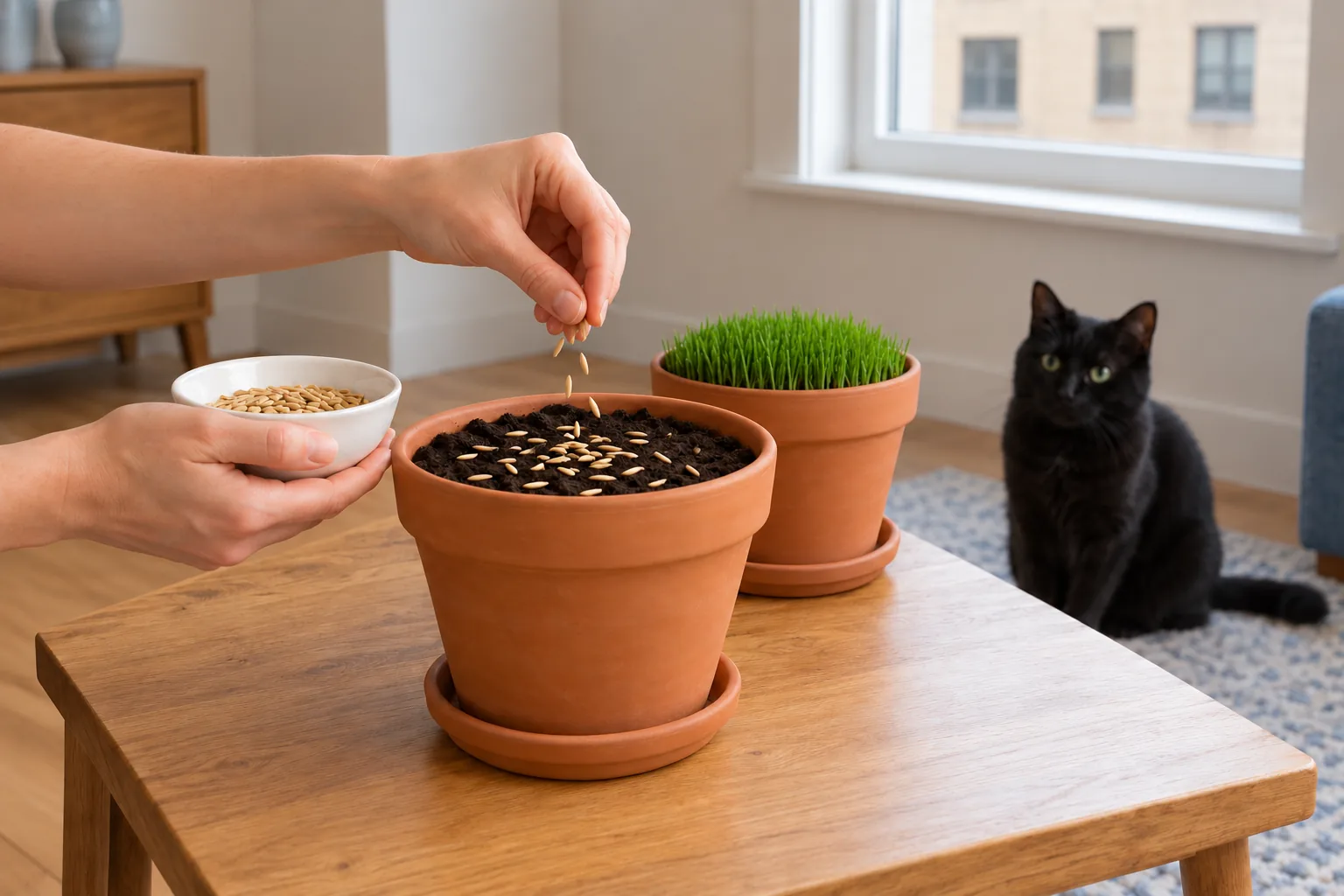
Sow a second pot every few weeks, as Iowa State advises, so one is growing while the other is in use.
Neither Iowa State nor any other source we read gives a number of days from sowing to 2 in (5.1 cm). The seed packet prints its own estimate, and that is the figure to plan by.
How to grow catnip from seed
Read the scientific name before you pay. Garden centers sell ornamental catmints too, such as Nepeta x faassenii and Nepeta racemosa, and Wisconsin’s horticulturists note their leaves interest cats less than true catnip does. For a cat, the packet should say Nepeta cataria.
Both extension pages stress drainage, so use a pot with a hole in the bottom and ordinary potting mix. NC State suggests a container anyway, because catnip can turn weedy in a bed. Wisconsin lists two ways to start it: from seed, or by dividing an existing plant. Garden advice to sow a few weeks before the last frost does not apply on a sill.
Once the stems are a few inches tall, pinch off the tips. Pinching gives a compact, less weedy plant, Wisconsin says, and compact is what a narrow sill needs. Catnip copes with dry spells once established, so water when the top of the soil has dried rather than keeping it wet. When it flowers, shear off the flower spikes: NC State says this brings more blooms, and Wisconsin adds that cutting the plant back after flowering cuts down on it seeding itself into your other pots.
Organic catnip seed is labeled for how the seed crop was grown. None of the veterinary or extension sources we read says that matters to the cat, so buy it if you prefer it.
Keep the cat off the seedlings
Your cat will not wait for the catnip to be ready. Wisconsin’s extension page warns that cats break the stems by rolling on the plant, and suggests caging it or growing it in a hanging basket until it fills out. In a rental, try one of these:
- A wire cloche, or a cylinder of hardware cloth, set over the pot.
- Hang the pot from a ceiling hook, but only one already in place or allowed by your lease.
- Shut the young plant in a bright bedroom while it grows. In a studio that leaves the bathroom, which only helps if it has a window.
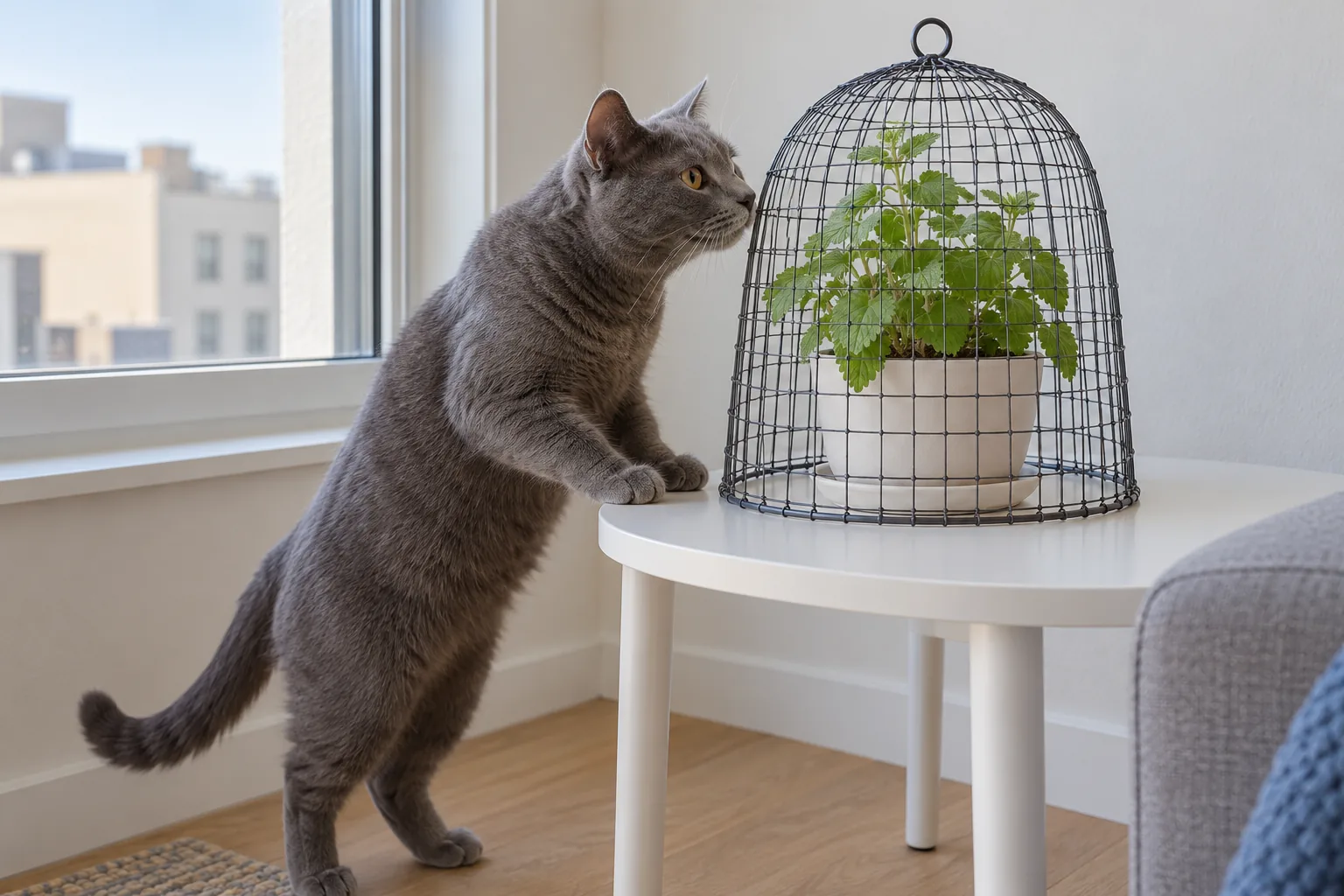
Cat grass needs less guarding. It is there to be eaten; just hold it back until one visit cannot strip the pot.
Serving it: grass at 2 inches (5.1 cm), catnip in pinches
Put the cat grass where your cat already spends time, on hard flooring you can wipe rather than a rug, given how many plant eaters bring it back up.

For catnip, snip a stem tip or a few leaves and set them on a towel or tuck them into a fabric toy. The ASPCA names vomiting and diarrhea as the risk when a cat eats catnip, and says it makes some cats sedated and others stimulated. So offer a few leaves at a time, not every day, and put the pot back under its cage between sessions. Kittens under about three months usually show no reaction, according to International Cat Care, so a young kitten walking past the pot tells you nothing yet.
Trimmings you do not use fresh can be dried and kept like shop-bought catnip; the silvervine guide explains storing a jar where paws cannot open it. To fit catnip into a varied week of play, the enrichment plan builder spaces scent days between other games, and our list of enrichment activities has ideas for the days in between.
Suspected poisoning. If your cat has chewed a plant you cannot name, or vomits again and again after grass or catnip, call your vet. The ASPCA Animal Poison Control Center answers at (888) 426-4435, and the ASPCA notes that a consultation fee may apply.
Questions about catnip and cat grass
Is there such a thing as catnip grass?
Not as one plant. Catnip grass is a shop label for two seeds sold together: catnip, Nepeta cataria, a mint-family herb that cats sniff and roll on, and cat grass, which Iowa State describes as oats, alone or mixed with wheat and rye, for cats to chew. Grow each one in a pot of its own.
Where is the best place to put cat grass?
While it grows, in your brightest spot. Once the blades are about 2 inches (5.1 cm) tall, move the pot to where your cat already rests, on a floor that wipes clean. Keep it apart from your houseplants, since Cornell’s Feline Health Center warns that a cat with grass of its own may still chew other greens nearby.
Does cat grass grow back every year?
Treat it as short-lived. A pot lasts until the cat has grazed it down, which is why Iowa State tells owners to start a new container every few weeks. Catnip works differently: Wisconsin’s extension service calls it a short-lived perennial, so one healthy plant keeps putting out stems you can pinch and offer.
Can I grow catnip in a north-facing apartment window?
You can try, but expect less growth than in a sunny window. The Wisconsin horticulture extension says catnip grows best in full sun and merely survives partial shade. In a dim apartment, put the catnip under a grow light and give the north window to the cat grass, which only needs bright light by Iowa State’s account.
Will a catnip plant make a small apartment smell?
It can. The leaves are strongly aromatic, and the University of Wisconsin’s extension page says many people dislike the smell, describing it as anything from thyme and oregano to mildly skunky. In a one-room studio, keep the pot at the window, away from your bed and desk, and pinch it back so it stays small.
Can a cat chew the mint or lemongrass from a kitchen herb pot?
Keep both out of reach. The ASPCA lists garden mint (Mentha) and lemongrass (Cymbopogon citratus) as toxic to cats, with vomiting and diarrhea from large amounts of mint and stomach upset from lemongrass. Catnip, a mint relative, is a different plant, and the ASPCA lists it as toxic too.
Next step. Add food play with puzzle feeders compared.
Sources
- Iowa State University Extension and Outreach, “What is cat grass?,” Yard and Garden, yardandgarden.extension.iastate.edu, read Oct 17, 2026.
- University of Wisconsin-Madison Extension, “Catnip, Nepeta cataria,” Wisconsin Horticulture, hort.extension.wisc.edu, read Oct 17, 2026.
- NC State Extension, “Nepeta cataria,” Extension Gardener Plant Toolbox, plants.ces.ncsu.edu, read Oct 17, 2026.
- ASPCA Animal Poison Control, plant entries for catnip, mint and lemon grass, aspca.org, read Oct 16 and 17, 2026.
- US Food and Drug Administration, “Lovely Lilies and Curious Cats: A Dangerous Combination,” fda.gov, read Oct 16, 2026.
- ASPCA, “Toxic and Non-Toxic Plant List: Cats,” aspca.org, read Oct 16, 2026.
- Cornell Feline Health Center, “Feline Behavior Problems: Destructive Behavior,” vet.cornell.edu, read Oct 17, 2026.
- Hart and Hart, “Characteristics of Plant Eating in Domestic Cats,” Animals, 2021, PubMed Central, read Oct 16, 2026.
- Bol and others, “Responsiveness of cats to silver vine, Tatarian honeysuckle, valerian and catnip,” BMC Veterinary Research, 2017, PubMed Central, read Oct 16, 2026.
- International Cat Care, “Playing with your cat,” icatcare.org, read Oct 16, 2026.
- Vnuk and others, “Feline high-rise syndrome: 119 cases,” Journal of Feline Medicine and Surgery, 2004, PubMed Central, read Oct 16, 2026.