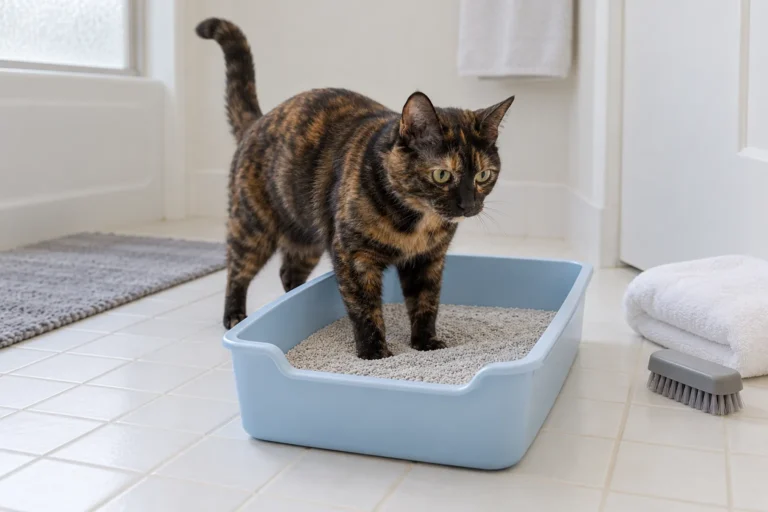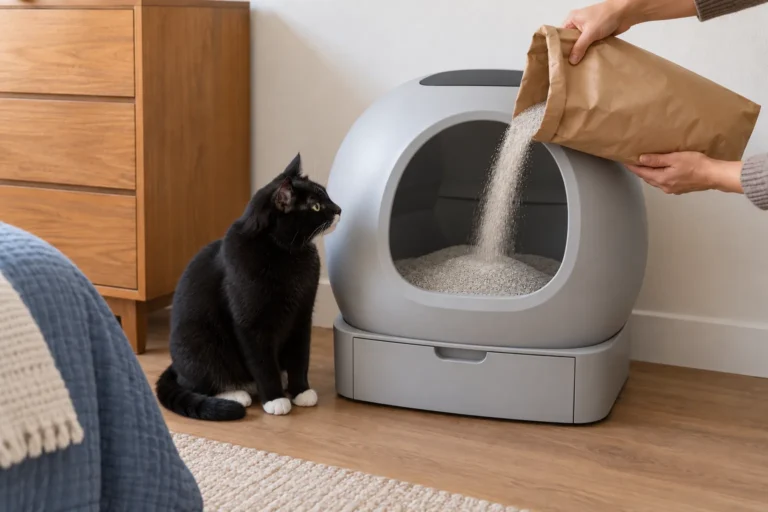
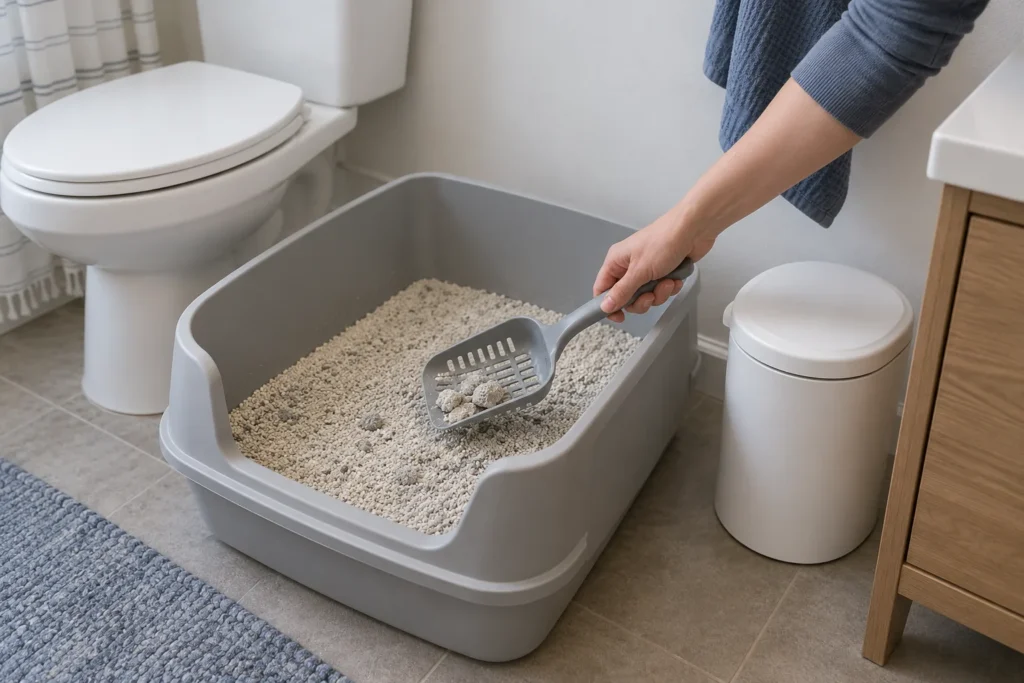
To keep a litter box from smelling, get the waste out before it builds up: scoop at least once a day, empty and wash the whole box on a schedule, and use unscented clumping litter. In a small apartment the box sits a few steps from where you cook and sleep, which leaves the routine no slack.
What you need
- A slotted scoop, and a small lidded bin or a roll of bags for the clumps.
- Unscented clumping litter, enough to refill to about 2 in (5 cm).
- A box 1.5 times your cat’s length or more, nose to tail base (the AAFP and ISFM yardstick).
- Hot water, mild dish soap, rubber gloves and a brush kept for the box.
- A shower or tub to wash it in. Not the kitchen sink.
How to keep a litter box from smelling, in short
Litter box odor usually starts in one of five places, each with its own fix:
| What you notice | Likely cause | Fix |
|---|---|---|
| Urine smell building between scoops | Clumps left waiting | Scoop twice a day |
| Smell soon after a scoop | Wet litter at the bottom and corners | Empty and wash the whole box |
| A washed, empty box that still smells | Plastic that has absorbed odor | Replace the box |
| Perfume mixed with urine | Scented litter, powder or spray over a dirty box | Go unscented and scoop more often |
| Smell away from the box | Urine or stool outside it | Clean without ammonia or vinegar, then call your vet |
Key takeaways
- Every guideline we read asks for a scoop at least daily, and iCatCare and the AVSAB call twice a day ideal. → how often to scoop
- On clumping litter, plan an empty-and-wash every 1 to 2 weeks, where the AAFP and ISFM, iCatCare and Nebraska Humane overlap. → the full wash
- Pick unscented clumping litter, since the AAFP and ISFM warn cats often find scented litter offensive; piling it deeper does not cut scooping. → the right litter
- Nothing on the store shelf replaces regular cleaning, say the AAFP and ISFM, who also advise against deodorizing powders and liners. → odor products
- Ask your vet first if smell turns much stronger on the same routine, urine clumps grow in size or number, or accidents start. → the vet note
Scoop at least once a day, twice if you can
Every guideline we read sets the same floor. The AAFP and ISFM house-soiling guidelines say to remove waste at least once a day, and both the 2025 iCatCare guidelines and the American Veterinary Society of Animal Behavior (AVSAB) put the ideal at twice a day. A cat visits the box roughly three to five times a day, by the AAFP and ISFM count. With one scoop, some of those clumps sit for most of a day.
Twice fits a working day: once in the morning, once before bed. Dig to the floor of the box and along the walls, where clumps stick, then top up the litter. Tie the clumps in a small bag or drop them in a lidded bin, and take them out with the kitchen trash. An open wastebasket by the sofa just moves the smell. A sealed pail can save the nightly walk to the chute, and our litter disposal bins compared page counts the days each bag holds.
Cats want this too, for their own reason. In a preference study described in Sarah Heath’s 2019 review, the smell of old waste did not change which box cats chose, but odorless fake deposits did. What a cat reacts to is the visible mess. Cornell’s Feline Health Center adds that some cats refuse a box with any waste in it at all.
Empty and wash the whole box every 1 to 2 weeks (clumping litter)
Scooping leaves damp litter and a film on the plastic, so the whole box needs a full change. For clumping litter, the sources differ:
- AAFP and ISFM: every 1 to 4 weeks.
- iCatCare (2025): every 1 to 2 weeks, sooner if soiled.
- Nebraska Humane Society: about every two weeks.
- San Diego Humane Society: about once a month, more often for some cats and litters.
- Cornell: no set interval, just often enough that the litter looks and smells dry and clean.
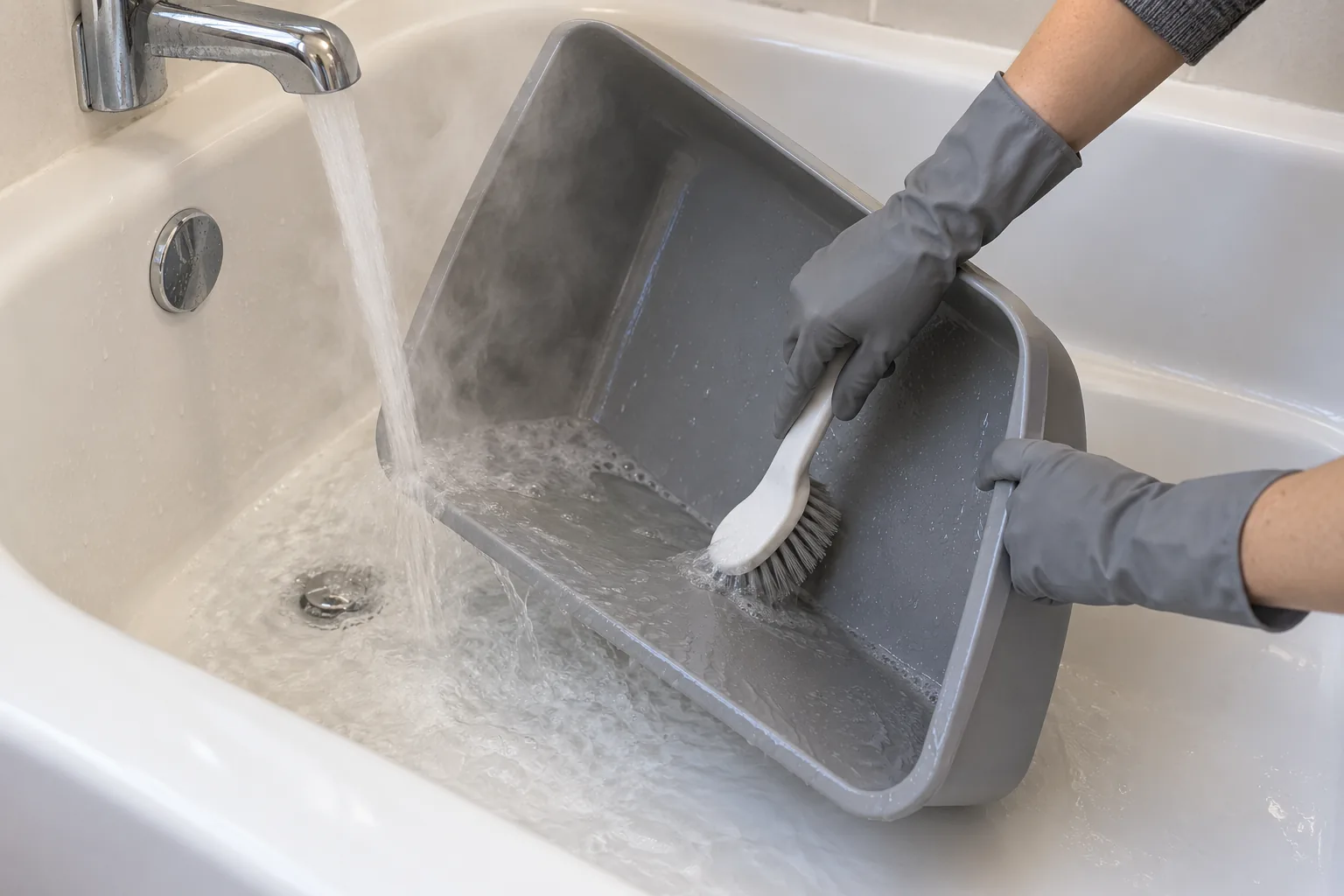
One to two weeks is where the first three overlap. If the box smells before the next change is due, even with two scoops a day, bring the change forward. Non-clumping litter needs emptying every 2 to 3 days, says San Diego Humane Society, because only the solids lift out.
Wash with hot water. On soap the sources split: the 2021 AAHA and AAFP guidelines say to avoid it, the AAFP and ISFM allow soap and hot water, and Cornell and iCatCare call for a mild detergent. Either way, rinse until nothing smells of soap and dry the box before refilling. Skip bleach, ammonia and citrus cleaners: Heath’s review notes that ammonia and chlorine smell clean to people but can signal urine to a cat.
Plastic holds on to odor. Nebraska Humane Society suggests a sniff test: if the washed, empty box still smells to you, it smells to your cat. Cornell says to replace a box that smells or has cracked. With no yard or hose, the step-by-step litter box cleaning guide walks through the full wash and when a box is past saving. The free litter box cleaning tracker has room for a month of scoops and every full change.
Why a litter box smells like ammonia
That sharp, eye-watering smell is urine. The ASPCA notes that urine contains ammonia, and Whisker, the maker of the Litter-Robot, puts the telltale ammonia scent down to urine breaking down in the box. So it builds with time: clumps left past a day, wet litter packed at the bottom of the pan, a full change that slipped past two weeks.
The fix is taking the urine away, not covering it. Scoop daily, empty and wash the whole box on schedule, and check the corners and floor of the pan for clumps that stuck. Then wash without ammonia: Cornell and the AAFP and ISFM warn that, to a cat, an ammonia cleaner smells like urine, and the ISFM’s 2019 guidelines add that ammonia and chlorine can signal to a cat that another cat urinated there.
When the litter box smells like ammonia and nothing in your routine changed, look at the urine itself. More or larger clumps, accidents outside the box or blood are reasons to call your vet, and a cat that strains and passes little or nothing needs one right away.
Choose unscented clumping litter, 1 to 2 inches (2.5 to 5.1 cm) deep
Clumping litter turns urine into lumps you can lift out, so each scoop removes the urine along with the stool. The AAFP and ISFM, Cornell and iCatCare all describe the litter most cats prefer as fine, sand-like, unscented and clumping; our page of cat litter types compared has the evidence, and the eco-friendly litter comparison covers the plant and paper kinds. Shoppers chase something else. In a UK survey published in 2025, 42.9% of owners picked their litter mainly for odor control, though the AAFP and ISFM warn that cats often find scented litter and deodorizers offensive. If odor control is your aim, San Diego Humane Society says clay tends to control odor best without added fragrance. The odor-control litter comparison puts eight unscented litters side by side on the evidence behind each maker’s claim.
Piling the litter deep does not stretch the time between cleanings. Nebraska Humane Society suggests about 2 in (5 cm) and says more litter does not mean less scooping. Cornell gives about 1 to 2 in (2.5 to 5.1 cm), and the AAFP and ISFM set the floor at 1.25 in (3 cm). Self-cleaning boxes are the exception: they fill to a line their maker sets, given model by model in what litter to use in an automatic litter box. The cat measuring tool checks your depth against those figures and, given your box’s length and width, estimates the liters a month that a 1 to 2 week change cycle uses. On a fourth-floor walk-up, that is weight you carry.
Litter box odor eliminators, powders and liners
The AAFP and ISFM guidelines advise against deodorizing powders and plastic liners, and add a line to remember in the store aisle: nothing on the shelf replaces regular cleaning.
Liners make the full change quicker, but Nebraska Humane Society says most cats do not like how they feel, and Cornell agrees that many object.
What is in a litter box deodorizer?
Baking soda splits the sources. San Diego Humane Society says many cats tolerate it, while the AAFP and ISFM put deodorizing powders on their avoid list. None of the guidelines we read tested baking soda, charcoal filters, air purifiers or odor eliminator sprays against litter smell, so we cannot say they work. If you try baking soda, use it in one box and watch the cat. The AAFP and ISFM read a cat balancing on the rim with only one or two feet inside as a possible sign of litter aversion.
If you still pick up a litter box deodorizer, read what it adds. Arm & Hammer builds its Super Scoop litter around baking soda, Purina sells its Tidy Cats Free & Clean range as powered by activated charcoal, and Van Ness fits a replaceable zeolite filter to its Giant enclosed pan. A litter box deodorizer can also mute the smell that tells you the box is overdue for scooping or a wash, which hides the cleaning problem rather than fixing it. Those are the makers’ own descriptions; the pages we read give no odor test results to compare them by.
Air fresheners belong on the avoid list too. The iCatCare guidelines ask owners to avoid heavily scented products around cats, naming incense, scented candles and strong cleaning agents. A plug-in beside the box lays perfume over the urine. The urine stays.
No oil diffusers, no strong cleaners near the box. Cats break down some essential oil compounds poorly, according to the Merck Veterinary Manual, which advises keeping pets out of any room where a diffuser runs. A studio has no other room, so leave diffusers out of the home. Store bleach, ammonia cleaners and oils away from the litter and the bowls, and if your cat may have licked one, call a vet or a pet poison helpline right away.
What to look for in a litter box for odor control
No guideline or study we found compared litter boxes for smell, so the best litter box for odor control is the one that makes scooping and washing easy and that your cat keeps using. Four features decide that:
- An open top, unless your cat clearly prefers a hood: the next section explains why a cover keeps the smell in with the cat.
- Hard, smooth plastic you can scrub, and a fresh box once the old one stops coming clean, as Cornell advises for any box that smells or cracks.
- No liner, which most veterinary guidelines advise against because many cats dislike the feel.
- A built-in filter only as a bonus: the zeolite filter on Van Ness’s Giant pan, mentioned below, comes with no figure for how much odor it removes.
Self-cleaning boxes rake waste away after each visit, which sounds like the answer, but no veterinary guideline takes a position on them and many are enclosed. For a cat too long for a standard pan, our large litter box comparison lists open boxes by length.
Does a covered litter box smell less?
To you, until you lift the lid. Cornell notes that people like covers for cutting odor and stray litter, but for the cat a cover holds the odor in, and the AAFP and ISFM point out that an open box avoids trapping it. In the one controlled study, cats used covered and open boxes about equally, yet those boxes were far larger than store models and were scooped every day.
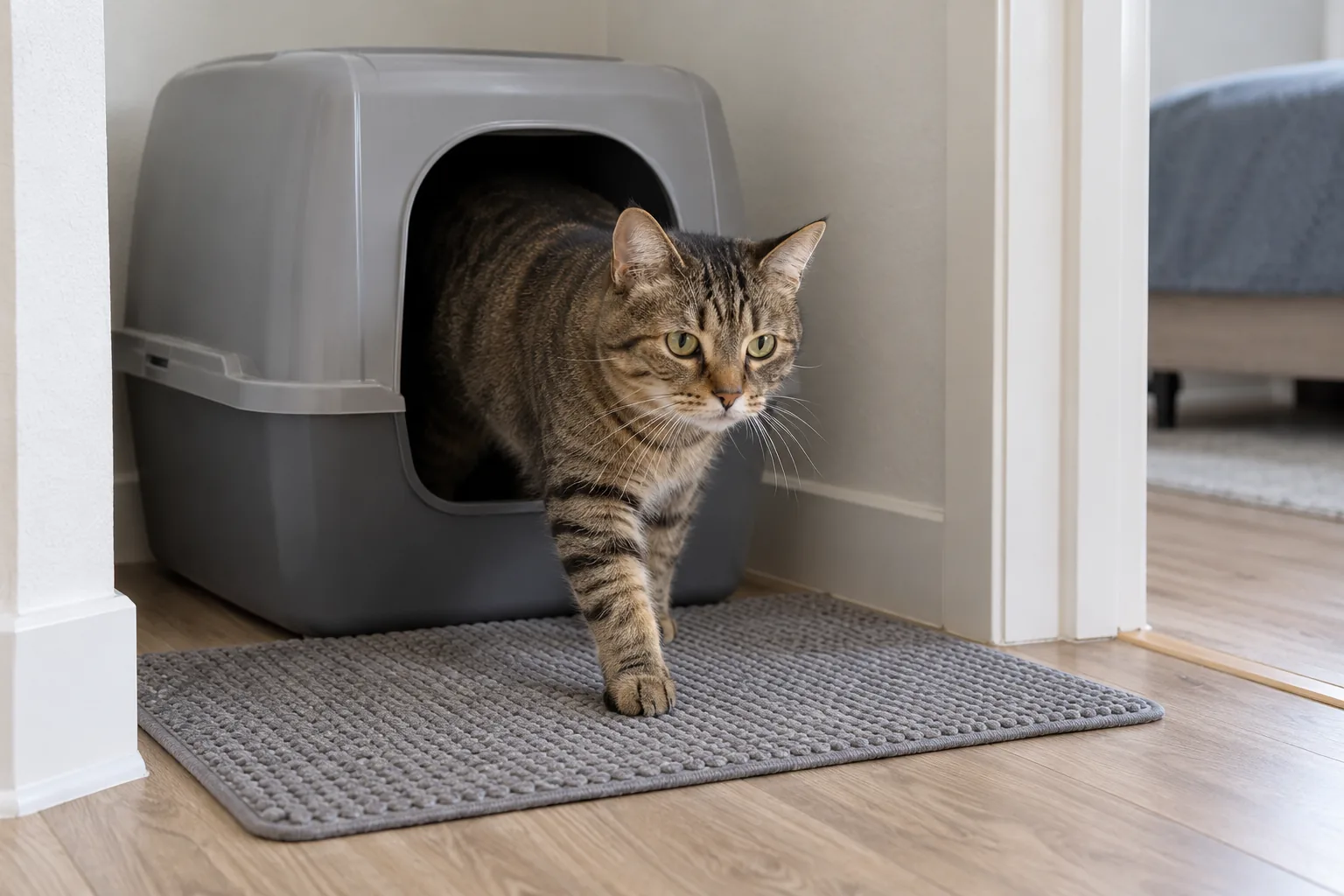
Daily scooping is the catch. Behaviorist Mikel Delgado, in a 2024 article for the AVSAB, cites an older study in which covered boxes were cleaned only about every five days. Use an open box if your cat accepts one. If it clearly prefers a hood, scoop it just as often and remove any door flap, which San Diego Humane Society says traps odor in with the cat. Our litter box sizes and styles page compares the designs.
Box size, a second box and where they go
Size affects smell as well as comfort. The AAFP and ISFM say many store-bought boxes are too small unless soiled litter comes out at least every 2 hours to stop odor building up. A second box helps too. The 2021 AAHA and AAFP guidelines count one per cat plus one, so a single cat’s waste is split between two boxes in separate spots. The same measuring tool checks box length and count, and if your box passes, look to the routine first.
Placement is mostly about the cat. Cornell says most cats want a quiet, private spot away from their food that they can reach at any hour, which rules out a closet whose door can swing shut overnight. Our guide on where to put a litter box in a small apartment covers the spots that work.
When the smell is not coming from the box
A clean box in a smelly apartment points elsewhere: behind the box, a bath mat, a pile of laundry, a sprayed patch low on a wall. Clean those spots without ammonia or vinegar, which Cornell says smell like urine. Then ask why it happened, because urine outside the box is a health question before it is a cleaning one.

When to call the vet. Ask your vet before you change the litter or the box if the smell turns much stronger while your routine stays the same, if you find more or bigger urine clumps than usual, or if your cat starts going outside the box. Cornell lists urinary disease, kidney and thyroid problems and diabetes among the causes of house soiling, and notes that cats with medical problems may not act sick. We found no source that ties a particular smell to a particular illness, so let the vet judge. A cat that strains in the box and passes little or no urine, most often a male, needs a vet at once: Cornell warns that a full blockage can kill in less than 24 to 48 hours.
Questions about litter box smell
How do I get my house to stop smelling like cat litter?
Fix the box before the air. Scoop twice daily, bag the clumps and take them out with the trash, then empty and wash the box on the 1 to 2 week cycle where the guidelines overlap. If a freshly washed box still leaves a smell in the room, look for urine outside it or for old plastic.
How do I get rid of used cat litter in an apartment building?
Small bags, taken out often. Knot each scoop’s clumps in a bag, keep it in a lidded bin, and carry it down with your trash instead of saving a week’s worth in a studio. Split a full change into bags light enough to lift, and check your building’s rules on chutes and bins.
What can I put in my litter box to make it smell good?
Ideally nothing that smells good to you. Veterinary guidelines advise against scented litter and deodorizing powders, which many cats find offensive, though San Diego Humane Society says many cats accept plain baking soda. What every source agrees on is fresh, unscented clumping litter and waste taken out at least once a day.
Why does a litter box suddenly smell so bad?
Check the routine first: a missed scoop, a full change that drifted past two weeks, or an old box that has started holding odor. If none of those changed, call your vet, more so if you also see extra urine clumps or accidents. Straining with little or no urine is an emergency.
What gets rid of an ammonia smell in a litter box?
Removing the urine that makes it: scoop every day, change all the litter and wash the empty box on schedule, and scrape out any clumps stuck to the pan. Clean with hot water and a little mild soap, never an ammonia cleaner, which smells like urine to a cat. Powders only hide it.
What is the best litter box for odor control?
None has an odor test behind it in the sources we read. Pick an open box big enough for your cat, in hard plastic you can scrub, and replace it once it holds smell, as Cornell advises. Scooping every day does more for the smell than any hood or filter.
What kills cat urine smell permanently?
Speed does more than any one product. Cornell says cleaning works best soon after a spot is soiled, and the odor has to be neutralized rather than masked to get past a cat’s nose. The AAFP and ISFM note that urine removal products vary widely in how well they work, and none of our sources names a permanent fix.
How do I protect rental carpet under a litter box?
Give the box a waterproof base. Set it on a tray or washable mat wider than the box on every side, and lift the whole setup at each full change to check the carpet underneath. If urine reaches the fibers, clean it that day and skip ammonia and vinegar cleaners: Cornell warns both smell like urine.
Next step. If the routine is right and the smell stays, odor-control litters compared checks the test behind each claim.
Sources
- AAFP and ISFM, “Guidelines for Diagnosing and Solving House-Soiling Behavior in Cats,” Journal of Feline Medicine and Surgery, 2014, journals.sagepub.com, read Oct 16, 2026.
- Cornell Feline Health Center, “Feline Behavior Problems: House Soiling,” vet.cornell.edu, read Oct 16, 2026.
- International Cat Care, “2025 iCatCare consensus guidelines on the diagnosis and management of lower urinary tract diseases in cats,” PubMed Central, read Oct 16, 2026.
- AAHA and AAFP, “2021 Feline Life Stage Guidelines: general litter box considerations,” aaha.org, read Oct 16, 2026.
- Cornell Feline Health Center, “Feline Lower Urinary Tract Disease,” vet.cornell.edu, read Oct 16, 2026.
- Heath, “Unacceptable indoor elimination,” Journal of Feline Medicine and Surgery, 2019, journals.sagepub.com, read Oct 16, 2026.
- Delgado, “What does the science say about cats and covered litter boxes?,” American Veterinary Society of Animal Behavior, 2024, avsab.org, read Oct 16, 2026.
- Taylor and others, “Feline management practices and resource provision in the UK,” Veterinary Record, 2025, PubMed Central, read Oct 16, 2026.
- Nebraska Humane Society, “Litter Box Set-Up,” nehumanesociety.org, read Oct 16, 2026.
- San Diego Humane Society, “Litter Boxes 101,” sdhumane.org, read Oct 16, 2026.
- Merck Veterinary Manual, “Toxicoses From Essential Oils in Animals,” merckvetmanual.com, read Oct 16, 2026.
- ASPCA, “Litter box problems,” aspca.org, read Oct 17, 2026.
- Whisker, “Best litter for the Litter-Robot,” litter-robot.com, read Oct 17, 2026.