


This cat food calculator turns your cat’s weight and the calories printed on your food into a starting range: calories a day, then grams, cups or cans, split into meals and, if you use one, the setting for an automatic feeder. It uses the resting energy formula from veterinary nutrition guidelines, and it works everything out in your browser, sending nothing anywhere.
Apartment Cats earns a commission when you buy through the Amazon links on this page, at no cost to you. Picks are made on published specs, never on commission. How this works
The calculator needs JavaScript. By hand: weight in kg to the power 0.75, times 70, times AAHA’s factor for your cat (below), divided by the kcal per cup or per can on your label.
What to buy for this answer
Timed feeders from our feeder guide, each with the portion size its maker publishes. Once your food’s calories are in, every card shows its setting for your cat, and the ones whose whole portions add up to your meals are marked.
PETLIBRO Granary Automatic Feeder 3L

- What it is
- A timed dry-food feeder set with buttons, no app: a 3 L hopper, up to six meals, from 1 to 50 portions in each.
- Its portion
- About 1/12 cup (20 mL), measured by volume, PETLIBRO’s help center says.
- Your setting
- Shown by the calculator above.
- Skip if
- You want to move meals around from your phone; this model is programmed on the feeder.
Details
Product prices and availability are accurate as of the date/time indicated and are subject to change. Any price and availability information displayed on Amazon.com at the time of purchase will apply to the purchase of this product.PETLIBRO Granary Smart Feeder 5L (Wi-Fi)
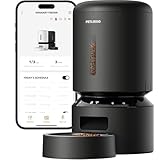
- What it is
- The app version: a 5 L hopper on 2.4 or 5 GHz Wi-Fi, with alerts for low food, a blockage or a weak battery.
- Its portion
- The same 1/12 cup (20 mL) by PETLIBRO’s help center; its product page puts it near 10 g.
- Your setting
- Shown by the calculator above.
- Skip if
- Your Wi-Fi drops often: on batteries alone its Wi-Fi switches off, though the timed meals keep running.
Details
Product prices and availability are accurate as of the date/time indicated and are subject to change. Any price and availability information displayed on Amazon.com at the time of purchase will apply to the purchase of this product.PetSafe FlexFeed Automatic Pet Feeder

- What it is
- A timed dry-food feeder with a locked button panel and no app, holding 8 cups (2 L), with up to eight meals.
- Its portion
- Each meal takes 1 to 15 portions, and one portion is about 1/15 cup (15 mL), its manual says, the finest step in this set.
- Your setting
- Shown by the calculator above.
- Skip if
- Your kibble is smaller than 1/4 in or larger than 1/2 in, the range PetSafe gives for its chute.
VOLUAS Automatic Feeder 4L

- What it is
- A timed dry-food feeder with an LCD screen and a lock button, no Wi-Fi: a 4 L hopper and up to four meals.
- Its portion
- Between 6 and 7 g by its user manual, changing with the kibble, so VOLUAS suggests weighing a few test portions. The calculator uses 6.5 g.
- Your setting
- Shown by the calculator above.
- Skip if
- Four meals are too few for your plan, or the kibble is bigger than the 10 mm (0.39 in) its manual allows.
Details
Product prices and availability are accurate as of the date/time indicated and are subject to change. Any price and availability information displayed on Amazon.com at the time of purchase will apply to the purchase of this product.How the cat food calculator works it out
Four steps, in the order a veterinary team would take them:
- Resting energy: the weight in kilograms raised to the power 0.75, times 70. The AAHA’s 2021 nutrition guidelines and the Merck Veterinary Manual both use this formula.
- Life stage factor: AAHA multiplies that by 1.2 to 1.4 for a spayed or neutered adult and by 1.4 to 1.6 for an intact one. Indoor or sedentary pets may need less, AAHA adds, so a cat that mostly rests gets 1.0 to 1.2.
- Your food: the day’s calories over the label’s kcal per kg give grams, over kcal per cup give cups, and over kcal per can give cans. Two foods split the calories, never the volume.
- Meals and feeder: the day divided by your meals, and for a feeder, whole portions per meal that keep the day inside the range.
For adults between 1 and 7 kg (2.2 and 15.4 lb), the calculator also shows WSAVA’s chart for that weight as a second opinion. WSAVA builds it from two older NRC formulas, one for lean cats and one for cats prone to gain, and its figures tend to sit at the low end of AAHA’s neutered range or just under it. Seniors keep the adult factors: the AAFP’s 2021 senior care guidelines say cats of 7 to 11 need fewer calories and cats from 12 need more, but they publish no factor to calculate with.
The label and the scale come first
Every source behind this cat calorie calculator calls its answer a place to start. Merck notes that a cat may need as much as 30 percent more or less than the formula gives, and AAHA says to adjust the amount by watching body weight and body condition. So weigh your cat on the same scale now and then, and bring the numbers to each checkup.
Use the figures printed on your own food. AAFCO requires the calorie content on cat food labels, treats included, and two foods that look alike can differ a lot per cup. Treats come out of the same day: AAHA’s guidelines keep them and other extras at 10 percent of the calories or less. If the label’s feeding chart and the calculator disagree, ask your vet which to follow for your cat.
Vet note. The calculator shows no amounts for kittens, for a cat that is pregnant, nursing, unwell or on a prescribed diet, or for a cat that should lose or gain weight. Those plans belong to your vet: VCA says the veterinary team works out the calories for weight loss, and Cornell’s Feline Health Center warns that feeding a cat too little risks hepatic lipidosis, a life-threatening fatty liver. Never cut meals or put a cat on a fast to slim it down.
Setting an automatic feeder from the answer
Feeders count in portions, not calories. PETLIBRO’s help center explains that its portion is set by volume, so its weight changes with the kibble, and VOLUAS suggests weighing a few test portions. Weigh ten portions on a kitchen scale, divide by ten and enter that, or pick the portion in cups from the feeder’s manual.
The calculator then looks for a whole number of portions per meal that keeps the day inside the range. When a meal comes out smaller than one portion, it suggests fewer meals; when the meals do not split into whole portions, it names the nearest meal count that does. The AAFP favors several small meals, while Cornell says one or two suit most adult cats, so either way is a reasonable starting plan. The timed feeders above hold dry food only, and our guide to choosing an automatic feeder compares their power, hoppers and kibble sizes.
Cat food questions, answered from the guidelines
How many calories should a cat eat?
It depends on weight, neutering and activity. Veterinary guidelines start from resting energy, 70 times the weight in kilograms to the power 0.75, then apply a life stage factor, which AAHA gives as a range for each kind of adult. Enter your cat above to see its range, and let its weight over the following weeks confirm it.
How much wet food should a cat eat?
Divide your cat’s calories for the day by the kcal in one can or pouch, which the label gives; the answer is the cans or pouches it needs. Brands differ widely, so never copy another cat’s count. Feeding wet and dry together, split the calories first, then work each food out from its own label.
How many calories are in a can of cat food?
It varies by brand, recipe and can size, which is why the label matters more than any average. AAFCO requires cat food labels to state their calorie content, usually as kcal per kg and kcal per can or cup. Copy the figure from your own can into the calculator rather than a typical value found online.
How much should I feed a kitten?
Follow the label on a kitten or all life stages food, and ask your vet at each kitten visit. Cornell’s Feline Health Center says kittens need more food per pound than adults and usually eat three meals a day until six months, then two until about a year. This calculator gives kittens no amounts.
Is half a cup of dry food enough for a cat?
It could be too much or too little, because a cup of one dry food can hold far more calories than a cup of another. Find the kcal per cup on your bag, enter it with your cat’s weight above, and compare. A cat that slowly gains or loses weight on any amount needs a vet check.
Sources
- AAHA, 2021 Nutrition and Weight Management Guidelines: weight reduction in the obese pet (Box 1, energy requirement calculations). Read Oct 22, 2026.
- AAHA, 2021 Nutrition and Weight Management Guidelines: feeding plans for healthy, appropriate weight cats and dogs. Read Oct 22, 2026.
- Merck Veterinary Manual, Nutritional requirements of small animals (Sherry Lynn Sanderson, full review Nov 2023). Read Oct 22, 2026.
- WSAVA Global Nutrition Committee, Calorie needs for an average healthy adult cat in ideal body condition (July 2020). Read Oct 22, 2026.
- Cornell Feline Health Center, How often should you feed your cat? Read Oct 16, 2026.
- AAFP, 2021 AAFP Feline Senior Care Guidelines, Journal of Feline Medicine and Surgery. Read Oct 16, 2026.
- VCA Animal Hospitals, Creating a weight reduction plan for cats. Read Oct 22, 2026.
- Feeder portions from the makers: PETLIBRO help center, PetSafe FlexFeed manual and VOLUAS user manual. Read Oct 16 and 22, 2026.
Related: all the feeding and water guides, automatic feeders, puzzle feeders compared and the weekend-away cost calculator for a trip with a feeder doing the work.