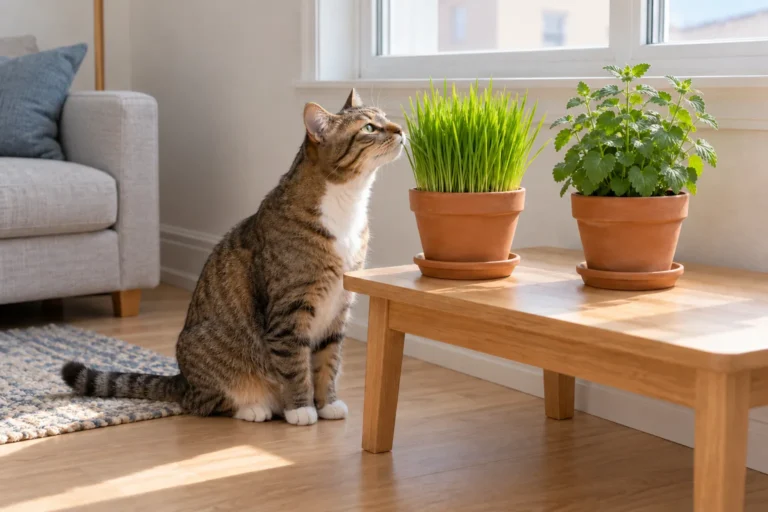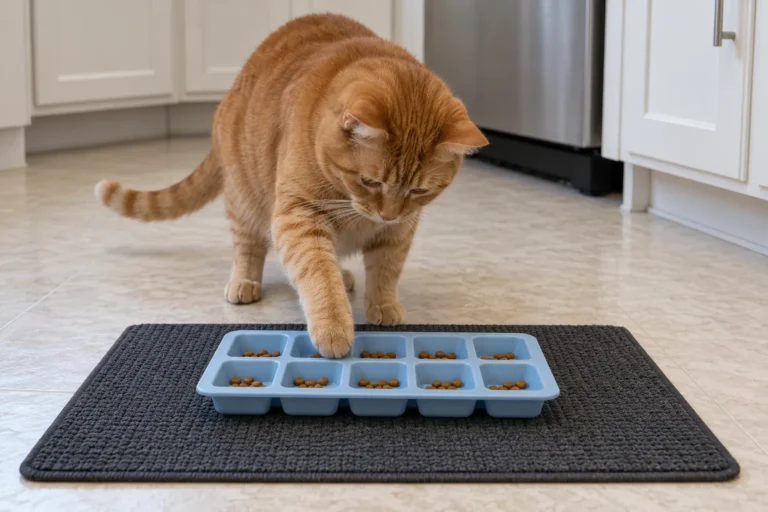

Puzzle feeders for cats come in two working types: mobile puzzles the cat rolls or pushes until food drops out, and stationary boards it paws or licks food from. In a small apartment, buy a stationary board first, since it can stay down overnight without clattering across the floor above your downstairs neighbor’s bed; our pick is the Trixie Fun Board.
Apartment Cats earns a commission when you buy through the Amazon links on this page, at no cost to you. Picks are made on published specs, never on commission. How this works
The short answer for a small apartment
We compared seven bought puzzles from five makers and sorted them by the types in a 2016 review for vets by Leticia Dantas and three colleagues, in the ISFM and AAFP’s Journal of Feline Medicine and Surgery. Six are stationary. One rolls. Not one maker says its puzzle takes wet food.
The Trixie Fun Board is our pick for most small homes. Its five puzzle styles share one 11.8 x 15.7 in (30 x 40 cm) board, so a single footprint gives the mix of types the review wants a cat to end up with, and Trixie lists non-slip rubber feet.
Will it fit? Trixie Fun Board (our pick)

- Footprint
- 11.8 x 15.7 in (30 x 40 cm)
- Height
- 3 in (8 cm), from the Amazon listing
- Type
- Stationary: five games on one base with non-slip rubber feet
- Best for
- A puzzle that stays down overnight, with a neighbor below
- Skip if
- Your only free floor is a gap narrower than 12 in (30 cm)
Details
Product prices and availability are accurate as of the date/time indicated and are subject to change. Any price and availability information displayed on Amazon.com at the time of purchase will apply to the purchase of this product.Other needs, other puzzles:
- First puzzle, tight cornerKADTC Cat Wheel, smaller and dishwasher safe by its maker.$18.90 Price as of Nov 2, 2026, 03:52 UTCCheck price at Amazon
Details
Product prices and availability are accurate as of the date/time indicated and are subject to change. Any price and availability information displayed on Amazon.com at the time of purchase will apply to the purchase of this product. - Daytime meals over a rugPetSafe SlimCat, the one that rolls.$7.95 Price as of Nov 2, 2026, 03:52 UTCCheck price at Amazon
Details
Product prices and availability are accurate as of the date/time indicated and are subject to change. Any price and availability information displayed on Amazon.com at the time of purchase will apply to the purchase of this product. - Wet foodNo maker here lists it, so go homemade.


Key takeaways
- Stationary puzzles take the night shift, as the 2016 review suggests; save a rolling ball for daytime, over a rug. → nights and neighbors
- Levels follow each brand’s own scale; start any new puzzle heaped full, as Dantas and colleagues advise. → difficulty levels
- Swallowable pieces come off before solo play, per the AAFP and ISFM; a puzzle with cracked plastic goes in the trash. → chewable parts
- Fill puzzles from the day’s portion, never extra; if your cat eats less, return the bowl, and phone your vet if meals stay uneaten. → no extra food
Will it fit? KADTC Cat Wheel
- Footprint
- 9.96 x 10.04 in (25 x 26 cm), from the listing; KADTC gives a 10 in (25 cm) track
- Height
- 2.44 in (6 cm), from the listing
- Type
- Stationary: eight sliding pods let food out a few pieces at a time
- Best for
- A first puzzle (Level 1 on KADTC’s own scale)
- Skip if
- Your cat already empties puzzles fast
Details
Product prices and availability are accurate as of the date/time indicated and are subject to change. Any price and availability information displayed on Amazon.com at the time of purchase will apply to the purchase of this product.Will it fit? PetSafe SlimCat
- Footprint
- It rolls. PetSafe gives no size; the listing gives 3.54 x 3.2 x 7 in (9 x 8 x 18 cm)
- Type
- Mobile: a ball with adjustable openings
- Needs around it
- A rug, or the lid of a big storage tote
- Best for
- Daytime meals for a cat that likes a chase
- Skip if
- It would roll at night above a neighbor
Details
Product prices and availability are accurate as of the date/time indicated and are subject to change. Any price and availability information displayed on Amazon.com at the time of purchase will apply to the purchase of this product.Seven cat puzzle feeders compared
Sizes are the maker’s where it prints them and the Amazon listing’s where it does not, marked as such. Food and cleaning are what each maker’s own page states, and a level appears only where someone printed a number.
| Puzzle | Type | Size | Food, per the maker | Cleaning, per the maker | Level as labeled |
|---|---|---|---|---|---|
| Trixie Fun Board | Stationary, five games | 11.8 x 15.7 in (30 x 40 cm) | Not stated (listing: treats or food) | Not stated (listing: hand wash or top rack) | None given |
| KADTC Cat Wheel | Stationary, sliding pods | Listing: 9.96 x 10.04 x 2.44 in (25 x 26 x 6 cm) | Kibble or treats | Dishwasher safe | Level 1 (KADTC) |
| Catstages Kitty Cube | Stationary, lift-off bones and lids | Listing: 8.7 x 6.61 x 1.85 in (22 x 17 x 5 cm) | Cat food or treats | Not stated | None given |
| Catstages Buggin’ Out | Stationary, pegs and flippers | Listing: 14.38 x 9.5 x 1.26 in (37 x 24 x 3 cm) | Food or treats | No removable parts (listing: wipe clean) | Level 2 (listing) |
| Catstages Rainy Day | Stationary, pegs, wheel and raindrops | Listing: 15.4 x 9.4 x 1.3 in (39 x 24 x 3 cm) | Food or treats | No removable parts (listing: hand wash) | Level 3 (listing) |
| All for Paws Treat Maze | Stationary, maze modules | 13.1 x 8.8 x 3.5 in (33 x 22 x 9 cm) | Treats | Not stated | Adjustable, no number |
| PetSafe SlimCat | Mobile ball | Not given (listing: 3.54 x 3.2 x 7 in, 9 x 8 x 18 cm) | Dry food or treats | Top rack dishwasher safe | Adjustable holes, no number |
Two gaps run through the table. No maker publishes a noise figure, so none of these can be ranked for noise. And Outward Hound, which makes the Catstages puzzles under the Nina Ottosson name, gives two different capacities for the Kitty Cube on a single product page; capacities stay off this page anyway.
Types of puzzle feeders for cats, as vets describe them
Dantas and colleagues define a food puzzle as anything that holds food and lets it out when the cat works at it, then sort puzzles two ways: mobile or stationary, dry food or wet. Mobile ones are balls, eggs or tubes pushed with a paw or the nose, mostly built for dry food or treats. Stationary ones run larger, with holes, cups or channels on a firm base. Dry pieces get hooked out with a paw. Wet food sits in wells the cat licks clean, which the review likens to working meat off a bone.

Cats differ. In one two-cat home from the review’s case table, the older cat chose stationary puzzles and the younger one the rolling kind. Puzzles serve the third of the five pillars the AAFP and ISFM set for every cat’s home, the chance to play and hunt; the enrichment hub covers the rest.
Rolling or stationary: nights, neighbors and floor space
The review answers night noise directly: stationary puzzles at night, or rolling ones kept to rooms away from the bedroom. A studio has no such room. Below you there is usually a neighbor, for whom a hard plastic ball knocking across a wood floor after midnight is a ceiling problem. So the board takes the night shift and the SlimCat works days, over a rug.
For a rolling ball, the review’s list of places to confine a puzzle includes the lid of a large storage tote, which keeps kibble off the rug and the ball out from under the stove. The authors name the cost: a small arena makes food easier to reach and cuts how far the cat moves, and the sides of a tub or bin are hard on an older, stiff cat.
By the figures in the table, the Kitty Cube is the smallest stationary puzzle here at 8.7 x 6.61 x 1.85 in (22 x 17 x 5 cm) overall, and the Trixie takes the most floor at about 185 sq in (1,194 cm²). Buggin’ Out and Rainy Day are barely over an inch tall, so they store flat in a drawer. Short on floor? The 30 enrichment activities sorted by floor space include several that need no puzzle.
Dry or wet: what goes in a cat food puzzle
Every maker here names dry food, kibble, treats or plain “food” in compartments sized for pieces, and none mentions wet food. PetSafe specifies treats or dry food; KADTC, kibble or treats; Outward Hound, cat food or treats; All for Paws, treats alone. Trixie’s page names no food, so “treats or food” comes from the listing.
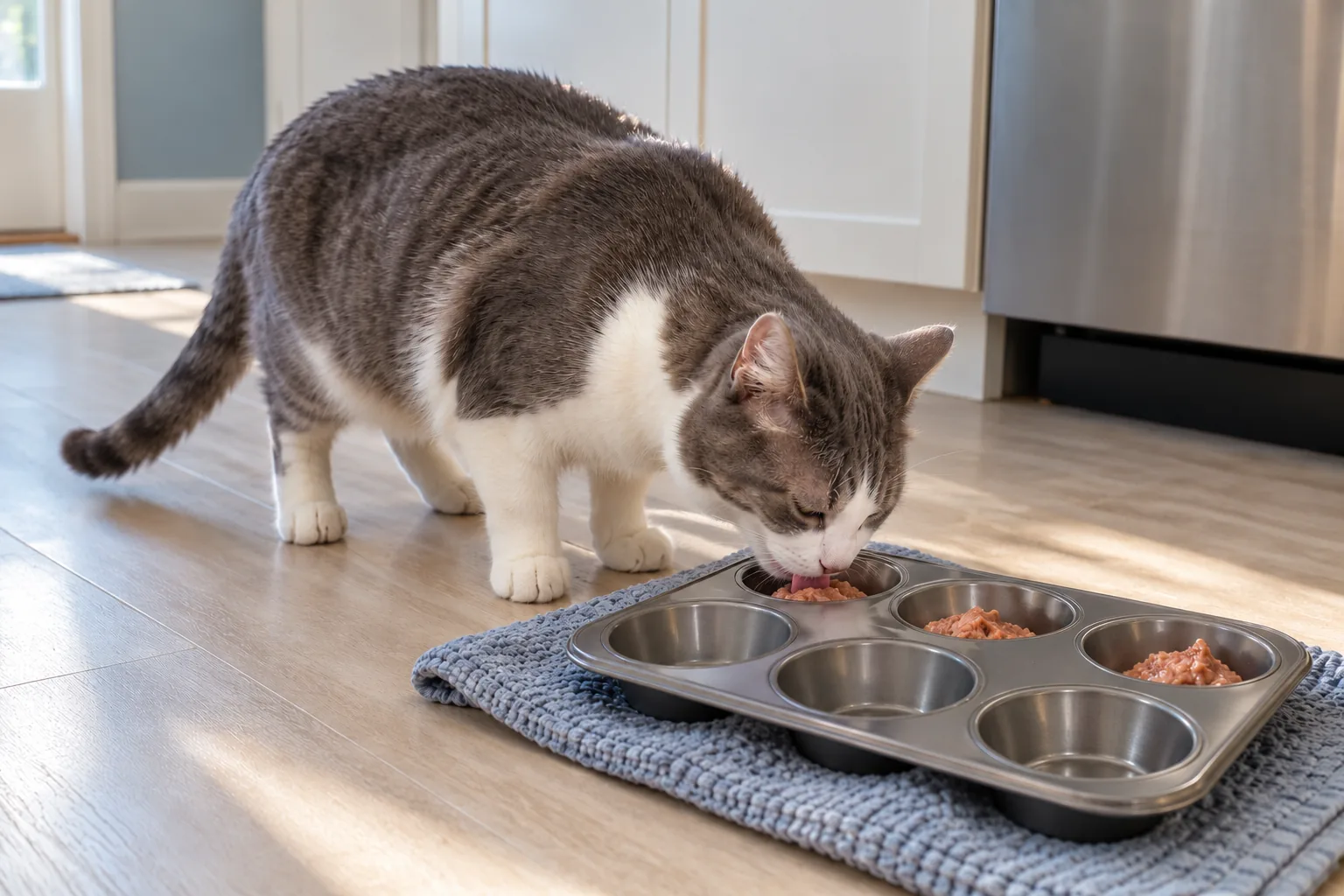
Wet food means homemade. The review suggests an ice cube tray or muffin pan, with yogurt lids over some cups once the open tray gets easy. The DIY cat toys guide covers the tray and builds the toilet paper roll tube and the egg carton puzzle step by step. Wet meals on a timer instead of a puzzle are a separate question, handled in the wet food automatic feeder guide. Two silicone slow-feeder bowls sold for wet food were dropped from our shortlist, because neither maker publishes a product page we could check.
A cat treat puzzle is usually the same object as a food puzzle with a different filling. The review starts with treats to build interest, then moves to the regular dry food or a mix of the two.
Difficulty levels, and whose scale each one is
A level belongs to the brand that prints it; there is no shared standard. Outward Hound explains its Nina Ottosson scale on a page written for its dog games: Level 1 is easy, a one-step solution; Level 2 intermediate; Level 3 advanced, needing two separate actions; Level 4 expert. The Amazon listings put Buggin’ Out at Level 2 and Rainy Day at Level 3, though Outward Hound’s own product pages give no number. KADTC calls the Cat Wheel Level 1 on its own scale. Trixie, All for Paws and PetSafe say only that difficulty adjusts.
Ignore the label at first. Dantas and colleagues want a new puzzle filled to the brim, with big openings and cups heaped over the rim, so the cat barely has to work. Each maker gives its own way to step up:
- Rainy Day: food in the open cups first, then inside the pegs, so the cat has to slide them (Outward Hound).
- Buggin’ Out: base compartments only; the listing adds the sliding cups later.
- Kitty Cube: bones off, then food in only a few cups.
- KADTC Cat Wheel: treats in the pods nearest the outlet, then farther around the ring as the cat learns.
- SlimCat: openings wide, narrowed later.
- Trixie and All for Paws publish no order.
The authors never saw a cat turn fearful or aggressive with a puzzle when the difficulty rose slowly. Even so, they treat puzzles as one part of a wider plan, which the 7-day enrichment plan builder sets around toys you already own.
Cleaning: which makers say dishwasher
Two makers say dishwasher: PetSafe, top rack, for the SlimCat, and KADTC for the Cat Wheel. Trixie’s page says nothing about cleaning, and the listing’s hand wash or top rack line is not the maker’s, so hand wash the board until Trixie says otherwise. Outward Hound notes that Rainy Day and Buggin’ Out have no removable parts; their listings add warm soapy water and a full dry for Rainy Day, a wipe for Buggin’ Out. The Kitty Cube and the All for Paws maze get no method from their makers.
Crumbs are the other chore. Pegs, sliders and covers trap crumbs, so the more parts a puzzle has, the longer it takes to clean. The review’s shortcut for anyone with several puzzles: fill the dry ones once a week and keep them in airtight bins.
Where a cat puzzle feeder goes in a small home
Keep it well clear of the litter box. The 2013 AAFP and ISFM guidelines want toileting kept apart from everything else a cat uses, and the AAFP’s 2018 feeding statement says feeding stations should not be close to litter boxes, though no source gives a distance. In a studio that usually means opposite ends of the room, and the guide to placing a litter box settles where the box goes first.
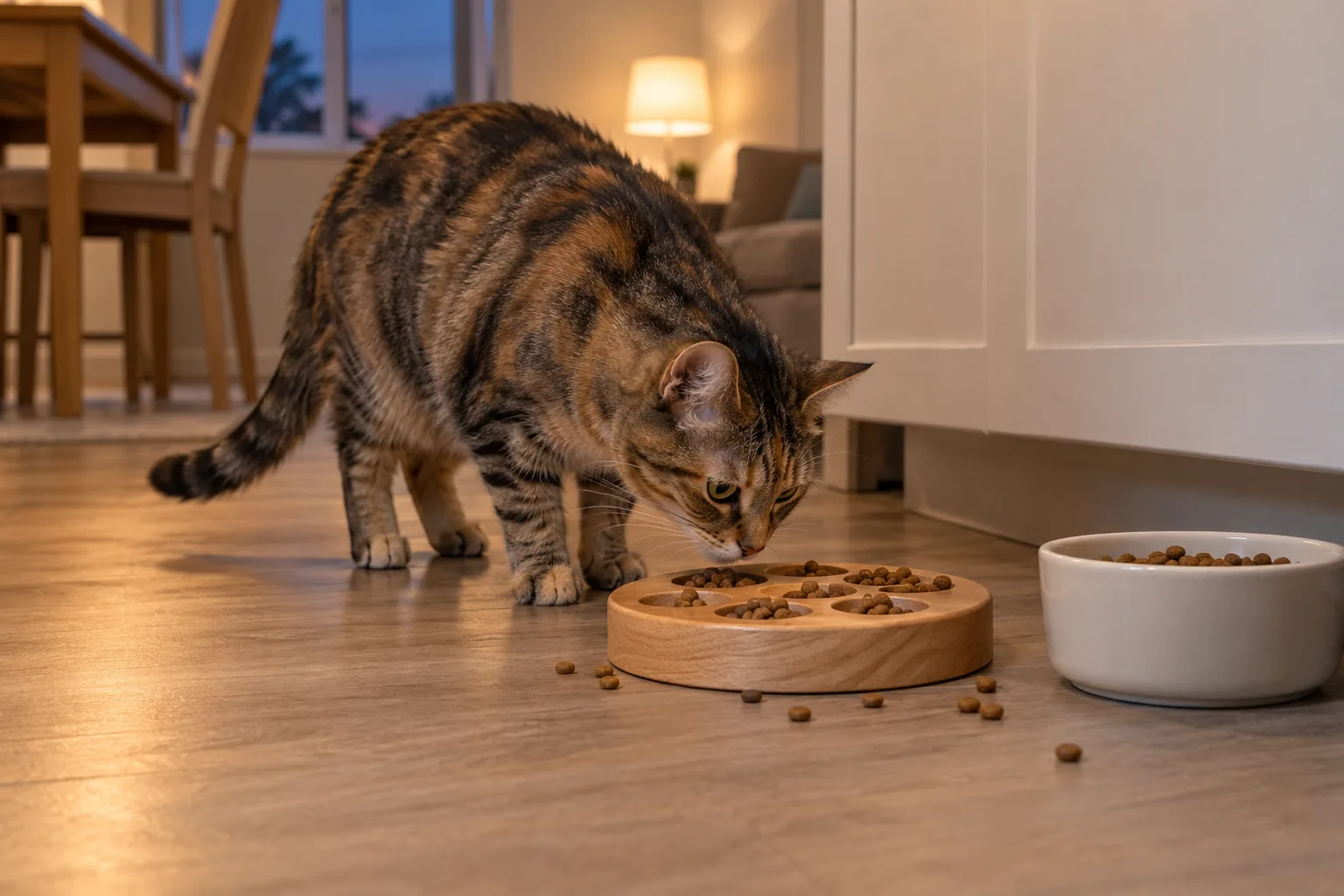
Start the puzzle next to the usual bowl, with the usual food in it, when the cat is likely to be hungry. With dry puzzles the review scatters a few pieces around it and nudges it gently. Nervous cats may prefer a quiet spot to explore undisturbed, the review says.
Parts a cat can chew off. Outward Hound’s pages for Rainy Day and Buggin’ Out tell owners to supervise every session, never leave a cat alone with the puzzle, stop any chewing, check for damage and put the puzzle away once it is empty. Under the 2013 AAFP and ISFM guidelines, anything small enough to swallow comes off a toy before the cat plays unsupervised. Look hard at lift-off pieces such as the Kitty Cube’s bones before any puzzle stays down while you are out, and throw out a puzzle with cracked plastic.
Two cats need two puzzles, so neither competes or eats beside the other, and the review suggests a second copy of any design both cats like. In a shelter study it cites, 23 of 27 group-housed cats (85%) used a puzzle with no rise in fighting. Kittens can begin early: International Cat Care puts puzzle feeding from twelve weeks, with a very simple design.
How much food goes in, and how often
No extra food at all. What goes in a puzzle comes out of the day’s portion, as the label or your vet sets it, and treats count toward it. Maker capacities describe the container, never a meal. For a starting range in your own food, try the cat food calculator and check it with your vet.
How many puzzle meals a day is where vet sources differ. The AAFP’s 2018 feeding statement splits the daily food into several small meals across 24 hours, through puzzle feeders where possible, and notes that cats can spend half of each day finding food. Cornell’s Feline Health Center finds one or two meals a day appropriate for most adult cats, as long as the schedule stays consistent. One answers what fits a cat’s nature, the other what a household can keep up, and a morning puzzle plus an evening one sits comfortably with both. For the hours you are out, the AAFP says automatic feeders can help but do not usually offer foraging; the feeding and water guides compare them.
A puzzle also closes a play session well. AAHA and the AAFP and ISFM guidelines end play the way a hunt ends, with a catch and then food, so a wand game that winds down onto the toy, then the evening puzzle, gives the whole sequence. The cat toys page covers the wand half.
When to call the vet. PetSafe markets the SlimCat for weight control, and the 2016 review reports weight loss in a few of its cases, but those are case reports looked at after the fact, not trials. A weight-loss plan, a diabetic cat’s meals or any change of diet belongs with your vet. If your cat eats less once a puzzle replaces the bowl, put the bowl back and call your vet if meals keep going uneaten; the AAFP asks owners to check that a puzzle-fed cat really eats what it needs.
Who should skip each puzzle
In the order of the table:
- Trixie Fun Board. Skip it if your free floor is a gap under 12 in (30 cm) wide, or if you want a cleaning method from the maker itself.
- KADTC Cat Wheel. Not for a cat that already solves puzzles fast.
- Kitty Cube. A poor fit for the hours you are at work, since its bones come off by design.
- Buggin’ Out. Wrong for workdays and nights; its maker wants every session supervised.
- Rainy Day. Too hard as a first puzzle at the listing’s Level 3, the highest number here, and the same supervision rule applies.
- All for Paws Treat Maze. Pass if you want the maker’s word on food and cleaning; its page gives the size and adjustable difficulty, little else.
- PetSafe SlimCat. Skip it if it would roll at night over a neighbor, or if you are buying it as a weight plan.
How these puzzle feeders were chosen
Seven puzzles from five makers were sorted by the mobile and stationary types in a 2016 veterinary review, then checked for floor space, named foods, cleaning and printed difficulty levels. Silicone bowls from Bifeaw and Sarnxgr and a CGBD model were left off because none has a maker page. No maker publishes a noise figure, and none lists wet food, so rolling designs are separated by movement, not decibels.
Questions about cat puzzle toys
Are puzzle feeders good for cats?
Feline vets think so, though the evidence is thinner than the enthusiasm. The 2016 review rests on case reports, not trials, and the AAFP’s 2018 statement agrees that puzzles add activity and mental work. The review’s authors never met a cat unable to adapt, including seniors, kittens, blind cats and three-legged cats.
Can a cat food puzzle replace the bowl?
For many cats it can, over time. The review describes moving all the day’s food into puzzles once a cat uses them easily, but starts with the puzzle beside the bowl, not instead of it. Keep to the amount on the label or from your vet, and check it gets eaten.
Can I leave a puzzle down while I am at work?
Not Rainy Day or Buggin’ Out, which Outward Hound says to supervise and store once empty, nor the Kitty Cube with its lift-off bones. Other makers say nothing, so judge the puzzle: no loose parts, no cracks, and it stays put. Wand toys and string go in a drawer before you leave.
Do puzzle feeders attract bugs in an apartment?
No maker or vet source we read mentions pests, so treat a puzzle like a bowl. Dantas and colleagues suggest prefilling dry puzzles weekly and storing them in airtight bins. Once one is empty, pick it up and shake the crumbs out of its pegs and sliders.
How do two cats share puzzles in a studio?
Each cat gets its own puzzle, per Dantas and colleagues, and the AAFP’s 2018 statement notes cats prefer eating alone. In one room, set the two at opposite ends with furniture between them, fill both at once, and keep each clear of the litter box.
Next step. Fit a puzzle into a whole week of play with the enrichment plan builder.
Sources
- Dantas and others, “Food puzzles for cats: feeding for physical and emotional wellbeing,” Journal of Feline Medicine and Surgery, 2016, journals.sagepub.com, read Oct 16, 2026.
- Sadek and others, AAFP consensus statement “Feline feeding programs,” Journal of Feline Medicine and Surgery, 2018, journals.sagepub.com, read Oct 16, 2026.
- AAFP and ISFM, “Feline Environmental Needs Guidelines,” Journal of Feline Medicine and Surgery, 2013, journals.sagepub.com, read Oct 16, 2026.
- Cornell Feline Health Center, “How often should you feed your cat?” vet.cornell.edu, read Oct 16, 2026.
- International Cat Care, “Playing with your cat,” icatcare.org, read Oct 16, 2026.
- AAHA, “How Often Should You Play with Your Cat?” aaha.org, read Oct 16, 2026.
- Trixie Pet Products, “Fun Board Strategy Game,” trixiepet.com, read Oct 16, 2026.
- Outward Hound, “Kitty Cube Puzzle for Cats,” outwardhound.com, read Oct 16, 2026.
- KADTC, “KADTC Cat Puzzle Toy, Slow Feeder, Interactive Enrichment for Indoor Cats,” kadtctoy.com, read Oct 16, 2026.
- Outward Hound, “Buggin’ Out Puzzle & Play Cat Game, Green,” outwardhound.com, read Oct 16, 2026.
- All For Paws, “Puzzle Cat Slow Feeder Treat Maze,” allforpaws.com, read Oct 16, 2026.
- Outward Hound, “Rainy Day Puzzle & Play Cat Game, White,” outwardhound.com, read Oct 16, 2026.
- PetSafe, “SlimCat Interactive Feeder,” petsafe.com, read Oct 16, 2026.
- Outward Hound, “Our Dog Game Difficulty Levels Explained,” outwardhound.com, read Oct 16, 2026.