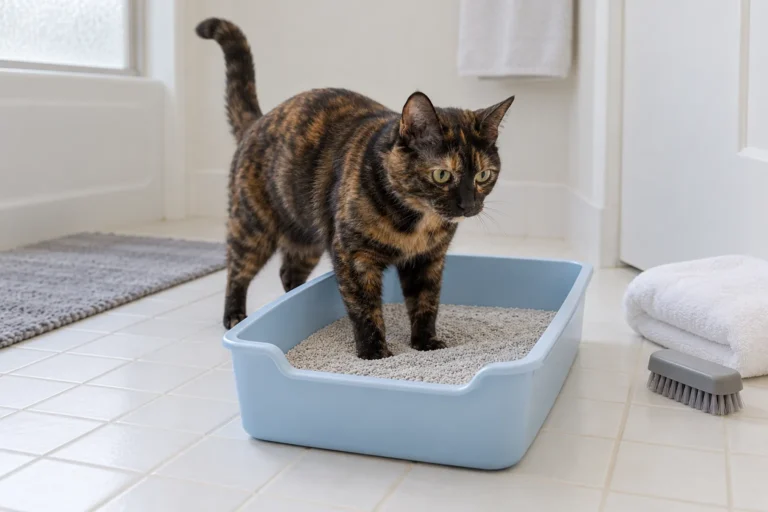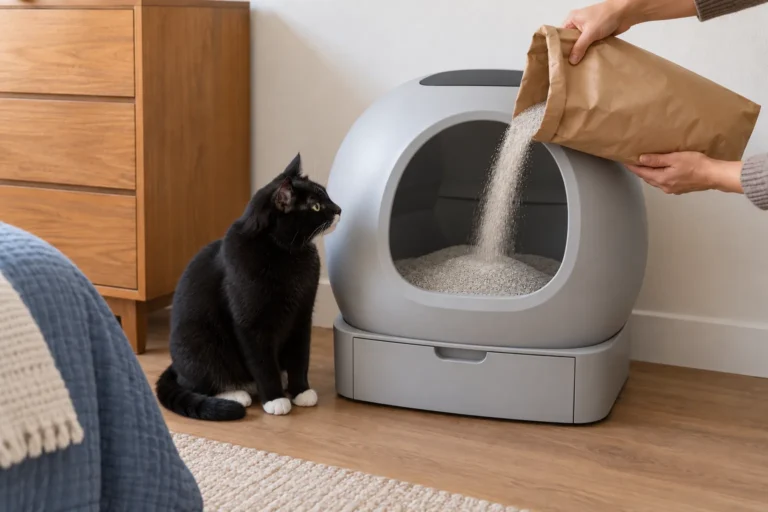

Put the litter box where your cat can reach it at any hour without walking past its food bowl or a running washer. In a small apartment that usually means the bathroom floor, a closet with its door fixed open or a low-traffic corner of the main room, and a single cat needs two boxes in two of those spots.
What you need
- A tape measure for the cat (nose to tail base) and for each spot.
- Two litter boxes for one cat, each at least 1.5 times as long as the cat.
- A rubber door stop or a hook-and-eye latch, so no door can swing shut on a box.
Where to put a litter box in a small apartment, in brief
A good spot passes five tests from the veterinary guidelines:
- Open at any hour. Cornell’s Feline Health Center wants a box the cat can reach 24 hours a day, so no door that can shut on it. An interior cat door keeps a shut one passable.
- Calm and private. Cornell says most cats prefer a quiet, private spot, and the AAFP and ISFM note that some avoid boxes near high-traffic areas.
- A way out. AAHA and AAFP list an escape route in their location advice.
- Apart from food and water. Every guideline we read says so, and none gives a distance.
- Away from loud machines. The AAFP and ISFM link boxes near noisy appliances to cats refusing them.

For one cat in a studio or a one-bedroom, start with the bathroom for the first box and a corner of the main room for the second. Nobody crosses the bathroom on the way somewhere else. The main room is where the cat spends its waking hours.
Key takeaways
- By the AAFP and ISFM minimum, a spot must fit a box 1.5 times your cat’s body length, nose to tail base. → measuring the spot
- Rule out the kitchen, where the bowls usually sit, and the laundry room, which Nebraska Humane Society says to avoid for its machinery. → spots to skip
- Keep the second box apart from the first; if they must be close, the AAFP and ISFM want entries at right angles, never facing. → the second box
- Moving a working box? The AAFP and ISFM say leave it at least 2 weeks, then shift it several inches a day. → moving a box
- Peeing or pooping outside the box calls for a vet visit before any move; a straining male passing little or nothing is an emergency. → the vet note
Step 1: measure the cat, then the floor
A spot only counts if a box of the right size fits on it. The AAFP and ISFM set the minimum length at 1.5 times the cat’s body length, counted from its nose to the base of its tail. AAHA and AAFP measure to the tip of the tail, which gives a longer box, so pick one yardstick and stick with it.
Store boxes run short. A common covered box sold as large is 19.5 in long and 15.25 in wide (50 x 39 cm), going by figures from AVSAB (the American Veterinary Society of Animal Behavior). For something longer, the AAFP and ISFM point to sweater boxes, under-bed storage containers and a 24 x 36 x 8 in (61 x 91 x 20 cm) concrete mixing tray.
Measure each spot at floor level, where baseboards and the base of the toilet take their share. No guideline we found gives a clearance figure for the entry, so let the cat be the gauge: it should step in, turn around and step out without brushing a wall. The cat measuring tool turns your cat’s length into a box length and a box count, and the space-fit planner draws that footprint on your floor spot to scale.
Step 2: check the usual small-apartment spots
The bathroom floor
For the first box, the bathroom is the natural home: a hard floor you can mop, a door, and no one passing through. The usual footprints are the gap between the toilet and the tub, the floor under a wall-hung sink and the far end of the tub. Measure all three. Keep the box clear of the shower’s splash, because wet clumping litter sets into lumps before your cat has used it. Litter carried out on paws lands on the bath mat instead; the litter mats compared page looks at which mats can sit under a bathroom door that swings over them.
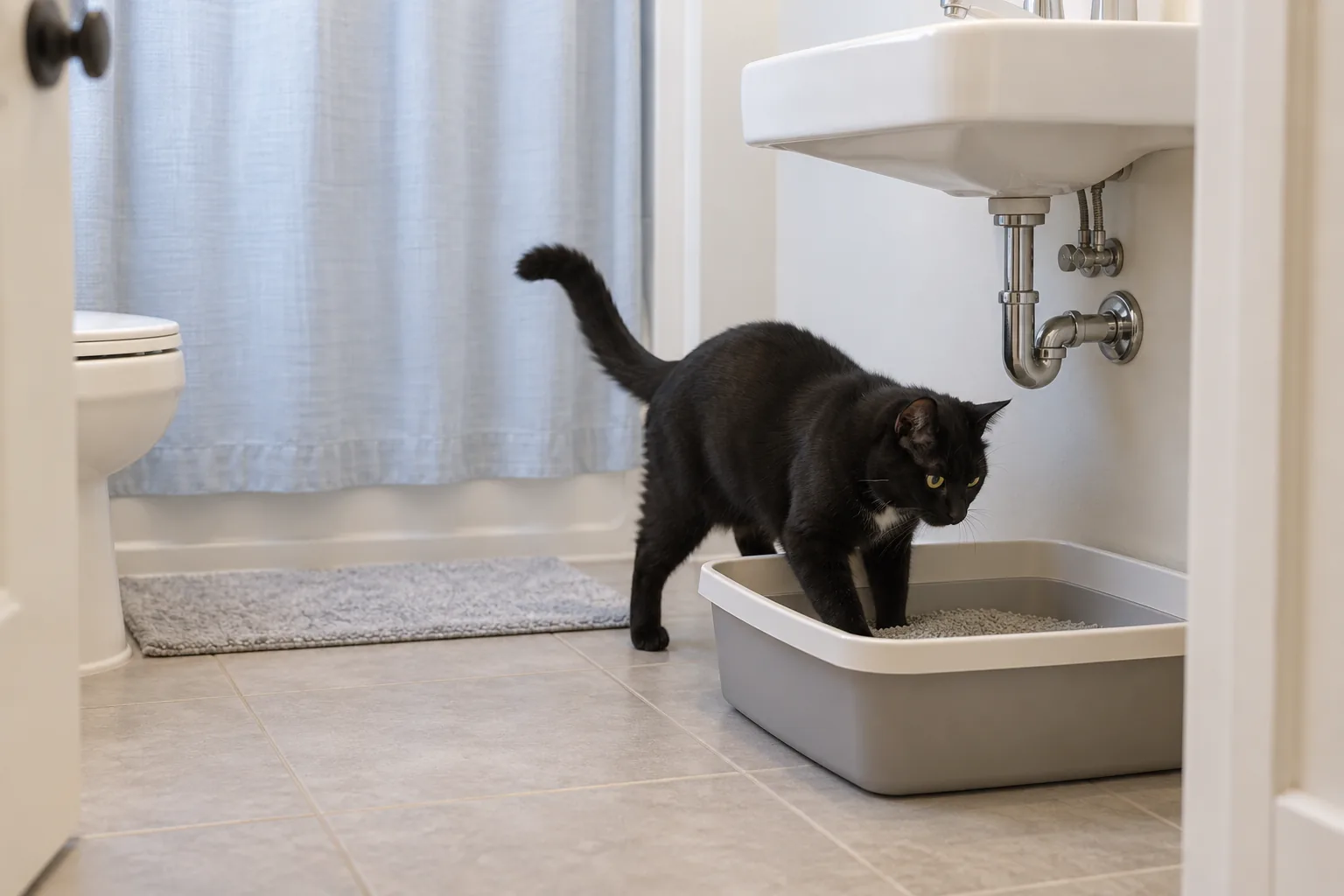
The door is the weak point. Guests close it out of habit, and so do you when you shower; a cat shut out at 3 a.m. has a box it cannot use. Hold the door a few inches open with a rubber door stop, or fit a hook-and-eye latch that stops it closing past the width of a cat.
Keep oil diffusers out of the litter room. A cat with its box in the bathroom is in there several times a day. Merck’s advice is to keep pets out of a room while a diffuser is running, because active diffusers release oil microdroplets that land on fur and get licked off. Run yours where the cat never needs to go.
A closet with the door held open
A hall or bedroom closet hides a box better than any other spot, and that is the catch: a box you cannot see is a box you forget to scoop. An older study cited by AVSAB found covered boxes were cleaned only about once every five days. A closet is a lid the size of a room. If you choose one anyway, set a reminder and follow our guide to scooping and washing the box.
Lift the closet door off its hinges or hook it open so a draft cannot shut it. Set the box with its entry facing out, and move hanging clothes up or away, because fabric over a box takes on its ammonia smell. The guide on keeping a litter box from smelling handles the rest. Cornell’s advice against a box walled in on three sides is aimed at homes where another animal ambushes the cat, so for a single cat with no dog, a closet corner is a fair trade.
A corner of the main room
For the second box, choose the corner farthest from the bowls and off your path between the front door, the kitchen and the bed: the end of a sofa or the side of a bookcase, not beside the desk where you work all day. A folding screen can hide the box from the sofa, as long as one side stays wide open. A self-cleaning box also needs an outlet nearby: measure the corner against each model in the Litter-Robot 3 vs 4 comparison, and check which litters automatic boxes accept before the first bag.
A hallway nook
Down the hall, a dead-end stretch past the closet or an alcove meant for a coat rack can work, because nothing leads past it. A hallway between the bedroom and the bathroom cannot, since you walk it half asleep and the cat would be squatting in your path.
Inside a cabinet or under a table
Litter box furniture, a cabinet or bench with a cat-sized hole in one side, makes a box look like storage. What counts is the length inside. In a 2013 study by Grigg and colleagues, cats used large covered boxes about as often as open ones, with both scooped every day. Only 8 cats showed a clear preference, split 4 and 4, and the study boxes were far longer than most covered boxes in stores. Check the cabinet’s inside length against your 1.5 times figure, not the outside width on the listing.
The AAFP and ISFM still lean toward open boxes, because a mess is easier to see. With a cabinet, open it at every daily scoop. An open box under a console table gives cover without a lid, if your cat can step in without ducking.
Spots to rule out: common litter box placement mistakes
Some spots look tidy on a floor plan and fail once a cat lives with them.
- The kitchen. In a UK survey of 565 cat households, published in 2025, it was the most common tray spot (27.7%), and it is where the bowls usually sit.
- Next to the first box. The AAFP and ISFM count two adjacent boxes as one big one, so a matched pair by the tub does not count twice.
- Up a ladder or stairs. Cornell says not to put the box upstairs or downstairs from a cat that has trouble with stairs, which can rule out a sleeping loft.
- Behind a door you shut on a schedule, such as a bedroom closed every night.
The laundry closet gets its own warning, because at least one guide on Google’s first page for this question, read Oct 15, 2026, lists a laundry room among the best spots. Nebraska Humane Society names it as a place to avoid for its loud, unpredictable machinery, and in the UK survey, 16.0% of households kept a tray within 20 in (50 cm) of a washer or other machinery. A spin cycle beside a squatting cat is a poor match.
Step 3: give the second box its own spot
One cat, two boxes. The 2021 AAHA and AAFP guidelines give each cat a box plus one spare, and the AAFP and ISFM put it plainly for a single cat: two boxes in two separate locations. The same AAFP and ISFM text calls plus-one a historical rule of thumb, not an absolute requirement, and no study we found has tested it. In the UK survey, only 16.9% of households had more trays than cats.
Keep the second box anyway if your floor allows it, since it covers the night the bathroom door gets shut by mistake. If the boxes must sit close, turn them so the entries face different ways; the AAFP and ISFM want nearby openings at right angles or around a corner, never face to face.
Two cats push the count to three. Where cats do not get along, AAHA and AAFP count per social group plus one. A kitten needs its box close and low: Cornell says young kittens need low sides, so keep the box in the room where the kitten spends its time.
Step 4: move a box in use a few inches at a time
The AAFP and ISFM advise leaving a working box in place for at least 2 weeks, then moving it several inches a day toward the spot you want. If the cat stops using it partway, Cornell says to go back to the last spot it used and start again.
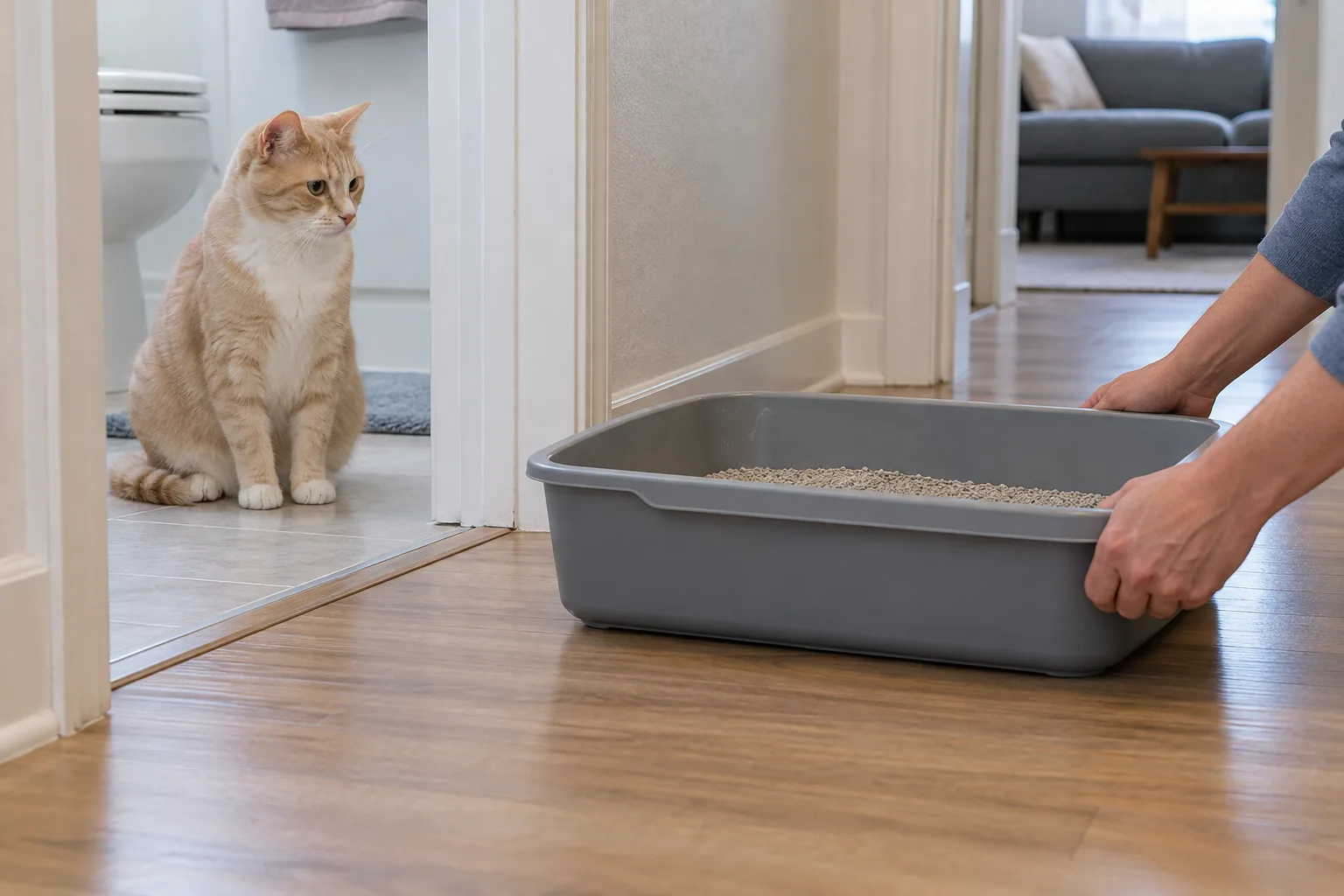
That pace feels silly when the move is from the bathroom to a closet a few steps away. It still beats a soaked rug. In a new apartment the order flips: the box starts in the cat’s first room, and the other spots open up later, as the 3-3-3 rule guide describes.
Vet first if litter habits change. A cat that starts peeing or pooping outside the box needs a vet visit before you move anything. Cornell’s Feline Health Center puts medical causes first, from bladder inflammation to kidney disease, thyroid trouble and diabetes, and a sick cat can look well. If a male cat squats and strains with little or nothing coming out, treat it as an emergency: by Cornell’s account, a total blockage can be fatal within 24 to 48 hours.
Questions about a litter box in a small apartment
Can a cat stay in the bedroom at night without a litter box?
Only if the bedroom door stays open. Cornell’s guidance is a box the cat can reach around the clock. By the AAFP and ISFM count, an average cat goes three to five times a day, so a night shut in with no box leaves it nowhere to go. Put a box in the room or prop the door.
Where is the most sanitary place to put a litter box?
Out of the kitchen, on a hard floor you can wipe, in a spot you pass daily. The scooping matters more than the room: Cornell says Toxoplasma eggs in cat feces need at least 24 hours to become infective. If you are pregnant, ask someone else to scoop and talk to your doctor.
Can I keep the litter box in the bathtub?
Only in a tub nobody showers in. Lifting the box out before each shower leaves your cat without one right then, and any water left in the tub soaks the litter from below. Young kittens are another limit: Cornell says they need low sides, and a tub wall is anything but low.
Can I put the litter box on the balcony?
Keep it indoors. A box out there is usable only while the balcony door stands open, and Cornell asks for access at any hour. Balconies are also where falls start: vets call the injuries high-rise syndrome, and in a 2004 Zagreb clinic study of falls, 59.6% of the 119 cats were not yet a year old.
How far should a litter box be from food and water?
No veterinary source we read gives a distance for inside a home; they only say to keep the two apart. A separate room is the simplest answer. Failing that, use opposite ends of the room with something solid in between, such as a cabinet, the bed or a wall that juts out.
What kind of litter box works for small spaces?
A long, narrow one. The AAFP and ISFM size rule is about length, 1.5 times the cat from nose to tail base, so a compact square box saves floor by being too short. Under-bed storage boxes are long and low, and the litter box guides compare other styles by size.
Next step. With the spot measured, large litter boxes compared lists the longest boxes and the floor each one takes.
Sources
- AAHA and AAFP, “2021 Feline Life Stage Guidelines: general litter box considerations,” aaha.org, read Oct 16, 2026.
- Cornell Feline Health Center, “Feline behavior problems: house soiling,” vet.cornell.edu, read Oct 16, 2026.
- AAFP and ISFM, “Guidelines for Diagnosing and Solving House-Soiling Behavior in Cats,” Journal of Feline Medicine and Surgery, 2014, journals.sagepub.com, read Oct 16, 2026.
- Cornell Feline Health Center, “Feline lower urinary tract disease,” vet.cornell.edu, read Oct 16, 2026.
- Grigg, Pick and Nibblett, “Litter box preference in domestic cats: covered versus uncovered,” Journal of Feline Medicine and Surgery, 2013, PubMed, read Oct 16, 2026.
- Cornell Feline Health Center, “Toxoplasmosis in cats,” vet.cornell.edu, read Oct 16, 2026.
- American Veterinary Society of Animal Behavior, “What does the science say about cats and covered litter boxes?” avsab.org, read Oct 16, 2026.
- Taylor and others, “Feline management practices and resource provision in the UK: a questionnaire-based study of 565 caregivers,” Veterinary Record, 2025, PubMed Central, read Oct 16, 2026.
- Nebraska Humane Society, “Litter Box Set-Up,” nehumanesociety.org, read Oct 16, 2026.
- Merck Veterinary Manual, “Toxicoses From Essential Oils in Animals,” merckvetmanual.com, read Oct 16, 2026.
- Vnuk and others, “Feline high-rise syndrome: 119 cases (1998 to 2001),” Journal of Feline Medicine and Surgery, 2004, PubMed Central, read Oct 16, 2026.