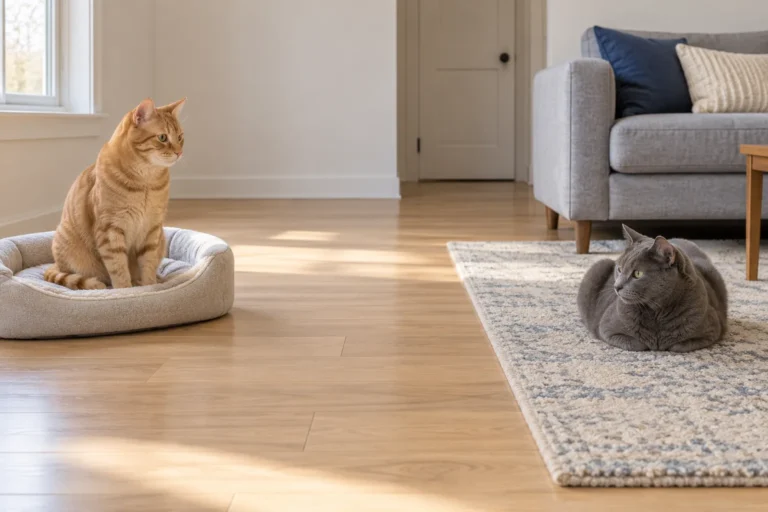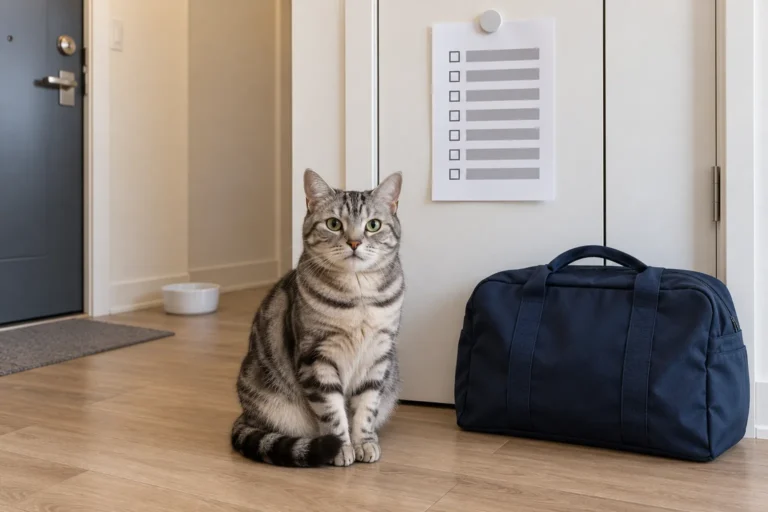

The 3-3-3 rule for cats is a shelter guide to the first months after adoption: about 3 days for a new cat to decompress, 3 weeks to learn your routine and 3 months to start feeling at home. In a small home the first stage happens in a single room, and how you set up that room shapes the next two.
What you need
- One small room with a door that closes. In a studio, that is usually the bathroom.
- A hiding place you can reach: an open carrier or a cardboard box with a towel inside.
- Food, water and a bed for one end of the room, a litter box for the other.
- A scratching post and a few toys the cat can bat around alone.
- Rolled towels or flattened cardboard to block the gap under a bed or behind a tub.
The 3-3-3 rule for cats, in short
Count from the day the cat comes through your door. Shelters use the three numbers to set expectations, not to set a schedule, and the Humane Society of the Pikes Peak Region says plainly that it is “not a strict timeline.” Some cats are curling up on the sofa by the end of the first week. A shy one can need the full three months and more.
| Stage | What you may see, and what helps |
|---|---|
| First 3 days: decompress | Hiding, skipped meals, a missed litter box, yowling at night. Keep the cat in its one room, keep visits short and calm, and let it come to you. |
| First 3 weeks: learn the routine | More time out of hiding, regular use of the box, curiosity about the door. Open the rest of the home one space at a time, at the same feeding and play times each day; on workdays a timed automatic feeder can hold the meal times. |
| First 3 months: feel at home | Scratching, kneading, slow stretches, a relaxed walk across the room. Add new people and pets gradually, and keep the routine steady. |
Key takeaways
- Set up one small room with a door first, and block the space under the bed so you never have to drag the cat out. → room setup
- Hiding and skipped meals are normal early on, yet no food at all after a day or two of hiding means a vet visit. → when to call the vet
- Wait for all four of San Diego Humane’s readiness signs, not just one or two, before opening the next space. → the four signs
- Before the cat roams, close or secure every window it can reach; an ordinary insect screen will not hold its weight. → windows first
Before the cat arrives: set up one room
San Diego Humane Society suggests a small, calm space with a door, such as a bathroom or a small bedroom. In a one-bedroom apartment the bedroom is the obvious pick, but it comes with the worst hiding place in the home: the space under the bed. Block it before the cat goes in, with storage bins, rolled towels or a strip of cardboard along the frame. You want to be able to sit with the cat without dragging it out from somewhere it cannot be reached.
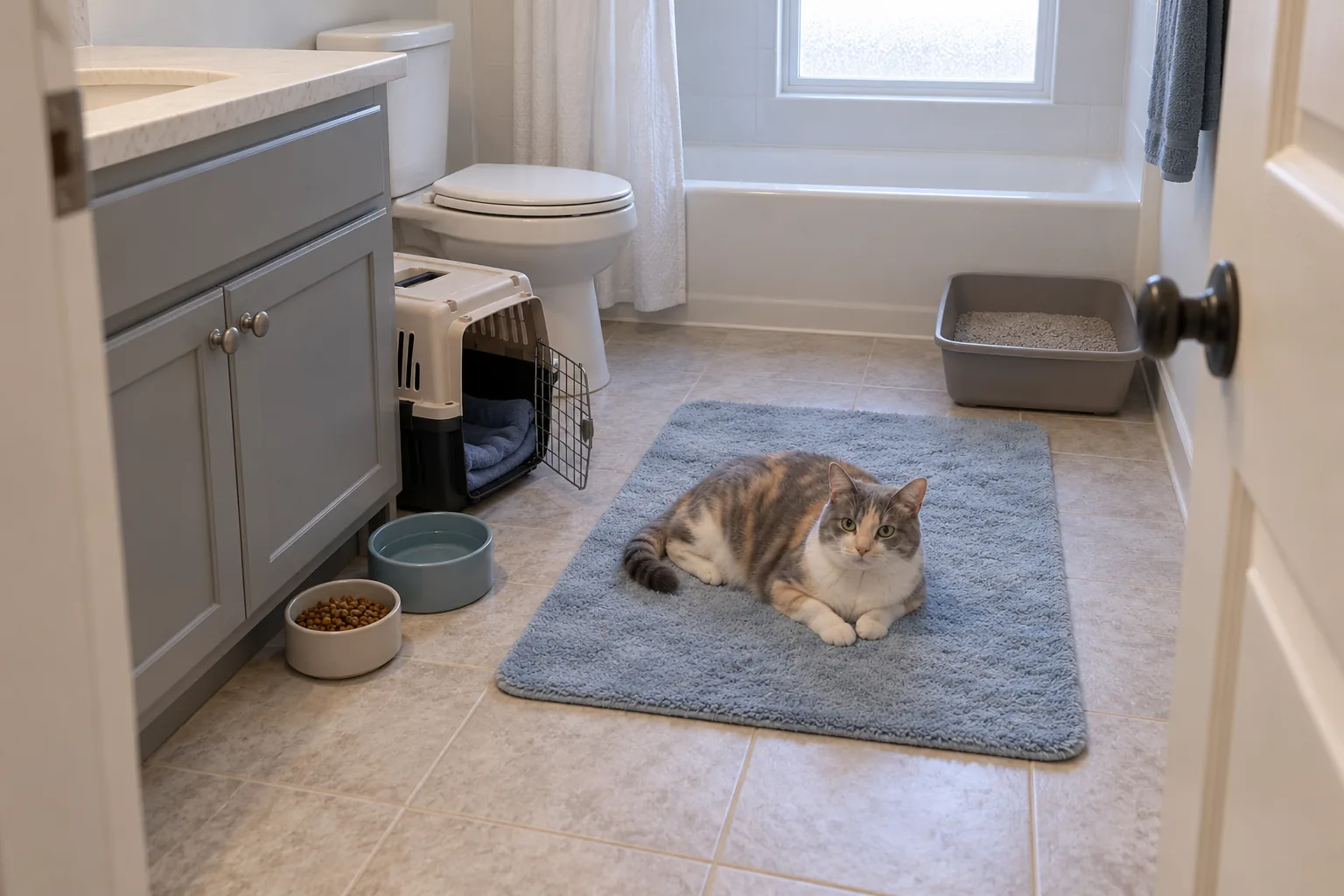
A studio usually leaves the bathroom as the only room with a door. That works. Put the toilet lid down, move cleaners and razors into a closed cabinet, and check the gap behind the tub panel, which is the bathroom version of under the bed. A bath mat on a tiled floor gives the cat somewhere soft to lie that is not the litter.
Then lay the room out in two ends. Food, water and bedding go at one end and the litter box goes as far from them as the room allows, which in a bathroom often means the vanity at one side and the tub end at the other. Add a hiding place you can reach, like an open carrier lined with a towel or a covered bed, plus a scratching post and a couple of toys for the hours you are out. If another cat already lives with you, this room is where the newcomer waits while you work through introducing cats in a small apartment.
The first 3 days: let the cat decompress
Expect very little. Pasadena Humane lists what a new cat may do in these days, and the list reads like trouble even though it is normal: not eating or drinking, hiding under furniture, missing the litter box, yowling, and showing no interest in play. The body says the same thing. Look for wide eyes with dilated pupils, ears turned back, whiskers pulled flat against the face and a tail tucked close.
Your job is to be boring and predictable. Feed and clean at the same times each day. Sit in the room with a book or your phone and let the cat decide whether to come closer. If it does, offer a hand to sniff, then try a gentle stroke along the cheek; San Diego Humane suggests bringing treats and giving the cat frequent breaks rather than one long session. Pulling a cat out of its hiding place undoes the whole point of the room.
When to call the vet. A few skipped meals are part of the first days, but a new cat that still has not eaten after a day or two in hiding needs a vet visit. So does a kitten that seems limp, sleepy at play time or uninterested in food. Call sooner rather than waiting out the three days.
Weeks 1 to 3: open the home one space at a time
The door opens when the cat is ready, not when the calendar says so. San Diego Humane gives four signs to wait for, and it wants all of them, not just one or two:
- eating, resting, grooming and using the litter box
- coming to you for petting and play
- staying calm while you stand up, walk around and go about normal life in the room
- showing real interest in the rest of the home. A cat that scratches at the closed door but bolts back to its bed once the door opens is not ready yet.

Then widen the territory slowly. In a one-bedroom, close the bathroom and the closets and let the cat explore the living room first. In a studio there is no next room: the bathroom door opens onto everything at once, so prepare the main room before you open it. Block the gap under the sofa and the bed, shut the closet doors, and decide where the scratching post and a raised resting spot will go. If the cat panics, put it back in its room and try again a few hours later.
Check the windows first. Cats fall from open windows and balconies often enough that vets have a name for it, high-rise syndrome. In a study of 119 cases, 59.6% of the cats were under a year old. Keep every window the cat can reach closed or properly secured, and do not count on an ordinary insect screen to hold its weight. The room-by-room cat-proofing checklist covers screens, tilt windows and the rest of the apartment.
Height helps a nervous cat more than floor space does. The AAFP and ISFM environmental needs guidelines describe raised spots as places where a cat can watch what is going on while feeling hidden, and they want a resting place with a view outside. A cat tree or a wall shelf near the window does that job in an apartment where floor is short.
This is also the moment for the second litter box. Feline guidelines from AAHA and AAFP give one box per cat plus one, each in its own spot, so a single cat ends up with two: the one in the safe room, which stays put, and a new one where the cat now spends its days. Two boxes side by side count as one. The measuring tool on our home page checks how long each box should be for your cat and how many you need.
By 3 months: what a settled cat looks like
Pasadena Humane describes this stage through behavior. A cat that is starting to feel at home scratches, purrs and kneads, stretches slowly, walks across the room with a loose body and takes treats gently. Missed litter boxes should be over by now in an adult cat. If they are not, the shelter’s advice is to see a vet first and only then a trainer or behavior professional, because a medical cause has to be ruled out before anything else.
Play is how many cats finish settling. Good sessions copy a hunt: let the cat stalk, chase and pounce, end on a real catch of the toy, then offer a treat or the next meal. Keep hands and feet out of it. Put wand and string toys away once the session ends, since string a cat swallows is a veterinary emergency, and never pull on string you see in a cat’s mouth.
The bond is real. In a 2019 study by Kristyn Vitale and colleagues, 65.8% of the 38 adult cats tested were securely attached to their caregiver, a share close to what researchers see in human infants. Three months of patience in a 400 sq ft (37 m²) studio buys a lot of that.
When the stages run slower
Kittens. They usually explore sooner, but they also squeeze into gaps you never knew your apartment had. San Diego Humane recommends keeping a kitten in a small room or a large crate both when it first arrives and whenever you go out, which also keeps its litter habits on track.

Shy or fearful cats. Give them less space, not more. A frightened cat with the whole apartment to itself can wedge itself somewhere unsafe and stay there without eating. The same shelter says the safe room can take a week, several weeks or longer for these cats, and that the pace is theirs.
A home with another cat or a dog. Keep the newcomer in its room for at least a few days so the animals meet by scent first. The AAFP and ISFM guidelines call for a gradual introduction with separate food, water and litter for each cat, and face-to-face meetings only once the new cat is relaxed. If a meeting turns into a fight, separate them and go back a step.
Once the routine is steady, the 7-day enrichment plan builder turns the toys you already own into a week of short play sessions, which keeps the third stage on track without much thought.
Questions about the 3-3-3 rule
Is the 3-3-3 rule based on research?
It comes from shelters, not from studies. Adoption teams built it from watching thousands of cats settle in, and no research we found has tested the three numbers. Shelters that use it stress that every cat runs on its own clock, so treat it as a way to set expectations rather than as a deadline.
How long should a new cat stay in one room?
Until it shows all the signs of being ready, which no source turns into a fixed number of days. Look for a cat that eats, grooms and uses its box, seeks you out, stays calm while you move around and wants to explore. Some cats get there within days; fearful ones can take several weeks.
Can I go to work while my new cat is settling in?
You can, and the safe room is built for those hours. None of the shelter or veterinary pages we read sets a limit on time alone for a healthy adult cat. Before you leave, refill the water, scoop the box and set out a toy, and serve meals at fixed times.
Does the 3-3-3 rule apply to kittens?
The stages still apply, though most kittens move through the first one faster than adult cats do. What changes is supervision. A kitten fits into spaces behind appliances and under cabinets, so a small room or a large crate makes sense whenever you are out, at least until you know where it likes to hide.
Should I let my new cat hide?
Hiding is how a frightened cat copes, so give it a good place to do it rather than stopping it. An open carrier or a covered bed in the safe room works well, because you can still reach the cat there. Block deep spots like the space under a bed, where a cat can stay out of reach for days.
When can my new cat meet my other cat?
After a few days apart at the very least, and only once the newcomer is relaxed in its own room. Start with scent: swap bedding between the two cats, then let them see each other through a cracked door or a gate. Keep separate food bowls and litter boxes throughout, and slow down if either cat hisses or skips meals.
Does the 3-3-3 rule apply when you move to a new apartment?
Shelters wrote it for adopted cats, but a move starts the same way, in one room. San Diego Humane Society says to confine a cat before the move as well as after it, and International Cat Care notes that indoor cats may take a little longer to adapt to a new home.
Next step. Choose the litter for the safe room’s box before adoption day, with cat litter types compared.
Sources
- Pasadena Humane, “The 3-3-3 Rule of Adopting a Cat,” pasadenahumane.org, read Oct 16, 2026.
- Humane Society of the Pikes Peak Region, “The 3-3-3 Rule: Helping Your New Cat Feel at Home,” hsppr.org, read Oct 16, 2026.
- San Diego Humane Society, “Adopting: Cat Confinement in a New Home,” sdhumane.org, read Oct 16, 2026.
- AAFP and ISFM, “Feline Environmental Needs Guidelines,” Journal of Feline Medicine and Surgery, 2013, journals.sagepub.com, read Oct 16, 2026.
- AAHA and AAFP, “2021 Feline Life Stage Guidelines: general litter box considerations,” aaha.org, read Oct 16, 2026.
- Vnuk and others, “Feline high-rise syndrome: 119 cases,” Journal of Feline Medicine and Surgery, 2004, PubMed Central, read Oct 16, 2026.
- Vitale and others, “Attachment bonds between domestic cats and humans,” Current Biology, 2019, PubMed, read Oct 16, 2026.
- Merck Veterinary Manual, “Gastrointestinal Obstruction in Small Animals,” merckvetmanual.com, read Oct 16, 2026.
- International Cat Care, “Moving house with your cat,” icatcare.org, read Oct 16, 2026.