
To stop cats from scratching furniture, you move the scratching instead of ending it. A scratch conditions the claws, gives the front legs and spine a full stretch and marks territory, so the veterinary advice is to offer something better to scratch, right where the cat already scratches, and make the sofa the worse option.
In a small apartment the sofa may be the only one you have, the doorframe belongs to your landlord, and floor for a post is scarce. The steps below are built around that.
Apartment Cats earns a commission when you buy through the Amazon links on this page, at no cost to you. Picks are made on published specs, never on commission. How this works
What you need
- A heavy upright post over 3 ft (91 cm) tall with sisal rope, such as KONELCARE’s 50 in (127 cm) sisal post.
- For a cat that scratches low, an angled one like New Cat Condos’ Premier Tilted post.
- Treats your cat will work for, and a wand toy.
- A heavy throw, double-sided tape or a sheet of plastic for the spot being scratched.
- Unscented dish soap and warm water.
- Cat nail clippers, if your cat lets you hold its paws.
How to stop cats from scratching furniture, in short
Watch where and how your cat scratches. Put a matching post right in front of that spot, cover the spot, and reward every scratch on the post. Once the post is the habit, move it in small steps to where you would rather have it.
Key takeaways
- Match the post to the surface and direction your cat uses now: Cornell suggests sisal or rope for sofa scratchers, carpet for carpet shredders. → watching first
- Same room is not enough: almost 70% of surveyed owners saw furniture scratching with a post there, so put it at the damaged spot. → placing the post
- Cover the spot with tape, plastic or a heavy blanket, but skip homemade sprays: Merck names citrus and peppermint among oils that harm cats. → covering the spot
- In the 2016 survey, 80.4% of owners who rewarded post scratching saw daily use, against 67.7% who never rewarded it. → rewarding the post
- Skip punishment, even a water squirt, which Cornell says teaches a cat to fear you; the AAFP opposes elective declawing in strong terms. → what not to do
Step 1: Watch what your cat scratches, and how
Cornell’s Feline Health Center starts with observation. Note the surface (carpet, drapes, wood, the nubby weave of a sofa arm) and the direction. Some cats reach up with their paws above their heads; others lie flat and rake a rug. The post you buy should copy both: Cornell suggests sisal or rope for a cat that goes for couches and other nubby fabric, and carpet for one that shreds the carpet.
Count the spots too. Scratch marks spread through the home, especially around doors and windows, can mean a cat that feels insecure, says International Cat Care. That pattern belongs with your vet, as the note further down explains.
Step 2: Put the post right at the scene
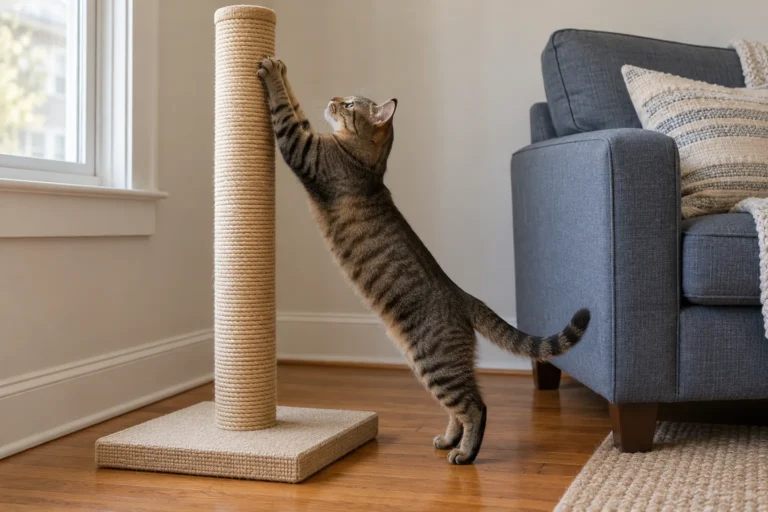
“Same room” is not close enough. In a 2016 survey of more than 4,000 cat owners, almost 70% still saw furniture scratching with a post in the same room, often not far from the damaged spot. The Feline Veterinary Medical Association (FelineVMA), which publishes the Cat Friendly Homes site, says to set a scratcher in front of the target, such as the corner of the couch, and another near where the cat sleeps, because cats often scratch on waking. Cornell adds one post beside each scratched spot.

Size and weight decide whether the post gets used at all. iCatCare wants a post as tall as your cat standing on its hind legs at full stretch, on a heavy base; scratchers that wobble or slide get ignored. In the same survey, furniture scratching came up in 55.2% of homes whose main post stood over 3 ft (91 cm), and in 64.7% of homes with shorter posts. Those are owner reports, not a trial, but they point the same way. Our scratching post comparison weighs six posts on height, base and surface.
Will it fit? KONELCARE 50 in (127 cm) Tall Cat Scratching Post

- Footprint
- A 21.6 in (55 cm) square of solid wood
- Height
- 50 in (127 cm) overall
- Weight
- 36 lb (16.3 kg), by the maker
- Best for
- Parking in front of the sofa arm a cat reaches up to scratch
- Skip if
- Your cat only scratches lying down, or you cannot carry 36 lb up your stairs
Details
Product prices and availability are accurate as of the date/time indicated and are subject to change. Any price and availability information displayed on Amazon.com at the time of purchase will apply to the purchase of this product.Already own a post? The scratching post panel in the cat measuring tool checks its height against that 3 ft (91 cm) line.
Short on floor? iCatCare suggests scratching panels fixed to the wall when space is tight. The survey adds a caution: wall-mounted scratchers were the least used kind and came with the most furniture scratching, 74.1% of those homes. Treat a wall panel as a second spot, not the only one, and see the compact cat tree comparison for upright options sized to a studio.
Step 3: Make the sofa the worse choice
Cornell is blunt: the only guaranteed way to stop scratching on an object is to block access to it. Where you cannot, change how it feels. Cornell lists blankets, sheets of plastic and double-sided tape; iCatCare suggests a thick, heavy blanket or a one-sided sticky plastic film; the ASPCA adds sandpaper or a vinyl carpet runner laid upside down, knobby side up, where the cat stands to scratch.
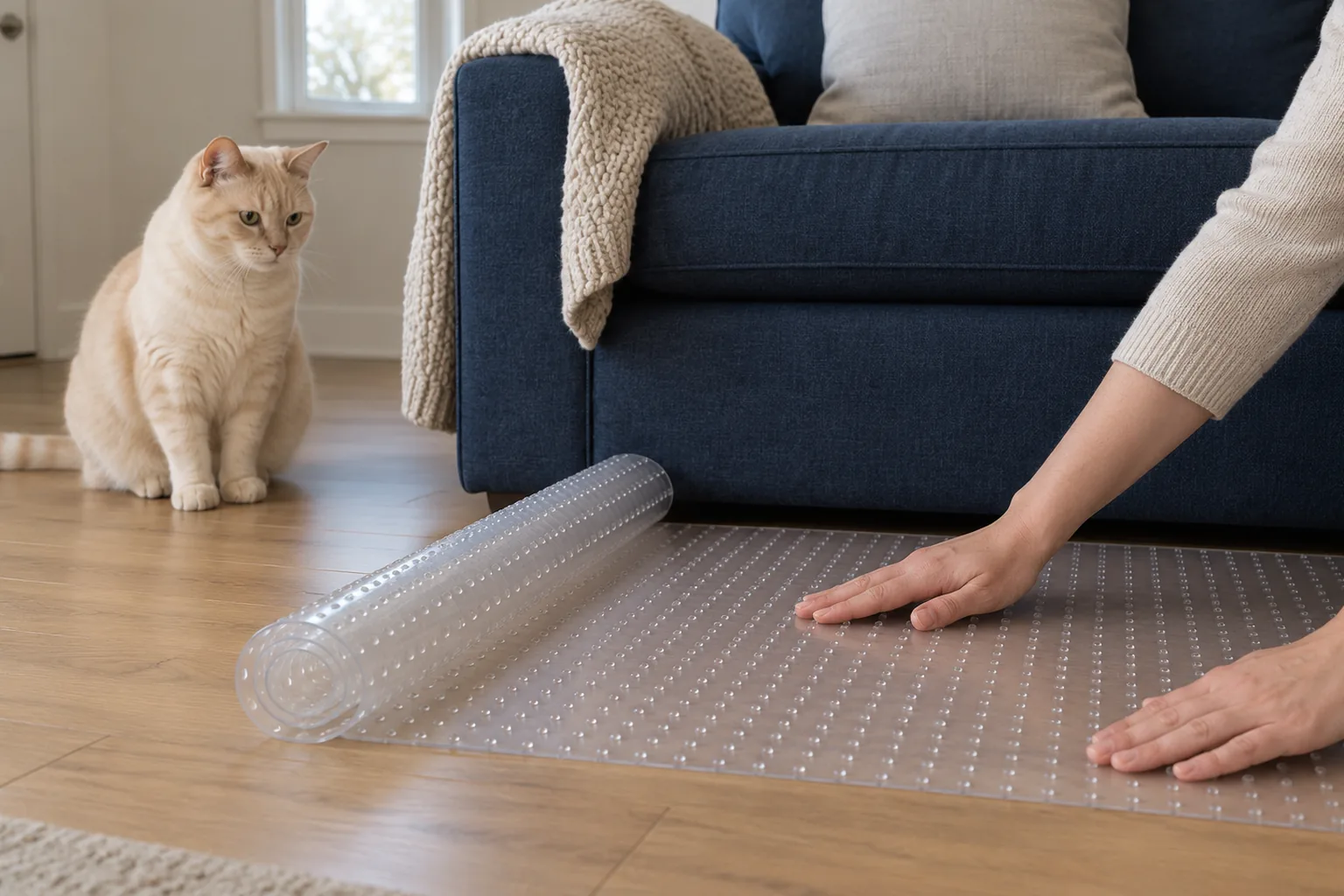
Then wash out the invitation. Scratching leaves scent from glands between the paw pads, and cats return to spots that smell of them, so Cornell recommends an odor neutralizer on scratched areas. For wood, iCatCare uses unscented soapy water. Try any cleaner on a hidden patch of fabric first.
Skip the homemade sprays. Some homemade deterrent recipes call for essential oils. The Merck Veterinary Manual names citrus, peppermint, eucalyptus and tea tree among oils that harm cats, whose livers clear some of their compounds poorly. Wand toys need care too: string can be deadly if swallowed (VCA Animal Hospitals), so put the toy away after each game.
Anti-scratch spray and tape: what they do
Anti-scratch tape is the double-sided kind above, sold ready-cut. Pioneer Pet’s Sticky Paws are transparent, medical-grade adhesive strips that go straight onto the furniture; Pioneer Pet says they fail on stain-repellent finishes such as Scotchgard; test a piece somewhere hidden first.
A cat scratch deterrent spray works on smell rather than feel, and we found no veterinary source that tested one. Read the label of any cat scratch deterrent spray: one built on citrus, peppermint, eucalyptus or tea tree oil carries the risk Merck describes above. Never spray the cat, and keep a post right beside the covered spot.
Step 4: Reward the post, every time
Owners who rewarded scratching on the post, with a treat, praise or a stroke, were more likely to see their cat use it daily: 80.4% against 67.7% for cats never rewarded, in the 2016 survey. Cornell suggests treats or catnip on and around the post. iCatCare’s trick is a short chase with a wand toy around the base; once the claws touch the surface, that is often all it takes.
When you catch the cat on the sofa, the FelineVMA’s advice is to pick it up gently, set it at the post and reward it there. Never press its paws onto the post. iCatCare and the ASPCA both warn that forcing it can frighten the cat off the post, and off you. And keep the ragged post; Cornell reads shredded sisal as a sign it is doing its job.
Step 5: Trim the claws, or try nail caps
Shorter claws do less damage while the new habit forms. Cornell shows trimming along an angle that takes off the hook while avoiding the quick, the pink part with nerves and blood vessels, and the FelineVMA suggests asking your vet for a demonstration. Start slowly, with breaks.
Glue-on nail caps are the other option, for a cat that lets you handle its paws, Cornell says. Sources disagree on how long they last: the FelineVMA and the ASPCA say re-apply every 4 to 6 weeks, Cornell says 6 to 12. Neither trims nor caps meet the need to scratch, iCatCare points out, so the post still has to be there.
Step 6: Move the post, slowly
A 50 in (127 cm) post in front of the sofa arm is not where most people want it forever. Cornell’s answer: once the cat uses it, move it gradually to the spot you prefer. Shift it a short distance, wait until the cat is scratching it every day again, then shift it once more. If the sofa gets hit again, slide the post back and leave the cover on longer.
Doorframes, carpet and the things your landlord owns
Photograph any existing marks on frames and carpet when you move in, so old damage is not put down to your cat. For wood, iCatCare’s routine is unscented soapy water on the scratched area and a post or panel close by; a wooden one can match what the cat was after. Cats that rake the bottom stair or a carpet edge lying down want a horizontal surface, so iCatCare puts carpet samples there.

That low scratcher is the job of the tilted New Cat Condos post. Its maker lists a 20 in (51 cm) slope, 13 in (33 cm) of it wrapped in sisal, standing 12 in (30 cm) high and weighing about 10 lb. Set it on the patch of carpet the cat already uses, and cover that patch with a runner until the habit moves.
What not to do: punishment, force and declawing
Do not punish scratching, not even with a squirt of water. Cornell explains that a cat sees no link between the punishment and the scratch, learns to fear you, and simply scratches when you are out; punishment may also lead to aggression. In the 2016 survey, reprimanding the cat or lifting it away made no difference to how often it scratched furniture. The ASPCA allows a clap or a squirt as a last resort, then warns the cat may learn to fear you. We would leave it out.
Declawing is not a shortcut. It amputates the last bone of each toe, comparable to cutting off a finger at the last joint, by the FelineVMA’s description. The AAFP’s 2017 position statement opposes elective declawing in strong terms. The ASPCA is strongly opposed too.
When to call the vet. Book a visit if scratching spreads to many spots, especially doors and windows, or if a claw looks thick or curls toward the pad. iCatCare links widespread scratching with insecurity, and notes that older cats may scratch too little to keep their claws short; overgrown claws can grow into the pads, which hurts. Your vet can also refer you to a feline behavior specialist.
Questions about cats scratching furniture
What scent keeps cats from scratching furniture?
None of the veterinary sources we read names a scent that repels scratching, and essential oils are a poisoning risk for cats. Cornell’s advice runs the other way: remove the cat’s own scent from the scratched spot with an odor neutralizer, because a spot that smells of the cat invites another round.
What repels cats from scratching furniture?
Texture works better than threats. Double-sided tape, a plastic sheet, a heavy throw or a vinyl runner turned knobby side up make the surface unpleasant to dig into, by Cornell’s, iCatCare’s and the ASPCA’s advice. Pair the cover with a better option right beside it, or the cat simply picks the next chair.
How do I protect a rental’s door frames from claws?
Clean the scratched wood with unscented soapy water to lift the scent mark, as iCatCare suggests, then stand a post or fix a scratching panel within reach of that frame. Until the cat switches, hang a towel or a heavy throw over the spot it targets.
Is a wall-mounted scratcher enough in a studio?
Usually not on its own. iCatCare suggests wall panels where floor is short, but in the 2016 owner survey wall-mounted scratchers were the least used type and their homes reported the most furniture scratching. A tall post on a heavy base in front of the sofa does more; add the panel as a second spot.
How do I protect the sofa while I am at work all day?
Cover it before you leave. Cornell calls blocking access the only sure method, and in a studio a heavy throw or plastic sheet over the arm the cat uses is the closest you get. Leave the post in front of that arm and another near the cat’s bed, since cats tend to scratch after napping.
Next step. Pick the post itself with the scratching post comparison, which sorts six by height, base and material.
Sources
- Cornell Feline Health Center, “Feline Behavior Problems: Destructive Behavior,” vet.cornell.edu, read Oct 17, 2026.
- International Cat Care, “Scratching on furniture and carpets,” icatcare.org, read Oct 17, 2026.
- Feline Veterinary Medical Association, “Alternatives to Declawing,” catvets.com, read Oct 17, 2026.
- Wilson and others, 2016, “Owner observations regarding cat scratching behavior: an internet-based survey,” journals.sagepub.com, read Oct 16, 2026.
- ASPCA, “Destructive Scratching,” aspca.org, read Oct 17, 2026.
- AAFP, “AAFP Position Statement: Declawing,” Journal of Feline Medicine and Surgery, 2017, journals.sagepub.com, read Oct 16, 2026.
- Feline Veterinary Medical Association, “What is Declawing?,” catfriendly.com, read Oct 17, 2026.
- Merck Veterinary Manual, “Toxicoses From Essential Oils in Animals,” merckvetmanual.com, read Oct 16, 2026.
- VCA Animal Hospitals, “Linear Foreign Body in Cats,” vcahospitals.com, read Oct 16, 2026.
- KONELCARE, “50 in Tall Cat Scratching Post,” konelcare.com, read Oct 16, 2026.
- New Cat Condos, “Angled Sisal Rope Cat Scratching Post,” newcatcondos.com, read Oct 16, 2026.