

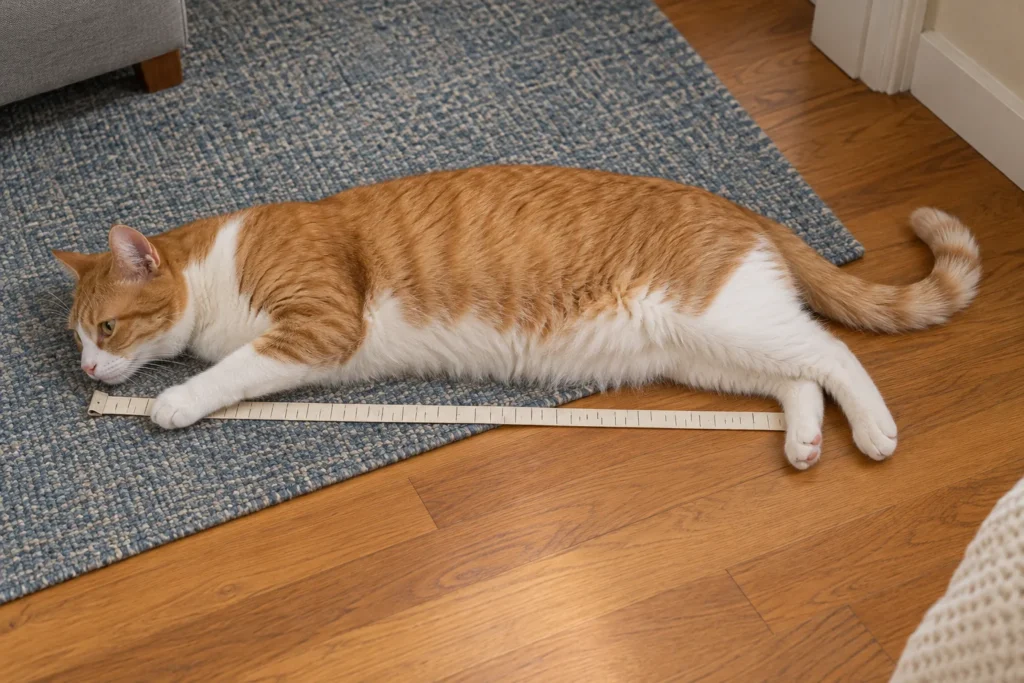
This cat measuring tool checks five things against published guidance before you buy anything: whether a litter box is long enough for your cat, how many boxes you need, whether the litter is deep enough and how much a month that takes, whether a scratching post clears 3 ft (91 cm), and whether a shelf fits a full stretch.
Apartment Cats earns a commission when you buy through the Amazon links on this page, at no cost to you. Picks are made on published specs, never on commission. How this works
What are you measuring?
Is the litter box long enough?
Starts at 18 in: grown cats average 18 to 20 in (46 to 51 cm) from the nose to the base of the tail, says Britannica. Type your own cat’s length for a real answer.
How to measure your cat
While the cat stands, run a soft tape from the tip of its nose along the back to where the tail starts, not to the tail tip. No soft tape? Lay a piece of string along the same line, then measure the string. Take two readings and use the longer one.
Box at least 27 in long (69 cm)
Next: keep that box from smelling in a small space
Next: litter boxes long enough for your cat
The rule: a box one and a half times the cat’s length or more, from the AAFP and ISFM house-soiling guidelines (2014). Many boxes sold in stores are shorter.
How many litter boxes do you need?
2 boxes in two different spots
Next: where each box can go in a small apartment
Next: litter boxes for two or more cats in a small home
One box per cat plus one, each in its own spot: a rule of thumb from the AAHA and AAFP life stage guidelines (2021), which the AAFP and ISFM (2014) say is not an absolute requirement. Two boxes side by side count as one.
Is there enough litter in the box?
2 in of litter (5 cm)
Next: the types of litter compared, by weight and dust
Next: lightweight litter, and the pounds you carry upstairs a month
Next: bags and cost a month for every box, in the cat litter calculator
About 1 to 2 inches suits most cats (Cornell Feline Health Center); the AAFP and ISFM put the floor at about 1.25 in (3 cm). The full change every 1 to 2 weeks is where the clumping litter guidelines overlap.
Is the scratching post tall enough?
30 in tall (76 cm)
Next: scratching posts that clear 3 ft, and the bases that hold them
Next: small cat trees compared by footprint and height
From Wilson and colleagues (2016), a survey of 4,105 cat owners for the Journal of Feline Medicine and Surgery. Owners reported it; nobody tested it, so read it as a pointer, not a rule.
Can your cat stretch out on the shelf?
Starts at 30 in, an example for a grown cat lying fully stretched: we found no source that gives an average paw to paw, so measure your own cat.
6 in short
Next: no-drill perches and shelves long enough for your cat
Next: window perches and shelves you can fit without drilling
A perch should let a cat stretch out fully, in length and in width, says the AAFP and ISFM environmental needs guidelines (2013). Measure your cat while it lies fully stretched, from the tips of its back paws to the tips of its front paws; the tail can hang over the end.
What to buy for the check you have open
Each card is a pick from one of our published guides and follows the answer above. In the box and shelf checks, it also says whether the product reaches the number you were given.
IRIS USA XL Open-Top with Shield

- What it is
- IRIS’s open pan with a shield wall around the back and sides, 30.2 in (77 cm) by 20 in (51 cm) from the outside.
- Why it fits
- It is the longest box in our large litter box guide and on the 1.5 times rule suits a cat of about 20 in (51 cm), so it also makes a good second or third box.
- Skip if
- Stiff joints matter more than length: the maker lists no step height, and the KittyGoHere below does.
Details
Product prices and availability are accurate as of the date/time indicated and are subject to change. Any price and availability information displayed on Amazon.com at the time of purchase will apply to the purchase of this product.KittyGoHere Senior Cat Litter Box, Jumbo

- What it is
- An open box with a 3 in (7.6 cm) way in (a gate that comes off changes it to 5 in, 13 cm); the listing gives 28 by 22 in (71 by 56 cm) and 9 in (23 cm) high.
- Why it fits
- For an older cat that needs a box of at least 1.5 times its length: its maker gives the step height, 3 in (7.6 cm), which IRIS does not.
- Skip if
- You want the maker’s own size: only the Amazon listing gives one.
Details
Product prices and availability are accurate as of the date/time indicated and are subject to change. Any price and availability information displayed on Amazon.com at the time of purchase will apply to the purchase of this product.Van Ness High Sides Giant

- What it is
- A plain pan with tall walls, 21.25 by 17.63 in (54 by 45 cm) and 9.25 in (23 cm) high, by Van Ness.
- Why it fits
- The smallest floor of the three, for a cat up to about 14 in (36 cm) and a narrow bathroom.
- Skip if
- Your cat is longer than 14 in (36 cm). Leave out the liners its care notes mention; the AAFP and ISFM advise against them.
Details
Product prices and availability are accurate as of the date/time indicated and are subject to change. Any price and availability information displayed on Amazon.com at the time of purchase will apply to the purchase of this product.Whisker Litter-Robot 4

- What it is
- Whisker’s self-cleaning globe, which needs a spot 27 in (69 cm) deep and 22 in (56 cm) wide and stands 29.5 in (75 cm) high.
- Why it fits
- Several cats share it: Whisker’s chart rates it for up to four, 3 to 25 lb each. It replaces one box in your count, not all of them.
- Skip if
- Your cats use pellets or crystals (it takes clumping litter), or its only spot would be a steamy bathroom.
Details
Product prices and availability are accurate as of the date/time indicated and are subject to change. Any price and availability information displayed on Amazon.com at the time of purchase will apply to the purchase of this product.Tidy Cats LightWeight Free & Clean Unscented

- What it is
- Purina’s light clumping clay without scent, sold as an 8.5 lb jug and in 12 and 17 lb sizes.
- Why it fits
- Every refill to your depth gets carried home; Purina rates 8.5 lb of it as doing the work of 20 lb of standard clumping clay.
- Skip if
- No stairs to climb, and a cat already happy with what it has.
Details
Product prices and availability are accurate as of the date/time indicated and are subject to change. Any price and availability information displayed on Amazon.com at the time of purchase will apply to the purchase of this product.Tidy Cats Free & Clean Unscented

- What it is
- Full-weight clumping clay with no fragrance, plus activated charcoal made from coconut shells; 16 lb by the listing.
- Why it fits
- With the box sorted, smell is next: this is the top pick of our odor control guide, and fine, unscented clumping litter is what most cats prefer.
- Skip if
- The bag has to go up several flights; the lightweight version above weighs less.
Details
Product prices and availability are accurate as of the date/time indicated and are subject to change. Any price and availability information displayed on Amazon.com at the time of purchase will apply to the purchase of this product.Boxiecat Premium Unscented

- What it is
- Plain bentonite clay with nothing added, made so clumps stay on top of the box, 16 lb.
- Why it fits
- For a nose or a cat that minds additives; the maker claims odor control for 30 days, its own figure.
- Skip if
- You want a lighter bag, since this is regular clay.
Details
Product prices and availability are accurate as of the date/time indicated and are subject to change. Any price and availability information displayed on Amazon.com at the time of purchase will apply to the purchase of this product.Cat’s Pride Max Power Total Odor Control Unscented

- What it is
- A scent-free clumping clay from two clays, in a 15 lb jug according to the listing.
- Why it fits
- Staying with full clay at that depth: its maker puts it 25% under traditional scoopable clay in weight.
- Skip if
- You want the biggest saving in pounds; the lightweight Tidy Cats claims more.
Details
Product prices and availability are accurate as of the date/time indicated and are subject to change. Any price and availability information displayed on Amazon.com at the time of purchase will apply to the purchase of this product.KONELCARE 50 in (127 cm) Tall Cat Scratching Post

- What it is
- One thick post wound in natural sisal rope, 50 in (127 cm) tall on a solid wood base 21.6 in (55 cm) square, by its maker.
- Why it fits
- Yours falls short of 3 ft (91 cm), and this is the tallest post in our scratching post guide, by a margin of 9 in (23 cm).
- Skip if
- It has to be carried up stairs often: the maker gives 36 lb.
Details
Product prices and availability are accurate as of the date/time indicated and are subject to change. Any price and availability information displayed on Amazon.com at the time of purchase will apply to the purchase of this product.MidWest Feline Nuvo Grand Forte

- What it is
- A sisal post trimmed with faux fur that MidWest says stands over 3 ft (91 cm); the listing gives 41 in (104 cm) on a 19 in (48 cm) square base.
- Why it fits
- It clears 3 ft (91 cm) on a smaller base than the KONELCARE, for a corner that cannot give up 22 in (56 cm).
- Skip if
- You want the maker’s own measurements, because MidWest publishes none.
Details
Product prices and availability are accurate as of the date/time indicated and are subject to change. Any price and availability information displayed on Amazon.com at the time of purchase will apply to the purchase of this product.Feandrea 37.8-inch (96 cm) Cat Tree

- What it is
- A tree 37.8 in (96 cm) high with a two-door cave, a top perch and a basket, on a base 18.9 in (48 cm) square.
- Why it fits
- Your post already passes 3 ft (91 cm); for climbing too, this is the square-based tree over 3 ft (91 cm) our small cat tree guide picks; Feandrea packs an anti-tip kit.
- Skip if
- Your cat weighs over 15.4 lb (7 kg), the per-cat limit on Feandrea’s page.
Details
Product prices and availability are accurate as of the date/time indicated and are subject to change. Any price and availability information displayed on Amazon.com at the time of purchase will apply to the purchase of this product.Zakkart SnugCloud Cat Perch for Windowsill, L

- What it is
- A hardwood and metal perch that hooks over the sill with no screws or suction cups; the L bed is 25 by 15 in (64 by 38 cm) and holds 40 lb.
- Why it fits
- The longest bed of the no-drill perches in our shelf guide; set its 25 in (64 cm) against the stretch you measured.
- Skip if
- The hook needs a slot of 0.5 in (1.3 cm) or more in the frame, and the bracket stops at sills 9 in (23 cm) deep.
Details
Product prices and availability are accurate as of the date/time indicated and are subject to change. Any price and availability information displayed on Amazon.com at the time of purchase will apply to the purchase of this product.Zakkart SnugCloud Foldable Cat Window Perch, M

- What it is
- A suction-cup perch on a cordless metal frame that folds back to sit 4.3 in (11 cm) off the glass, with a 22.8 by 15.7 in (58 by 40 cm) bed rated for 40 lb.
- Why it fits
- There is no sill to hook onto: it holds on the glass and folds away when you need the window.
- Skip if
- The stretch you measured is longer than 22.8 in (58 cm); the L size has a 24.8 in (63 cm) bed.
Details
Product prices and availability are accurate as of the date/time indicated and are subject to change. Any price and availability information displayed on Amazon.com at the time of purchase will apply to the purchase of this product.The numbers in the fields when the page opens are examples to show how each measure works. Replace them with your own; nothing you type leaves your browser.
How the cat measuring tool works
Litter box length
Take your cat’s length, nose to tail base, and multiply it by 1.5. That is the shortest box the 2014 AAFP and ISFM house-soiling guidelines allow, and the tool rounds up, never down. A longer answer comes from the 2021 AAHA and AAFP life stage guidelines, which take the length all the way to the tail tip. This tool sticks with the 2014 version rather than mixing the two. An 18 in (46 cm) cat needs 27 in (69 cm). Plenty of boxes on pet store shelves are shorter.
How many boxes
The count is the number of cats plus one, with every box in a different place. Nobody has tested that figure: it is guidance from AAHA and AAFP, and the 2014 AAFP and ISFM guidelines say it is not an absolute requirement. Boxes pushed together count as a single box. Where cats in the same home do not get along, count each group of friends separately and add one.
Litter depth and litter per month
Cornell’s Feline Health Center puts the usual depth at about 1 to 2 inches (2.5 to 5.1 cm). The AAFP and ISFM set the floor a little higher, at about 1.25 in (3.2 cm). Add your box’s length and width and the tool works out the litter it takes to fill the box: length times width times depth in cubic inches, divided by 61.02 to get liters. For the month it assumes a full change of clumping litter every 1 to 2 weeks, where the iCatCare and AAFP advice overlaps. That makes about 2 to 4 fills a month. Top-ups after scooping come on top, and no source puts a figure on them.
Scratching post height
The 3 ft (91 cm) line comes from a 2016 survey of 4,105 owners by Wilson and colleagues: homes with posts taller than 3 ft (91 cm) reported less scratching of furniture, 55.2% against 64.7%. Owners reported it and nobody tested it, so treat the line as a pointer. The same survey found sisal rope and upright posts or multi-level trees in the most use.
Shelf or perch length
The 2013 AAFP and ISFM environmental needs guidelines want a perch long and deep enough for the whole cat when it stretches. They give no number. So the tool compares the shelf with your own measurement of your cat lying flat out, nose to tail base. Judge the depth by eye: a cat on its side needs more than a narrow ledge.
What the tool leaves out
It does not pick products, and it covers only measures with a published number or rule behind them. Carrier size, the distance between food and litter, and the number of cat trees in a home have no sourced figure, so they are not here. To see whether a box, a cat tree or a fountain fits a particular floor spot, use the space-fit planner, which draws the layout to scale.
For the reasons behind each number, read the litter box guides, the comparison of litter types and the cat tree and scratcher guides. A cat that is new to your home starts in one small room, as the 3-3-3 rule guide explains.
Sources
- AAFP and ISFM, “Guidelines for Diagnosing and Solving House-Soiling Behavior in Cats,” Journal of Feline Medicine and Surgery, 2014, journals.sagepub.com, read Oct 16, 2026.
- AAHA and AAFP, “2021 Feline Life Stage Guidelines: general litter box considerations,” aaha.org, read Oct 16, 2026.
- Cornell Feline Health Center, “Feline behavior problems: house soiling,” vet.cornell.edu, read Oct 16, 2026.
- International Cat Care, “Consensus guidelines on feline lower urinary tract diseases,” Journal of Feline Medicine and Surgery, 2025, PubMed Central, read Oct 16, 2026.
- Wilson and others, “Owner observations regarding cat scratching behavior,” Journal of Feline Medicine and Surgery, 2016, journals.sagepub.com, read Oct 16, 2026.
- AAFP and ISFM, “Feline Environmental Needs Guidelines,” Journal of Feline Medicine and Surgery, 2013, journals.sagepub.com, read Oct 16, 2026.