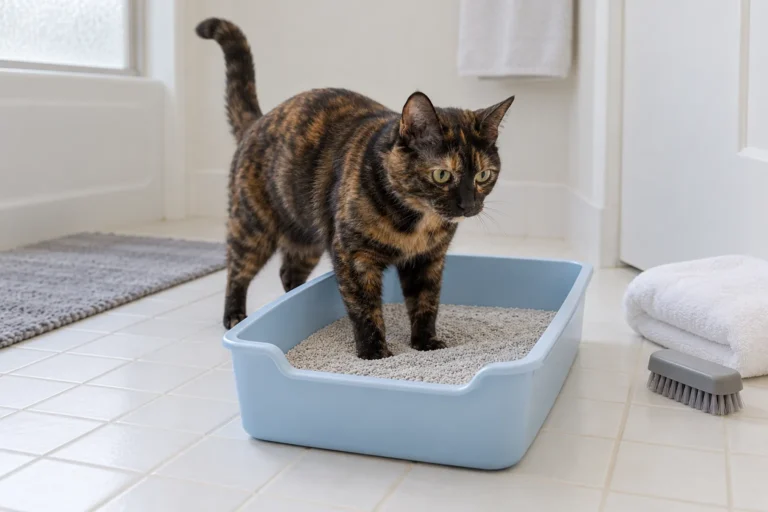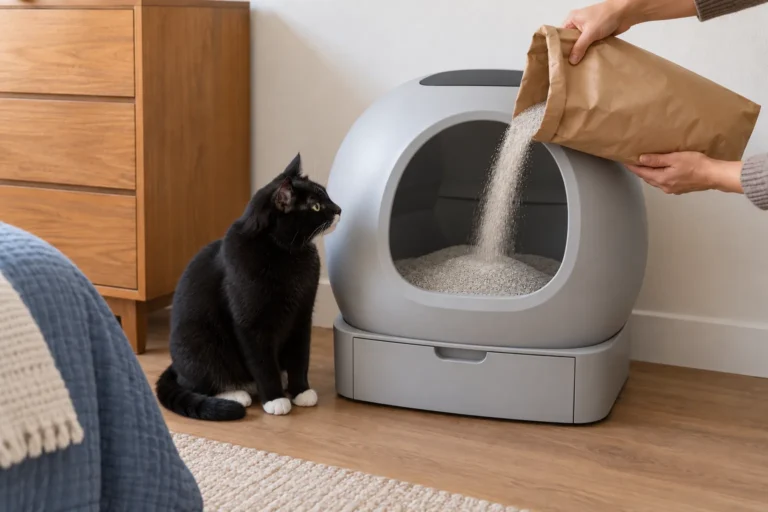
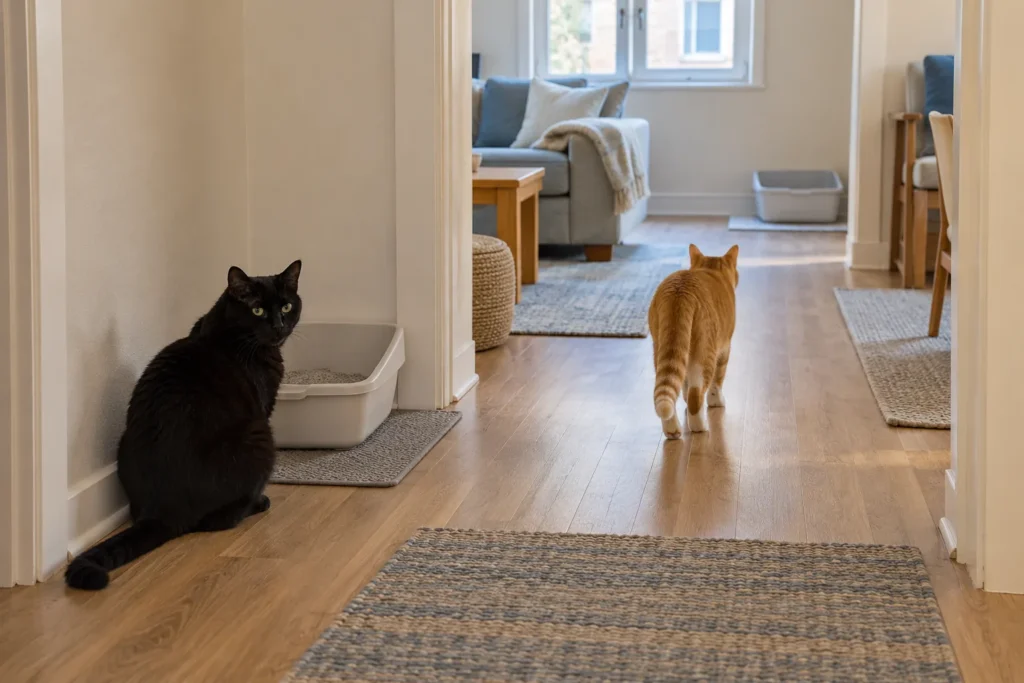
Plan on three boxes when you set up a litter box for two cats: veterinary guidelines give each cat its own box plus one spare, every box in a different spot. In a studio or a one-bedroom the real work is finding room for the third, and knowing what the guidance allows if the floor runs out at two. If the second cat has only just come home, begin with how to introduce a new cat to your cat in a small apartment.
What you need
- A tape measure for both cats and each floor spot.
- Three litter boxes, each long enough for the longer cat.
- Unscented clumping litter for all three. In a walk-up, compare the lightweight cat litters before hauling three boxes’ worth up the stairs.
- A rough floor plan with the bowls, the beds and every door marked. A door that has to stay shut can take an interior cat door, so a box behind it stays open to both cats.
Litter box for two cats: the count in short
Two cats, three boxes: Cornell, iCatCare and the feline guidelines from AAHA, AAFP and ISFM all count one box per cat plus one. How the pair gets along mostly changes where the boxes go:
| Your two cats | Boxes | Why |
|---|---|---|
| Friends that groom each other and sleep touching | 3, or 2 by the per-group count | AAHA: one box per social group plus one |
| Cats that stare, block or chase | 3, in separate parts of the home | Separate litter stations (AAFP and ISFM) |
| A newcomer still in its own room | 3, counting the box in that room | The resident’s boxes stay put |
Three cats need four boxes, six need seven. The How many boxes panel of the cat measuring tool works it out for 1 to 6 cats, and its Litter box panel sizes each box.
Key takeaways
- Cats read boxes side by side as one big box, say the AAFP and ISFM, so each box needs its own spot. → where three boxes fit
- Only room for two? Treat that as a fallback for a bonded pair; cats that avoid each other still get three by either count. → when only two fit
- Either cat going outside the boxes means a vet call before any setup change; straining to pass little or no urine is an emergency. → the vet note
- Heath’s review suggests a week of watching: grooming and rubbing mark one social group, while staring and avoidance are overlooked signs of hostility. → counting social groups
- Base all three boxes on the longer cat; each should be at least 1.5 times that cat’s length, nose to tail base (AAFP and ISFM). → sizing the boxes
Why two cats get three boxes, and how firm that is
The spare is about choice. Cornell says one more box than cats cuts competition and gives each cat a box of its own; San Diego Humane Society adds that extra boxes split the waste. At three to five eliminations a day per cat, the AAFP and ISFM average, two cats make 6 to 10 visits a day. That is a lot of clumps to carry out, and the litter disposal comparison works out trips to the trash for each bin.
Firm, though, it is not. The AAFP and ISFM label the extra box a historical rule of thumb and add that it is not an absolute requirement; we found no study that tests it. In a UK survey of 565 cat homes published in 2025, only 16.9% of those with trays had more trays than cats, and its authors’ first example of a barrier is reluctance to give up space to more trays.
Where three boxes fit in a studio or a one-bedroom
Three boxes count as three only in three places. The AAFP and ISFM say cats read boxes next to each other as one large box, so two lined up beside the toilet are one toilet to a cat. No guideline gives a distance between boxes. Their test suits a pair: a cat leaving one box should be able to turn away from a cat walking toward it, so boxes that must sit close get their openings at right angles.
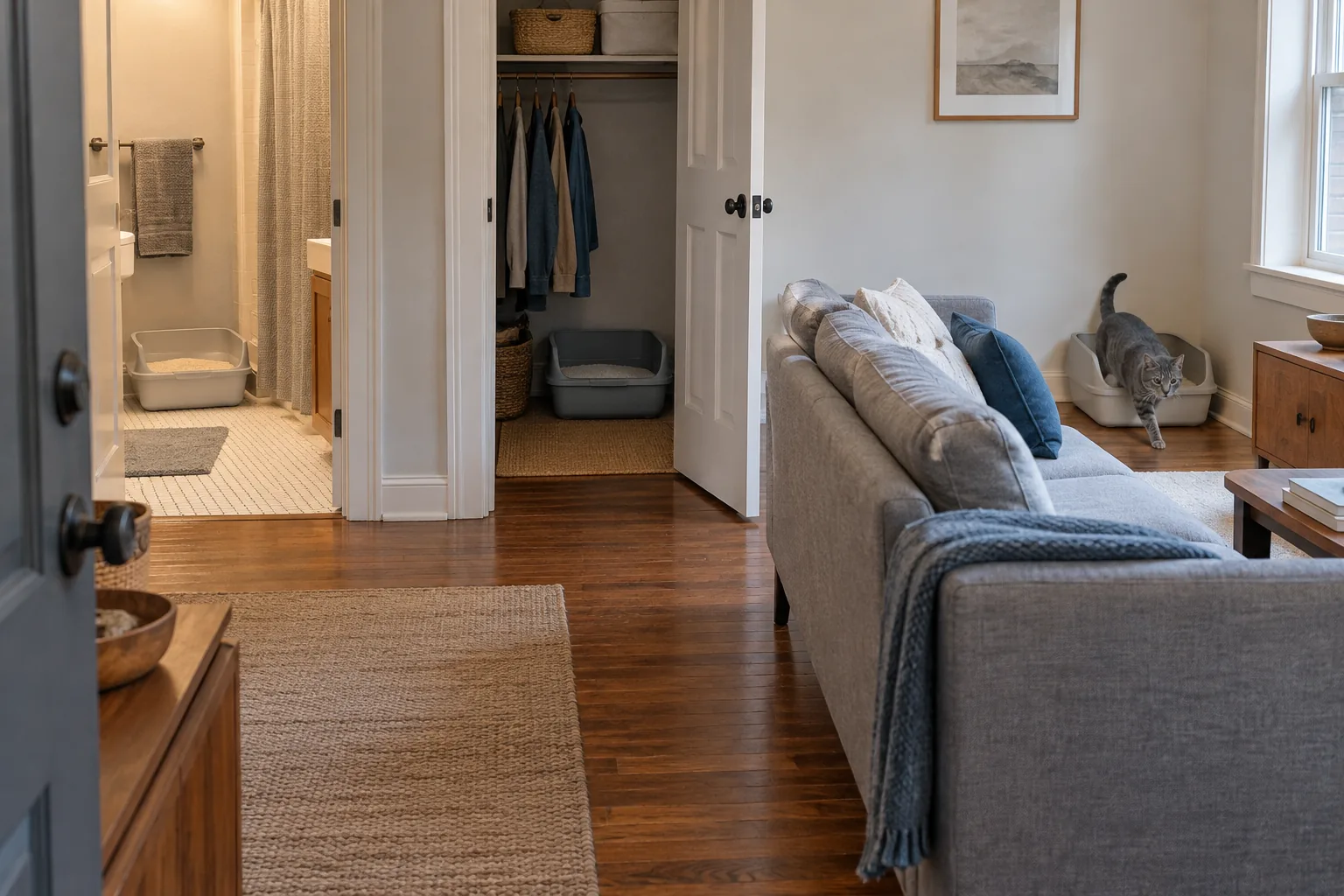
| Home | Box 1 | Box 2 | Box 3 |
|---|---|---|---|
| Studio | Bathroom | Main room, the end farthest from the bowls | Opposite end or entry nook, screened from box 2 |
| One-bedroom | Bathroom | Bedroom corner, door held open | Living room corner, away from the kitchen |
In a studio, a bookcase or sofa end between the main-room boxes keeps them out of each other’s view, as the 2013 AAFP and ISFM environmental guidelines ask. The space-fit planner draws a box of the right length on each spot before you buy.
Spots that suit one cat can fail two. A closet or the gap beside the toilet has one way in, and Cornell warns that a box enclosed on three sides lets another animal ambush the cat inside. Give every box open floor on at least two sides, and a two-level apartment one box per level (AAFP and ISFM, iCatCare). Our guide to litter box spots in a small apartment rates each one.
When there is only room for two boxes
Some floor plans stop at two, and the guidance bends a little: bonded cats may share more willingly, the AAFP and ISFM add, and AAHA’s per-group count comes to two for a pair that forms a single group. No source we read says:
- that two boxes suit cats that avoid each other. Both counts give them three;
- that one jumbo box can stand in for two, since touching boxes already count as one.
So two boxes is a fallback for a bonded pair, not a plan for any pair. Put them in separate rooms or at opposite corners of a studio, size both for the longer cat, scoop twice a day, and add the third at the first of these signs:
- one cat waiting beside a box, or sitting in its path, while the other wants in
- a cat perched on the edges with one or two paws in the litter, which the AAFP and ISFM tie to litter aversion
- a cat pounced on as it leaves
- urine or stool outside the boxes, a question for the vet first
Call the vet before you change the setup if either cat goes outside the boxes. Cornell lists urinary inflammation, kidney and thyroid disease and diabetes among the causes, and counts life with other cats among the stresses tied to urinary signs. Not sure which cat it was? Tell the vet. Straining with little or no urine is an emergency, above all in a male: Cornell says a complete blockage can kill in less than 24 to 48 hours, and iCatCare warns it can pass for constipation.
Cats that do not get along: count by group
Sharing a home does not make two cats a pair. Sarah Heath’s 2019 review asks owners to count social groups by watching for a week for grooming and rubbing between the cats, and the AAFP and ISFM add sleeping together. Cats that gather at one bowl or one sunny bed may only be there because it is the only one, they warn.
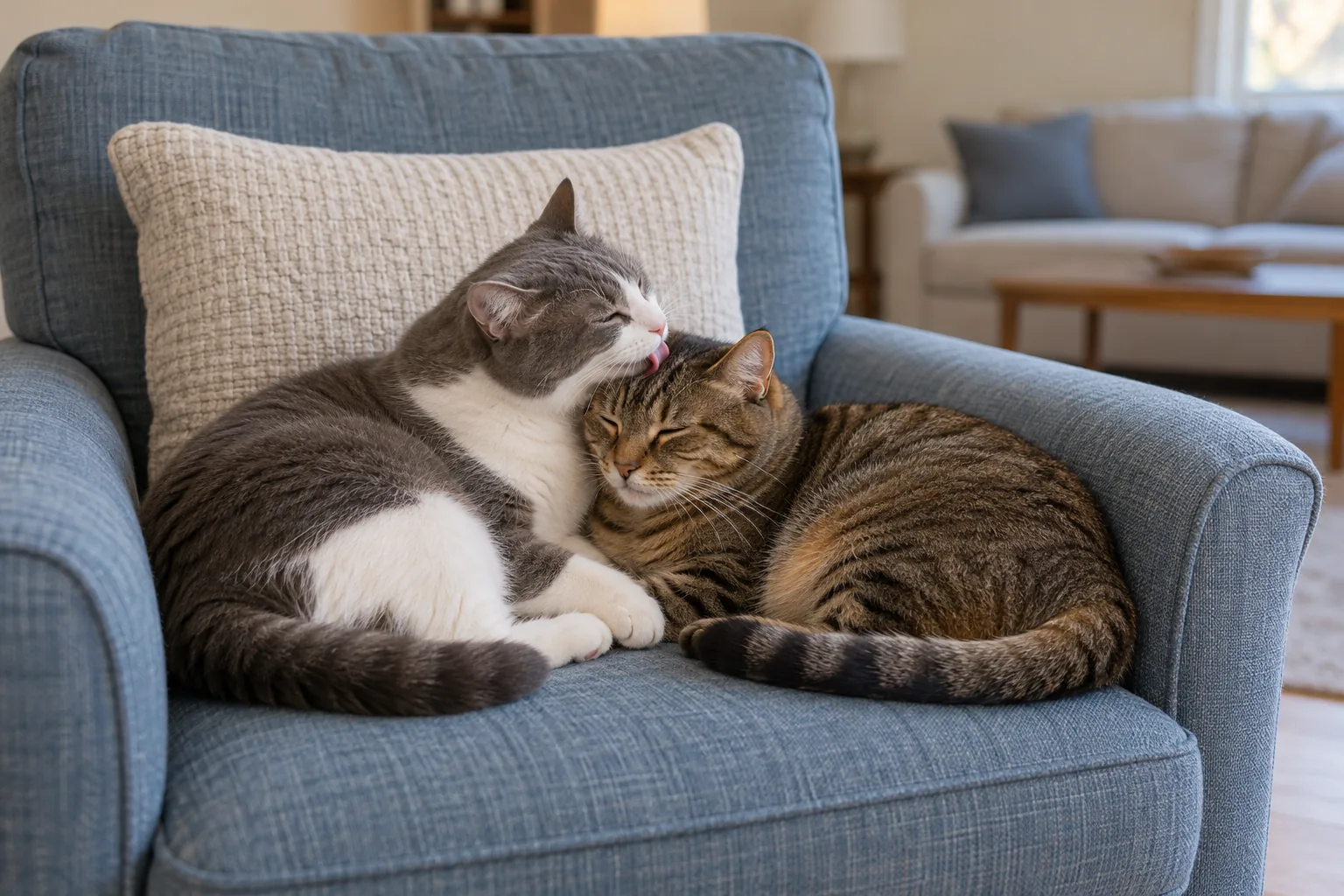
Tension is easy to miss. Heath names staring and avoidance as overlooked signs of hostility, and the AAFP and ISFM describe a “despot” cat that keeps a timid one from getting in or out of the box. The timid cat may go elsewhere. Sometimes that is the owner’s bed.
For a pair like that the count stays at three, but the layout changes: the AAFP and ISFM want cats to reach a box without meeting another cat. Give each cat a box where it spends most of its time and put the spare where both can reach it by different routes, such as the bedroom, living room and bathroom of a one-bedroom. With three or more cats, AAHA’s group count matters more, and the AAFP and ISFM want each group to have enough boxes of its own.
How the count changes during an introduction
A second cat raises the count on day one. Shelters such as San Diego Humane Society start a newcomer in a room of its own (the 3-3-3 rule guide covers those first days), and the AAFP and ISFM want resources the resident does not have to share. In a small home, order matters:
- Before the newcomer arrives, check the resident’s boxes. A studio’s bathroom is often the only room with a door and the first box’s home, so add main-room boxes early and make sure the resident uses them.
- Give the newcomer a box at the far end of its room from its food and bed, and leave the resident’s boxes where they are.
- Once the newcomer roams freely, keep its first box if that door can stay open. It becomes the third box, one the new cat already trusts.
- When you can tell what kind of pair they are, adjust: friends keep the layout, cats that avoid each other get the split one above.
When an introduction goes wrong. Stop and call your vet or a certified behavior consultant if a meeting ends in injuries, or if either cat stops eating.
What makes a good litter box for multiple cats
Size every box for the longer cat, since either may use any of the three. The AAFP and ISFM minimum is 1.5 times the cat’s length, nose to tail base, so a 16 in (41 cm) cat needs 24 in (61 cm). AAHA and AAFP measure to the tail tip and get a longer box, so pick one yardstick for all three. Read “multi-cat” on a label as marketing: the AAFP and ISFM list it among the litter claims aimed at people rather than cats.
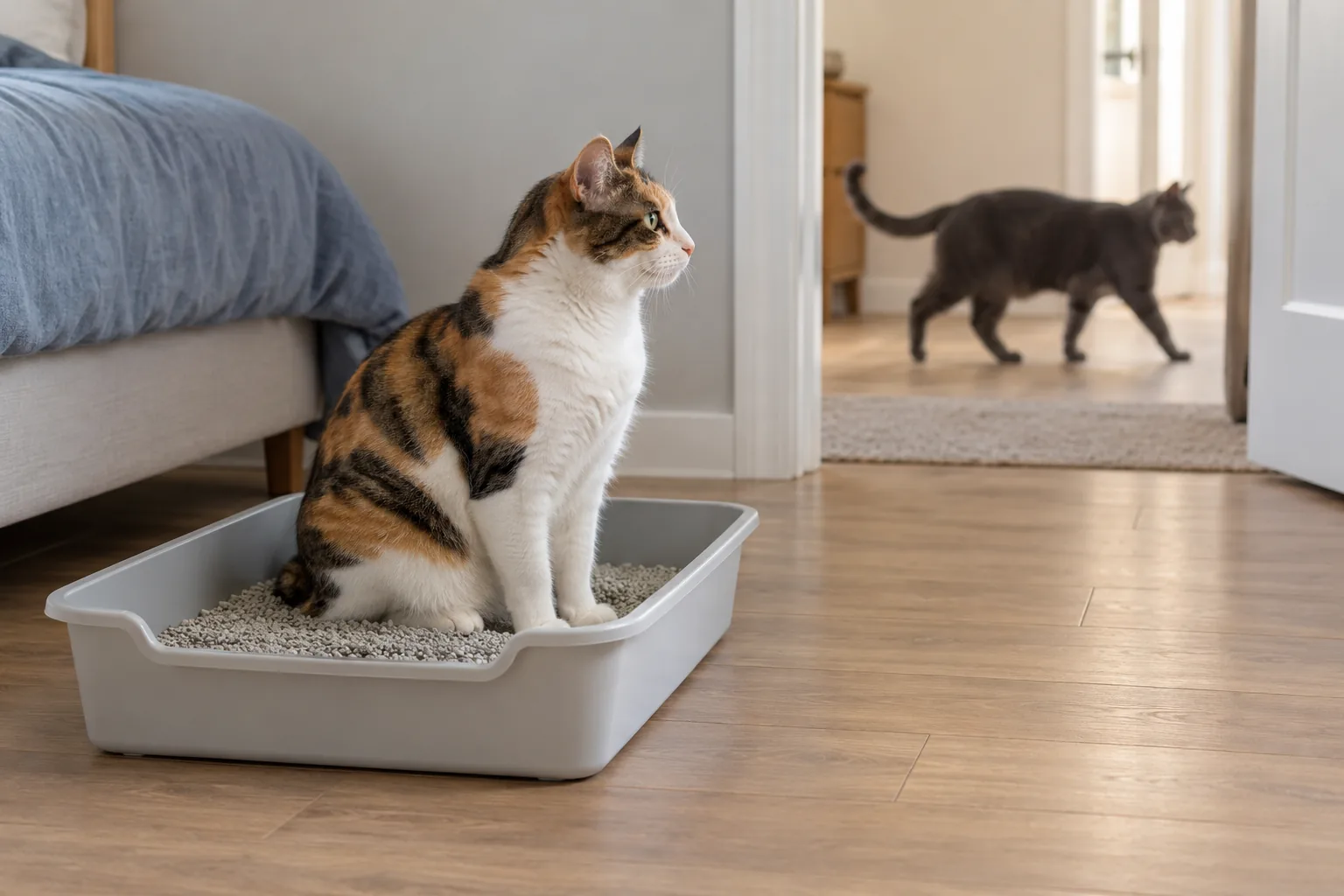
Choose open boxes. The one controlled study of covered and open boxes kept cats apart from their housemates, as behaviorist Mikel Delgado explains on the AVSAB site, so it says nothing about sharing. Cornell wants a 360-degree view and more than one exit for a cat that gets ambushed, and iCatCare advises against top-entry boxes. A lid leaves the cat inside one exit and no view of who waits by it.
Mixed pair? Give a cat that stands to urinate high sides (AAFP and ISFM) and a kitten or stiff older cat a low entry (Cornell); a storage bin with one side cut low does both.
Self-cleaning boxes are often sold for multi-cat homes, yet the guidelines and studies we read take no position on them. San Diego Humane Society suggests them for some multi-cat homes and notes they tend to be enclosed and small; Delgado advises against them. The litter box sizes and styles guide compares shapes by length.
Keeping three boxes clean
Scoop all three at least daily, twice if you can, as iCatCare’s 2025 guidelines prefer. In a multi-cat study described in Heath’s review, cats chose clean boxes over used ones, but which cat had used a box made no difference.
Full changes run from every 1 to 4 weeks (AAFP and ISFM) or 1 to 2 weeks (iCatCare) to roughly monthly (San Diego Humane Society). Cornell sets no interval but says the more cats share a box, the more often it needs one, so two cats belong at the short end: three refills of 1 to 2 in (2.5 to 5.1 cm) of litter, Cornell’s depth, carried up a walk-up. The litter box smell guide has the full routine.
Questions about litter boxes for two cats
Is it okay for two cats to share one litter box?
It is common but falls short of every published count: in the UK survey, 27.1% of homes with trays had fewer trays than cats. One box sits below both the per-cat count of three and the per-group count of two, and Heath’s review names multi-cat living as a house-soiling risk factor.
What size litter box do you need for two cats?
Size follows the cat, not the headcount. Make every box no shorter than 1.5 times the longer cat, nose to tail base by the AAFP and ISFM yardstick, so a 17 in (43 cm) cat needs 25.5 in (65 cm). One oversized box cannot replace the other two, because it still sits in one place.
Do I really need 3 litter boxes for 2 cats?
Three is the published starting point, not a proven minimum, with no study behind it that we could find. A bonded pair makes the strongest case for two, while cats that avoid each other make the weakest. Start with three if the floor allows, and never drop below two for any pair.
What if two cats ignore the third litter box?
Check the spot first. A box both cats skip may sit near a washer, beside the bowls or behind a door that swings shut, so try a quieter place. If it still goes unused and the pair groom each other, AAHA’s per-group count allows two. Cats that avoid each other keep all three.
Where should litter boxes go for two cats?
In different rooms, or at the far ends of a studio with furniture between them, never side by side. Each cat should reach one without passing the other’s favorite spot, and every box needs two ways out. The placement guide checks the usual apartment spots.
How many litter boxes do you need when a roommate has a cat too?
Plan on three, and treat the two as strangers until they show otherwise. Put one box in each person’s room, where that cat spends its time, and the third in shared space such as the bathroom, its door held open. Introduce them gradually, as the AAFP and ISFM advise, and agree on who scoops which box.
Next step. Size all three boxes for the longer cat, using our large litter box comparison.
Sources
- AAHA and AAFP, “2021 Feline Life Stage Guidelines: general litter box considerations,” aaha.org, read Oct 16, 2026.
- AAFP and ISFM, “Guidelines for Diagnosing and Solving House-Soiling Behavior in Cats,” Journal of Feline Medicine and Surgery, 2014, journals.sagepub.com, read Oct 16, 2026.
- AAFP and ISFM, “Feline Environmental Needs Guidelines,” Journal of Feline Medicine and Surgery, 2013, journals.sagepub.com, read Oct 16, 2026.
- Cornell Feline Health Center, “Feline Behavior Problems: House Soiling,” vet.cornell.edu, read Oct 16, 2026.
- Cornell Feline Health Center, “Feline Lower Urinary Tract Disease,” vet.cornell.edu, read Oct 16, 2026.
- International Cat Care, “2025 iCatCare consensus guidelines on the diagnosis and management of lower urinary tract diseases in cats,” PubMed Central, read Oct 16, 2026.
- Heath, “Unacceptable indoor elimination,” Journal of Feline Medicine and Surgery, 2019, journals.sagepub.com, read Oct 16, 2026.
- Delgado, “What does the science say about cats and covered litter boxes?,” American Veterinary Society of Animal Behavior, 2024, avsab.org, read Oct 16, 2026.
- Taylor and others, “Feline management practices and resource provision in the UK,” Veterinary Record, 2025, PubMed Central, read Oct 16, 2026.
- San Diego Humane Society, “Litter Boxes 101,” sdhumane.org, read Oct 16, 2026.
- San Diego Humane Society, “Adopting: Cat Confinement in a New Home,” sdhumane.org, read Oct 16, 2026.