An eco-friendly cat litter swaps mined clay for something farmed or recycled: walnut shells, corn, wheat, grass seed or paper. All six bags below clear that bar. Beyond it, their green claims barely overlap, and the one that matters most in a rental sits in the small print: where the used litter goes.
We read each maker’s product page, plus its sustainability page or FAQ. How these litters feel, clump and shed dust is the subject of our types of cat litter comparison; this page covers the green claims and the disposal.
Apartment Cats earns a commission when you buy through the Amazon links on this page, at no cost to you. Picks are made on published specs, never on commission. How this works
Which eco-friendly litter to choose if…
Our pick for most small apartments: SmartCat All Natural Clumping. Of the six, it is the one whose maker describes the litter most cats prefer by the veterinary guidelines: soft, sand-like and clumping, with no added fragrance. Pioneer Pet also puts its weight at half that of clay clumping litter, and with no elevator, that is the line that matters. Its green case is two words on the page, renewable and biodegradable, with no figure behind either.
Will it fit? SmartCat All Natural Clumping

- Bag
- 10 lb (4.5 kg); the listing also offers 5 and 20 lb
- Made of
- Grass farmed in the USA, with no added fragrance
- Weight claim
- Half of what clumping clay weighs, by the maker’s count
- Best for
- A cat used to fine litter, in a building with stairs
- Skip if
- Stray grains bother you: the maker expects some tracking and suggests a rug by the box
Details
Product prices and availability are accurate as of the date/time indicated and are subject to change. Any price and availability information displayed on Amazon.com at the time of purchase will apply to the purchase of this product.Find the line that sounds like your home:
- You carry every bag up stairsSmartCat.$17.99 Price as of Nov 3, 2026, 04:24 UTCCheck price at Amazon
Details
Product prices and availability are accurate as of the date/time indicated and are subject to change. Any price and availability information displayed on Amazon.com at the time of purchase will apply to the purchase of this product. - Litter tracked across a studio floor is the real complaintSustainably Yours Large-Grain, with a mat.$21.99 Price as of Nov 3, 2026, 04:24 UTCCheck price at Amazon
Details
Product prices and availability are accurate as of the date/time indicated and are subject to change. Any price and availability information displayed on Amazon.com at the time of purchase will apply to the purchase of this product. - You want numbers behind the green claimNaturally Fresh, unreviewed as its life-cycle analysis is.$22.99 Price as of Nov 3, 2026, 04:24 UTCCheck price at Amazon
Details
Product prices and availability are accurate as of the date/time indicated and are subject to change. Any price and availability information displayed on Amazon.com at the time of purchase will apply to the purchase of this product. - Two to four cats share the boxesWorld’s Best Multiple Cat.$19.15 Price as of Nov 3, 2026, 04:24 UTCCheck price at Amazon
Details
Product prices and availability are accurate as of the date/time indicated and are subject to change. Any price and availability information displayed on Amazon.com at the time of purchase will apply to the purchase of this product. - Recycled beats farmed for you, and you can face a full change every few daysFresh News.$12.99 Price as of Nov 3, 2026, 04:24 UTCCheck price at Amazon
Details
Product prices and availability are accurate as of the date/time indicated and are subject to change. Any price and availability information displayed on Amazon.com at the time of purchase will apply to the purchase of this product. - Your cat uses a clay box without fussKeep the clay, and switch slowly if you switch at all.


Key takeaways
- Only Naturally Fresh puts numbers on its green case, and by its footnote, no third-party authority reviewed the life-cycle results. → the green words
- Bag used litter for the trash: San Diego Humane Society says flush none, even kinds sold as flushable, and keep it out of gardens. → disposal in a rental
- Buy less by pouring less: Cornell’s figure for most cats is about 1 to 2 in (2.5 to 5.1 cm), and four of these six makers ask for more. → pouring less
- Is plant litter healthier than clay? We found no veterinary research on corn, wheat or walnut litter, so the evidence does not say. → the health question
Eco-friendly cat litter brands compared
Claims come from each maker’s pages, read Oct 17, 2026; “listing” marks a bag weight from Amazon.
| Litter | Made from | Where it comes from, per the maker | Clumps | Bag | Disposal, per the maker |
|---|---|---|---|---|---|
| Naturally Fresh Quick-Clumping (walnut) | Walnut shells | Walnut groves; solar-run production within a 16-mile radius | Yes | 16 lb (7.3 kg), listing | Would rather you not flush; suggests compostable bags |
| World’s Best Cat Litter Multiple Cat Unscented (corn) | Whole-kernel corn and a plant-based odor ingredient | US corn from Midwest farmland; made in the USA | Yes | 15 lb (6.8 kg) | Flushable, 1 to 2 clumps at a time, in well-maintained systems |
| Sustainably Yours Large-Grain (corn and cassava) | Corn and cassava | Renewable crops, mostly GMO, the maker admits | Yes | 10 lb (4.5 kg), listing | Trash; no longer recommends flushing any litter |
| sWheat Scoop Multi-Cat (wheat) | Wheat | Grown in the USA on regional farms | Yes | 25 lb (11.3 kg), listing | A few clumps, soaked 20 minutes; not in California |
| SmartCat All Natural Clumping Cat Litter (grass seed) | Grass | 100% USA-farmed grasses | Yes | 10 lb (4.5 kg) | None given on its page |
| Fresh News Original (paper) | Recycled paper, baking soda, zeolite | Paper from recycling centers; made in Michigan | No | 12 lb (5.4 kg) | Trash only; never flushed or buried |
Worried more about tracking than weight? See the second card.
Will it fit? Sustainably Yours Large-Grain
- Bag
- 10 lb (4.5 kg), by the listing
- Made of
- Corn and cassava only, never scented, per the maker
- Packaging
- Single-material polyethylene, codes 2 and 4, that the maker calls highly recyclable; 51% of it is bio-plastic from sugar cane
- Best for
- A one-room home where litter on the floor is the problem: the large grain is meant to stay in the box
- Skip if
- Your cat is fussy about texture: no grain size is printed, and most cats prefer fine litter
Details
Product prices and availability are accurate as of the date/time indicated and are subject to change. Any price and availability information displayed on Amazon.com at the time of purchase will apply to the purchase of this product.What the green words on a litter bag cover
Five words carry most of the green case. Here is who uses each, and how far the claim goes:
- Renewable: World’s Best, sWheat Scoop, SmartCat and Sustainably Yours, each meaning a farmed crop instead of mined clay.
- Biodegradable: SmartCat for its grass, Fresh News for its paper, Naturally Fresh in a blog post. None says how fast, or where.
- Flushable: World’s Best and sWheat Scoop, both with limits.
- Compostable: Naturally Fresh, on its sustainability page and its blog.
- Recycled: only Fresh News.
Naturally Fresh alone puts figures on its case. A life-cycle analysis by the firm Trayak, arranged through the Pet Sustainability Coalition, credits its litter production with “nearly 42% fewer fossil fuels” and “97% fewer mineral resources” than clay litter. Its footnote says no third-party authority reviewed the results. A third line, nearly 130% fewer greenhouse gases thanks to 7,800 solar panels, has no footnote and no word on how a cut can pass 100%.
Packaging gets even less attention. Only Sustainably Yours says what its bag is made of (see its card above), and Naturally Fresh lists fully recyclable packaging as a goal on its roadmap.
Walnut cat litter: Naturally Fresh
Naturally Fresh Quick-Clumping is walnut shell litter from Eco-Shell, whose sustainability page goes further than most: thousands of walnut trees planted a year, production kept within a 16-mile radius to hold down transport emissions, solar-run plants. The product page promises clumps in as little as 15 minutes.
Its blog is frank about flushing. Walnut litter is septic-safe in small portions, Naturally Fresh writes, but it would rather you not flush, and an apartment building may have its own rules. It suggests compostable waste bags instead, or composted litter for flower beds, which runs into a shelter’s advice below. Skip it if you want a maker’s word that this formula is fragrance free; the page gives none.
Corn cat litter: World’s Best and Sustainably Yours
World’s Best Multiple Cat Unscented is whole-kernel corn from Midwest farmland, by the maker’s account, made in the USA. Its extra odor ingredient comes, the FAQ says, from a natural plant material used for animal feed. World’s Best sets its renewable corn against clay, which it calls heavy, dusty and “produced from mining and drilling.”
No brand here leans harder on flushing. The page calls every formula flushable and septic-safe, then narrows that in a footnote to well-maintained systems and one or two clumps at a time, with California’s notice against flushing cat feces right beneath. Its usage table covers one to four cats: a 15 lb bag lasts 36 days or more with two, by the maker’s figures, which may vary.
Sustainably Yours Large-Grain uses just two crops, which its maker calls climate resilient and high-yielding. Its FAQ is unusually candid: most corn and cassava grown today is GMO, so an entirely non-GMO litter is out of reach at scale. On disposal it changed course and now says the trash, citing vulnerable ecosystems and sewage rules that differ from city to city.
The large grain is there to cut tracking, and the maker also suggests a big mat in front of the box (see our litter mat comparison). Skip World’s Best if flushing was the appeal and your building is old. Skip Sustainably Yours if your cat has only known fine, sand-like litter.
Wheat cat litter: sWheat Scoop
sWheat Scoop Multi-Cat is wheat and nothing else, grown in the USA on regional farms. Its eco page says “everything we take from the earth can go right back into the ground,” without saying how. Its flushing rules are the most specific here: a few clumps at a time, soaked 20 minutes, never down a sump pump hole that pumps uphill. The product page then asks Californians not to flush cat litter at all.
Two other lines count in a small home. sWheat Scoop wants 4 in (10 cm) of litter, double what Cornell says most cats like, kept sealed somewhere cool and dry until it is poured. If your cat eats it, the FAQ says, call your vet. Skip wheat if your home has no cool, dry corner for an open 25 lb bag.
Grass seed cat litter: SmartCat
Pioneer Pet makes SmartCat All Natural Clumping Cat Litter from 100% USA-farmed grasses and labels it clay free, fragrance free, renewable and biodegradable. Those last two stand alone, with no standard, study or timeframe beside them. What the page does describe is the litter itself. Soft and sand-like, listed at 99% dust free.
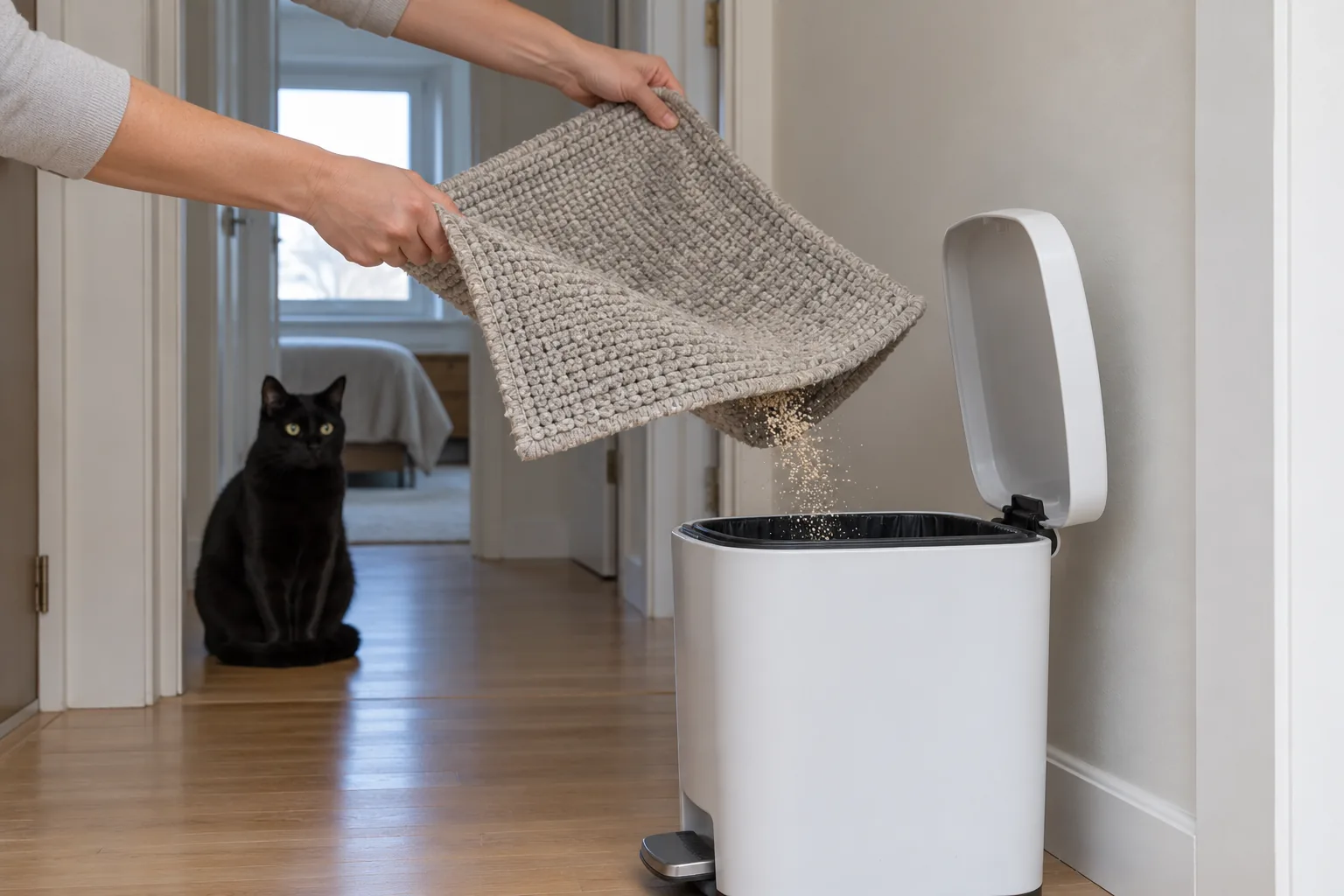
Light grains travel, and Pioneer Pet says so: it recommends a rug in front of the box, shaken out at each daily cleaning. There is no disposal advice, so the trash it is. Skip it if the box sits on a dark floor, since the maker calls the color cream and every stray grain will show.
Recycled paper cat litter: Fresh News
Fresh News Original is the one litter here made from something already used. Its paper comes from recycling centers and from the maker’s Papergator collection program, and the litter is made in Michigan with baking soda and zeolite. Fresh News calls the paper biodegradable. Its compostable answer, though, covers only its small animal bedding.
It is also the strictest maker on disposal: trash only, never flushed, buried or tipped outdoors. The pellets do not clump, so San Diego Humane Society calls for a full change every 2 to 3 days, against about monthly for clumping litter. Each change is another bag up the stairs. Skip paper for a cat raised on fine litter; pellets are far from the sand-like texture most cats prefer.
Flushing, composting or the trash: disposal in a rental
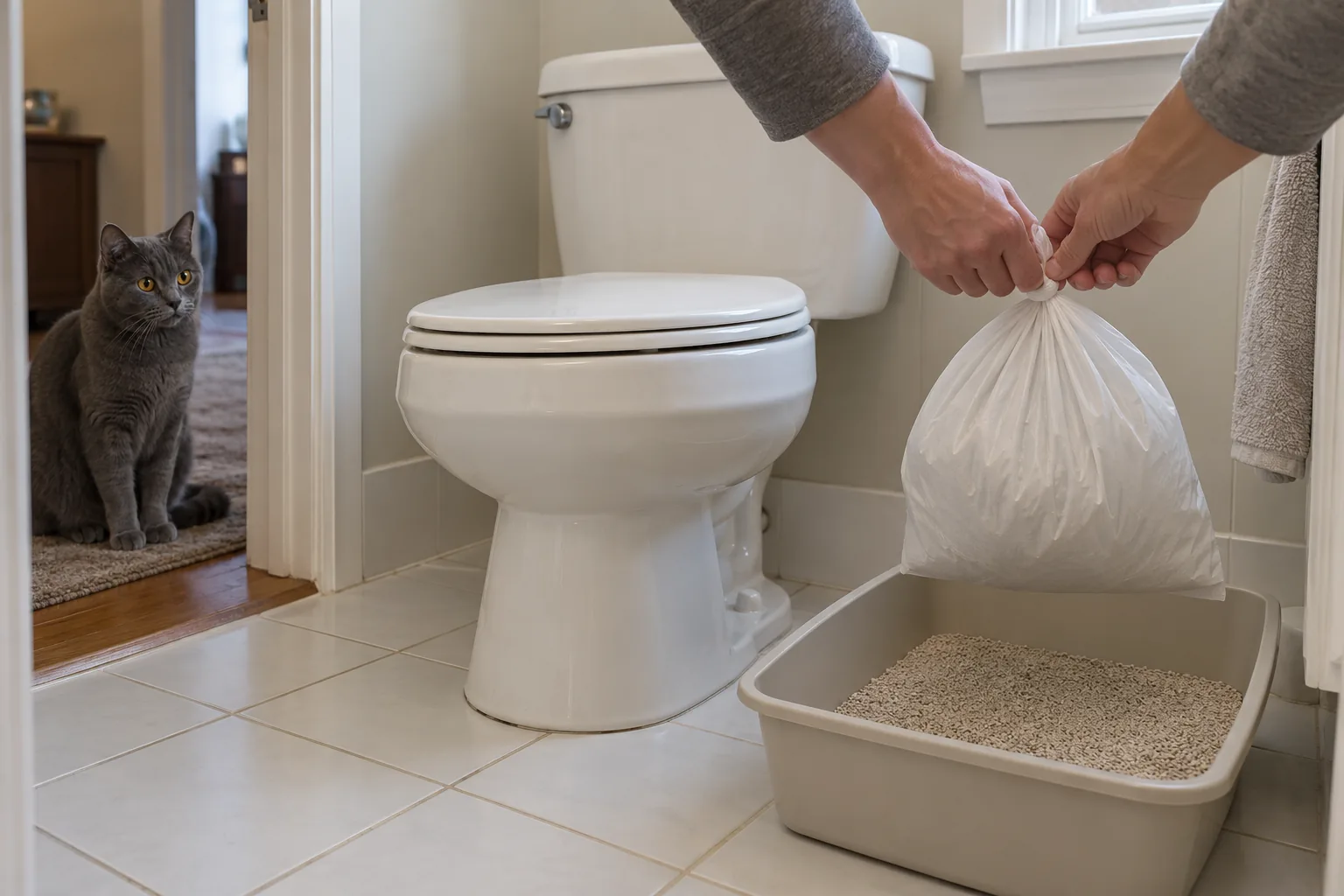
Bag it and put it in the trash. San Diego Humane Society says not to flush any litter, even the kinds sold as flushable, because it can clog older pipes. It also says to keep used litter out of gardens and yards, since parasites in it may survive outdoor temperatures. The advice is the same for walnut, corn, wheat, grass and paper.
California writes part of this into law. AB 2485, its 2006 sea otter act, records the Legislature’s finding that studies link cat feces, the parasite Toxoplasma gondii and sea otter deaths, and requires any cat litter sold in the state to carry a statement against flushing. That is why both flushable brands here print it.
For renters our advice is flat: do not flush. The drain stack is shared with the units above and below you, and a backup there becomes your landlord’s problem, then yours. Composting fails too. A balcony planter or a community garden plot is still a garden, so used litter stays out of both, whatever a walnut maker’s blog suggests.
Flushable cat litter: what to check before you flush
Two makers here do call their litter flushable. World’s Best says every one of its corn formulas has been tested as sewer- and septic-safe, and its “flushable” asterisk points to the footnote covered in the corn section above. Naturally Fresh calls its walnut litter septic-safe when flushed in small portions. Those are the makers’ own claims, and we found no independent test of either.
Even Naturally Fresh tells apartment dwellers to check first: a building may have rules about flushing litter because of its plumbing, and local and state regulations can forbid it. It also warns that a clay litter could clog pipes or damage a septic system, so a clay blend never goes in the toilet. Add the lease and California’s required no-flush statement, and for a renter every check lands on the same answer: bag it.
What you can change is the trip to the bin. A sealed pail beside the box cuts the trips; our comparison of litter disposal bins measures how much floor each one takes.
Pregnant? Cornell’s Feline Health Center advises leaving the litter box to someone else. Where that is impossible, gloves and a hand wash afterward lower the risk, and scooping daily matters because the eggs take at least a day in the box to become infective. Ask your own doctor or midwife too.
Pour less: the depth that sets how much you buy
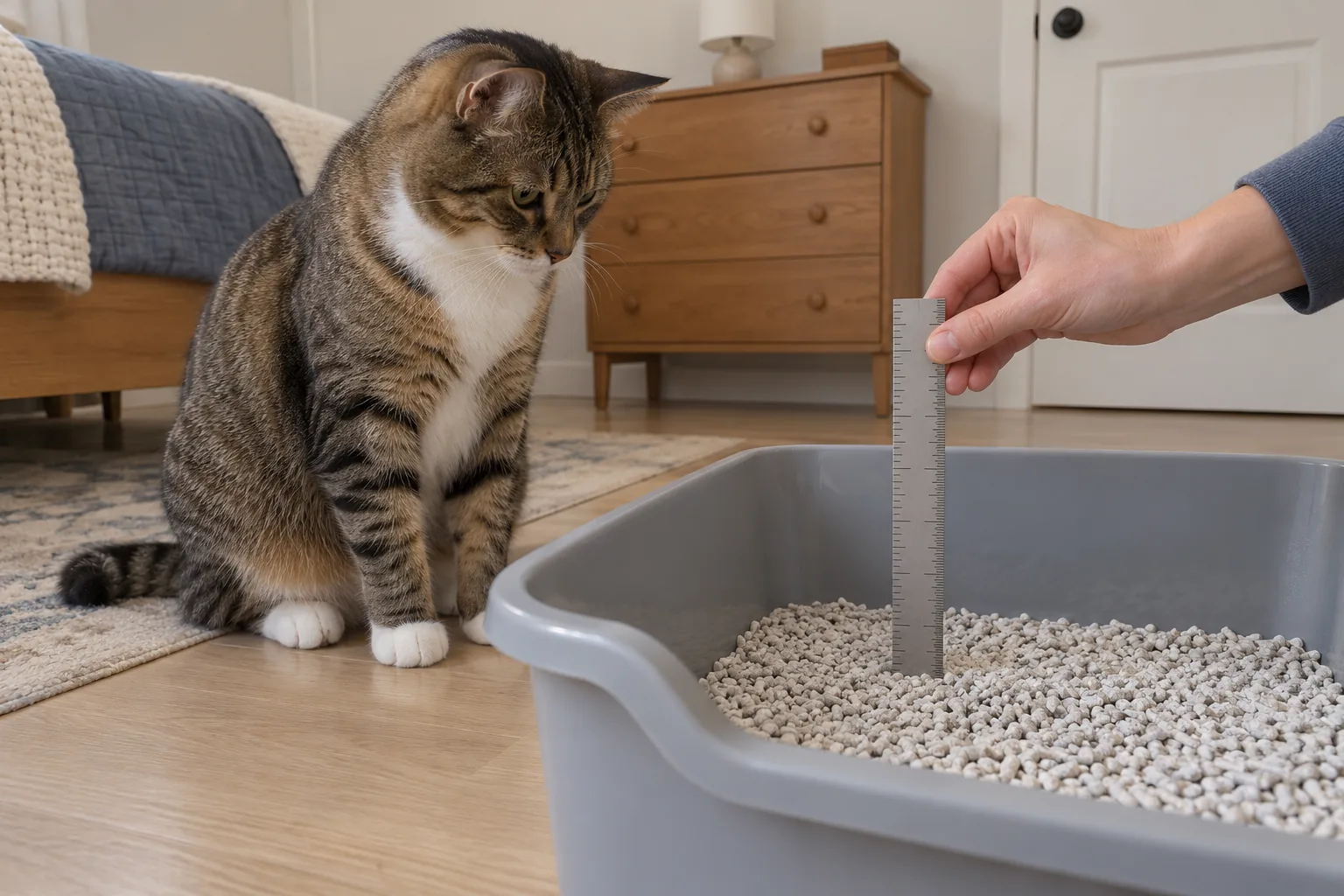
The greenest litter is the litter you never buy, and depth decides how much that is. Cornell’s figure for what most cats like is about 1 to 2 in (2.5 to 5.1 cm), with a floor near 1.25 in (3 cm) in the AAFP and ISFM guidelines. These makers ask for more: 2 to 3 in (5.1 to 7.6 cm) for World’s Best, 3 in (7.6 cm) for Naturally Fresh and Sustainably Yours, 4 in (10 cm) for sWheat Scoop.
Naturally Fresh promises at least 30 days between full changes for one cat at 3 in (7.6 cm), and World’s Best rates its 8 lb bag at 38 days or more for one cat. Neither shows its working, and the guidelines keep their own clock for emptying and washing the box: every 1 to 2 weeks in iCatCare’s 2025 consensus, 1 to 4 weeks from the AAFP and ISFM.
SmartCat is the only maker of the six to put a number on weight against clay; our lightweight cat litter guide for apartment stairs compares bags by weight. The cat measuring tool turns your box’s size and depth into liters per fill and per month.
When a new litter seems to cause trouble. Go back to the old litter first. If your cat still goes outside the box, book a vet visit before trying anything else: Cornell lists urinary tract inflammation, kidney and thyroid disease, diabetes and age-related mobility problems, and sick cats may not act sick. A cat that strains and passes little or no urine needs a vet at once; Cornell calls a urethral blockage an absolute emergency.
How these eco-friendly litters were chosen
The shortlist covered every material in the topic, walnut, corn, wheat, grass seed and paper, which came to six litters from six makers. Each was compared on the maker’s own sourcing words, bag weight, whether it clumps and where used litter may go. Okocat’s wood litter, pine litters and tofu brands such as pidan fell outside those five materials, and Naturally Fresh’s Ultra Odor Control was skipped because its page does not state a scent. Only one maker backs its green claims with figures, and its footnote says no outside party checked them. Veterinary research on corn, wheat and walnut litters turned up nothing.
Questions about eco-friendly cat litter
What is the most environmentally friendly cat litter?
Nobody has ranked them independently, as far as we could find. Naturally Fresh is the only maker here with life-cycle figures, and its own footnote says no third party reviewed them. On what is published, choose a plant or paper litter your cat accepts, pour it only as deep as needed, and bin the used litter.
Is plant-based cat litter healthier for cats than clay?
The evidence does not say so. We found no veterinary study of corn, wheat or walnut litter. In a 2025 trial of three clumping litters, cats used clay most, then wood, then paper, and the maker of all three litters employs the study’s first author. What guidelines describe is texture and scent: fine and unscented.
Can used cat litter go in balcony planters or a garden compost bin?
Keep it out of both. San Diego Humane Society advises against putting used litter in gardens or yards, because parasites in it can outlast outdoor weather, and a planter counts. Naturally Fresh’s blog suggests composted litter for flower beds; we side with the shelter and bag it for the trash.
Is flushable cat litter safe for a septic tank?
World’s Best and Naturally Fresh both say theirs is septic-safe, Naturally Fresh only in small portions, but we could not check either claim against an independent test. San Diego Humane Society advises flushing no litter at all, and Naturally Fresh itself warns that clay litter could damage a septic system.
Where do I keep a big bag of plant litter in a small apartment?
Somewhere cool and dry: Sustainably Yours and sWheat Scoop both say so, and sWheat Scoop adds a sealed bag or container. A closet floor suits it better than the cabinet under a bathroom sink. When no spot stays dry, buy smaller bags, such as World’s Best’s 8 lb size.
How do I switch litters with room for only one box?
Change the contents gradually instead of the box. Cornell’s advice is to stir a small share of the new litter into the old and raise it at every top-up. Match clumping to clumping, as World’s Best’s listing warns against mixing its corn with non-clumping litter. A second box, even briefly, lets the cat choose.
Next step. Before the first bag of a new litter, work out how many bags a month your box will take with the cat litter calculator.
Sources
- San Diego Humane Society, “Litter Boxes 101,” sdhumane.org, read Oct 16, 2026.
- Cornell Feline Health Center, “Feline Behavior Problems: House Soiling,” vet.cornell.edu, read Oct 16, 2026.
- California Legislature, “AB 2485, Fish and game: sea otters,” chaptered Sept 18, 2006, leginfo.ca.gov, read Oct 17, 2026.
- Cornell Feline Health Center, “Feline Lower Urinary Tract Disease,” vet.cornell.edu, read Oct 16, 2026.
- AAFP and ISFM, “Guidelines for Diagnosing and Solving House-Soiling Behavior in Cats,” Journal of Feline Medicine and Surgery, 2014, journals.sagepub.com, read Oct 16, 2026.
- Cornell Feline Health Center, “Toxoplasmosis in Cats,” vet.cornell.edu, read Oct 16, 2026.
- International Cat Care, “2025 iCatCare consensus guidelines on the diagnosis and management of lower urinary tract diseases in cats,” published in the Journal of Feline Medicine and Surgery, PubMed Central, read Oct 16, 2026.
- Iwabuchi-Inoue and others, “Litter box size and litter type preference and their associated behavioral changes in cats,” Journal of Veterinary Medical Science, 2025, PubMed Central, read Oct 16, 2026.
- Naturally Fresh, “Quick-Clump Formula,” naturallyfreshlitter.com, read Oct 17, 2026.
- World’s Best Cat Litter, “Multiple Cat Unscented,” worldsbestcatlitter.com, read Oct 17, 2026.
- Naturally Fresh, “Sustainability,” naturallyfreshlitter.com, read Oct 17, 2026.
- Sustainably Yours, “Litters,” sylitter.com, read Oct 17, 2026.
- Naturally Fresh, “To Flush or Not to Flush?,” naturallyfreshlitter.com, read Oct 17, 2026.
- Sustainably Yours, “FAQ,” sylitter.com, read Oct 17, 2026.
- sWheat Scoop, “Multi-Cat,” swheatscoop.com, read Oct 17, 2026.
- Pioneer Pet, “Smart Cat Litter,” pioneerpet.com, read Oct 17, 2026.
- sWheat Scoop, “Eco-Friendly Cat Litter,” swheatscoop.com, read Oct 17, 2026.
- Fresh News, “Fresh News Products,” freshnewslitter.com, read Oct 17, 2026.
- Fresh News, “FAQs,” freshnewslitter.com, read Oct 17, 2026.