


Most cat toys for indoor cats end up under the couch within a week, and the reason is rarely the toy. A feather on a stick does nothing until someone makes it move like prey. This page covers how often vets suggest playing, what a session should look like, and which toy guides help you choose gear that fits a small room.
If your cat ignores the toys you already own, start with toys for bored indoor cats: it sorts toys by the kind of hunt they stand in for.
Who are the toys for?
A bored adult indoors
Pick toys you move yourself first: a wand, a kicker, a ball to bat. Move them like prey, darting away and hiding, never dangled in the cat’s face.
Start with toys for bored indoor cats
An older cat
Short, gentle games on the floor, and fewer of them if the cat has arthritis; the vet can say how much. A new reluctance to play or jump is worth that visit.
Start with low-impact toys for senior cats
A kitten
Kittens play in short bursts and tire fast. A wand keeps your hands at a distance, and string, ribbon and pipe cleaner toys are never left with them. Simple puzzle feeding can start at about 12 weeks.
Then see puzzle feeders for later
A cat alone during the day
Toys a cat can work alone are mostly food puzzles; wand toys go back in the drawer when you leave.
Start with puzzle feeders compared
No budget
Paper balls, boxes with holes and tubes stuffed with paper cost nothing. Skip yarn and ribbon.
Start with DIY toys from household materials
How to use cat toys with indoor cats
| Question | What the sources say |
|---|---|
| How often | Two or three sessions a day of about 10 to 15 minutes each, adjusted for age and energy (AAHA; VCA Animal Hospitals; San Francisco SPCA). This is expert advice, not a trial result. |
| Does a short burst count? | Cats are sprinters, so even a minute of hard play counts (International Cat Care). |
| Shape of a session | Let the cat stalk, chase and pounce, end with a real catch, then offer a treat or the next meal (AAFP and ISFM; AAHA). |
| Laser pointers | Finish on a toy the cat can actually catch (International Cat Care). |
| Hands and feet | Never use them as toys (AAFP and ISFM, 2013). |
In a 2025 UK survey, cats played with for 20 minutes a day or less showed more problem behaviors than cats who got more play. That is an association, not proof that play fixes behavior, yet it lines up with the advice above. Two quarter-hour sessions, one before you leave and one in the evening, fit around most work days.
Toys in a small room
Space shapes the choice more than price does. A wand toy needs only the length of a hallway, while an exercise wheel claims a permanent patch of floor. Food puzzles take almost none and turn a meal into a hunt, and the guidelines suggest one per cat in a home with two. The AAFP and ISFM suggest rotating toys so they stay interesting; VCA goes further and suggests offering four or five at a time from a larger stock and swapping them weekly, which also keeps a studio floor clear.
Put string toys away. Swallowed string, yarn, ribbon or wand line is a veterinary emergency, so these toys go in a closed drawer after every session, as VCA Animal Hospitals advises. Should a piece trail from the mouth, leave it alone and phone a vet straight away.
Toy and play gear guides
Each guide compares toy types, battery life and the noise figures makers publish, and the floor space each one needs while it is in use.
-

Toys for bored indoor cats
Wand, kicker, puzzle, laser and motion toys matched to the steps of a hunt, plus a rotation routine and the signs that need a vet.
13 min readUpdated
-
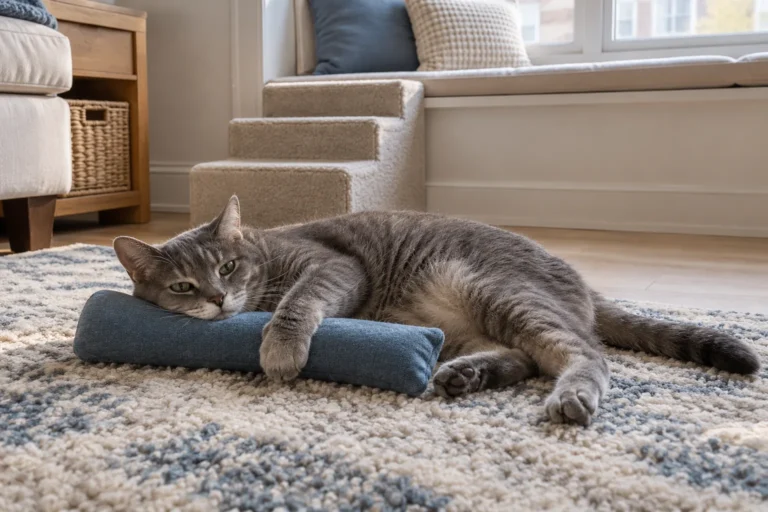
Toys for senior cats: low-impact play
Slow wand games, kickers, easy puzzles and scent toys for a stiff older cat, plus steps to the window and signs that need a vet.
11 min readUpdated
Toy questions
Why would a cat ignore a new toy?
Often the toy is fine and the movement is wrong. Vets describe prey as twitching and darting along the floor or through the air, around corners and under things, and cats differ in whether they chase ground prey or air prey. Try both before you give up on a toy.
Should play come before or after a meal?
Before. Good play copies a hunt: stalk, chase, pounce and a real catch, then a treat or a meal to close it. Timing the last game just ahead of dinner gives the hunt its ending, and a game near bedtime may help it settle down for the night.
Sources
- AAHA, How often should you play with your cat? Read Oct 16, 2026.
- VCA Animal Hospitals, Cat behavior and training: play and play toys. Read Oct 16, 2026.
- San Francisco SPCA, Playing with your cat (resource page). Read Oct 16, 2026.
- International Cat Care, Playing with your cat. Read Oct 16, 2026.
- AAFP and ISFM, Feline Environmental Needs Guidelines, 2013. Read Oct 16, 2026.
- Veterinary Record, feline management practices and resource provision in the UK, 2025. Read Oct 16, 2026.
- VCA Animal Hospitals, Linear foreign body in cats. Read Oct 16, 2026.
- Dantas and others, Food puzzles for cats, 2016. Read Oct 16, 2026.