The best toys for senior cats ask for a pounce, not a leap: a wand lure pulled slowly across the floor, a soft kicker to wrestle lying down, an easy food puzzle, a sniff of catnip or silvervine, or a pot of windowsill catnip and cat grass. Keep sessions short. If your cat has quit playing altogether, see the vet first.
What you need
- A wand toy you can drag along the floor
- A soft kicker
- One flat food puzzle, or an open egg carton
- A catnip or silvervine toy
- Pet steps or a ramp up to the window
Key takeaways
- Fewer jumps, less play, more hiding, a smaller appetite or changed litter habits send an older cat to the vet before any new toy. → when to worry
- Two or three daily sessions of roughly 10 to 15 minutes, per AAHA, VCA and the San Francisco SPCA, are a stiff cat’s ceiling. → short sessions
- Drag the wand slowly along the floor and skip overhead swoops, which invite the leap a stiff cat avoids; afterward it goes in a drawer. → slow wand play
- Choose a flat tray with shallow wells, not a rolling ball, start it no harder than a bowl, and fill it from the day’s food. → easy food puzzles
- If you buy one thing this year, make it steps to the window perch, and keep that window closed or firmly guarded. → a window and a way up
Toys for senior cats, by what they ask of the body
No study we found compares toys for older cats, so the table sorts them by effort, with floor play first: the AAFP’s senior guidelines list decreased jumping among the mobility signs of pain that owners can spot.
| Toy type | What it asks of your cat | How to adapt it |
|---|---|---|
| Wand lure on the floor | A crouch, a few steps, a pounce | Slow it down and let the catch come early |
| Soft kicker | Hugging and kicking while lying down | Leave it where the cat already naps |
| Easy food puzzle | Pawing and licking from a crouch | Start as easy as a bowl; flat beats rolling |
| Catnip or silvervine | Sniffing and rolling | Now and then, sealed away between uses |
| Window perch | Watching the street | Add steps or a ramp |
Why older cats play less, and when to worry
Who counts as senior depends on whose guidance you read. The 2021 AAHA and AAFP feline life stage guidelines say over 10 years old; the AAFP’s senior care guidelines from the same year add that some cats are better treated as seniors from about 8.
Joints are the usual reason the games change. Cornell’s Feline Health Center describes one X-ray study of 100 cats aged 10 and up in which 90 percent of those over 12 showed signs of degenerative joint disease, which includes osteoarthritis. One study, not a census. The signs pass for a calmer personality: fewer jumps, avoided stairs, more resting.
Play still earns its place. The AAFP lists interactive toys and puzzles among the things that may help slow sarcopenia, the loss of muscle that comes with age. International Cat Care says a senior that plays lying down still benefits, and AAHA suggests slower, shorter sessions for seniors, and fewer, gentler ones with arthritis, as your vet advises.
Vet first, then toys. A cat that stops jumping, plays less, hides more, changes its litter habits or eats less needs a vet visit before any new toy. Joint pain and other illness can pass for old age. Cornell advises a checkup for a cat that is slowing down, and the AAFP counts diminished play and a smaller appetite among the subtle signs of pain at home. Once the vet has seen the cat, the AAFP’s 2021 senior care guidelines list a low-entry litter box for older cats with joint disease; the large litter box comparison has one with a 3 in (7.6 cm) front opening.
Short sessions, low to the ground
AAHA, VCA and the San Francisco SPCA suggest two or three sessions daily of roughly 10 to 15 minutes each. For a stiff cat, treat that as a ceiling. International Cat Care calls cats sprinters, so a senior that strolls off after two pounces has finished, not failed. Play on the rug between the bed and the sofa rather than down the hallway, and each chase stays a few steps long. No source we read covers footing, but a cat that skids on laminate has one more reason to stop pouncing.
Slow wand play along the floor
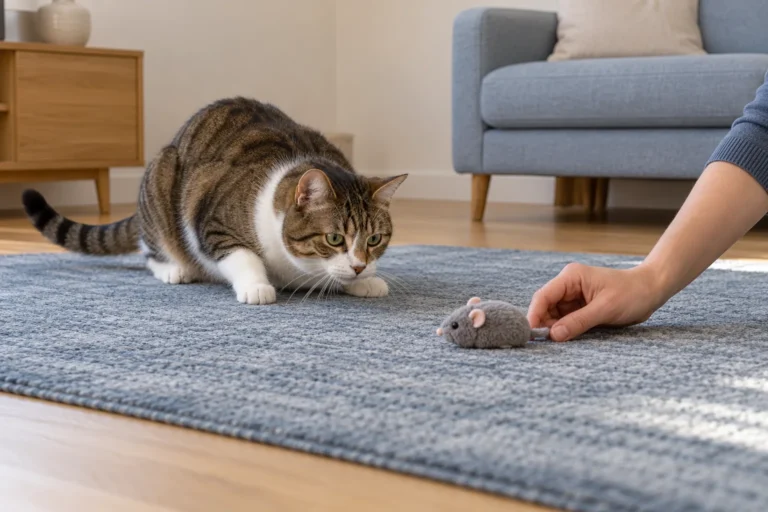
A wand puts the pace in your hands. The San Francisco SPCA says an elderly or out-of-shape cat gets more from ground hunting than from chasing things in the air, so skip the overhead swoop: it invites exactly the leap a stiff cat is avoiding. Run a slow session like this:
- Hold the lure still a body length away, then twitch it.
- Draw it along the floor in stops and starts, like a mouse slipping between chair legs.
- Let the cat catch it within a few steps.
- Pause, and go again only if the cat crouches or stares.
- End with the lure in its paws, then serve a treat or dinner.
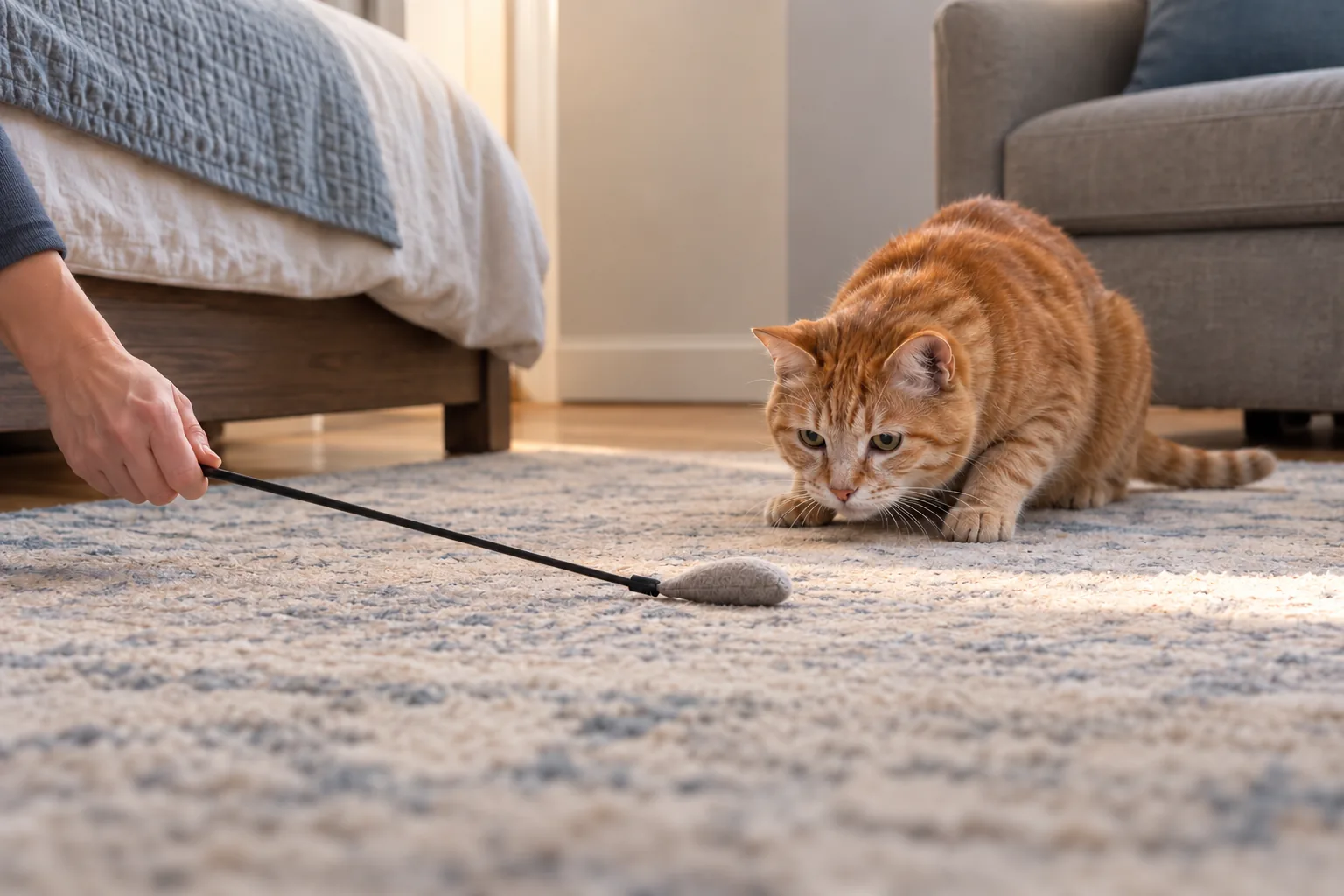
Let an old cat win often. VCA notes that cats lose interest when they never succeed, and the AAFP and ISFM guidelines want the toy caught at the end. Hands and feet stay out of it.
Wands go in a drawer. Swallowed string, ribbon or yarn can kill a cat, and a wand’s cord counts. VCA Animal Hospitals advises against leaving a cat alone with wand toys, so put the wand away after each session. Never pull a strand you see in a cat’s mouth, since the Merck Veterinary Manual warns that pulling can cause a perforation. Call a vet.
Kickers and cat toys for older cats who play lying down
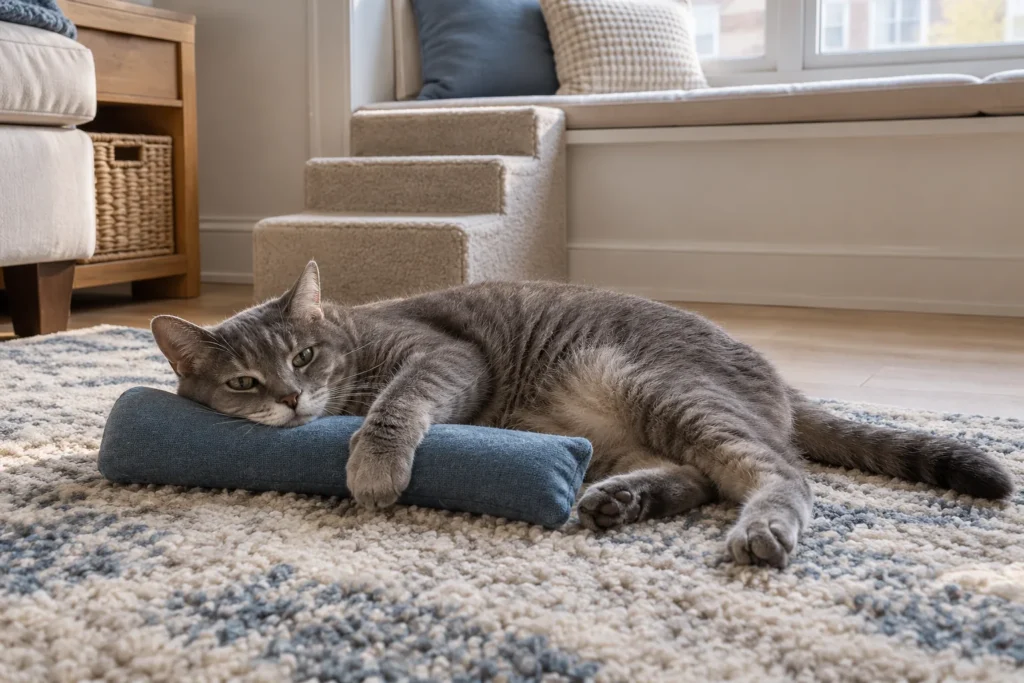
Much of the best play for a stiff cat happens on its side. A kicker is a long, soft toy the cat clutches with its front paws while it bites and rakes with the back legs, so the whole catch needs no standing up. Leave one where your cat already naps, on the bed or a blanket in the sun.
Bring small toys to the cat, too: roll a crinkle ball within reach of its paws, and the crackle lets it follow by ear. Before a soft toy stays out, remove bells and anything small enough to swallow, as the AAFP and ISFM advise. The DIY cat toys guide ties a kicker from two old socks.
Food puzzles that are easy to start
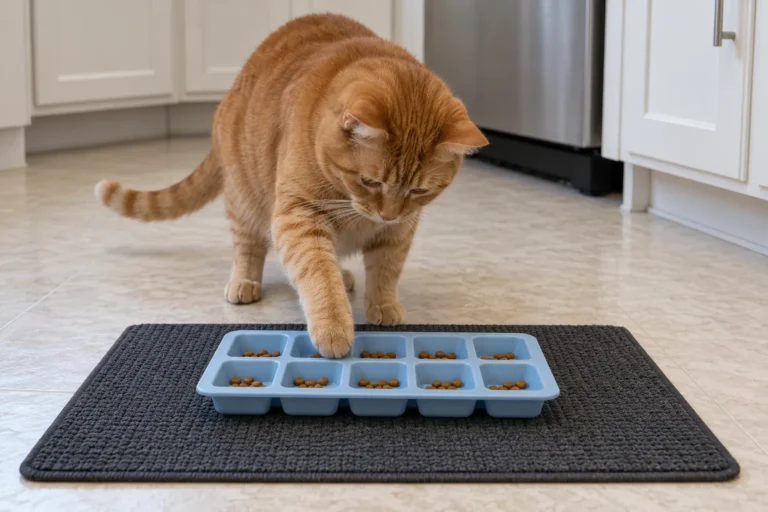
For an older cat the first puzzle should be almost too easy. In their 2016 paper for vets, Dantas and colleagues advise that a new puzzle be no harder at first than eating from a bowl, offered when the cat is hungry next to its usual dish. Fill it from the day’s food, never on top of it.
Pick a flat tray with shallow wells over a treat ball, which rolls off and has to be chased. Shallow wells match the AAFP’s advice on low-sided, wide bowls that spare the whiskers. The AAFP adds that raised bowls may benefit cats with joint disease, so set the puzzle at the height your cat eats at now.
A cat that stops finishing its puzzle is worth a mention to the vet, because the AAFP notes that mouth pain often goes unnoticed at home. For free floor-level foraging, try the scatter mat or the towel roll from the 30 cat enrichment activities.
Scent toys: catnip and silvervine
Scent asks almost nothing of the joints: a cat that responds sniffs, rubs its cheeks and rolls. In Bol and colleagues’ 2017 study, 68% of the cats responded to catnip and 79% to silvervine (the dried fruit galls of Actinidia polygama).
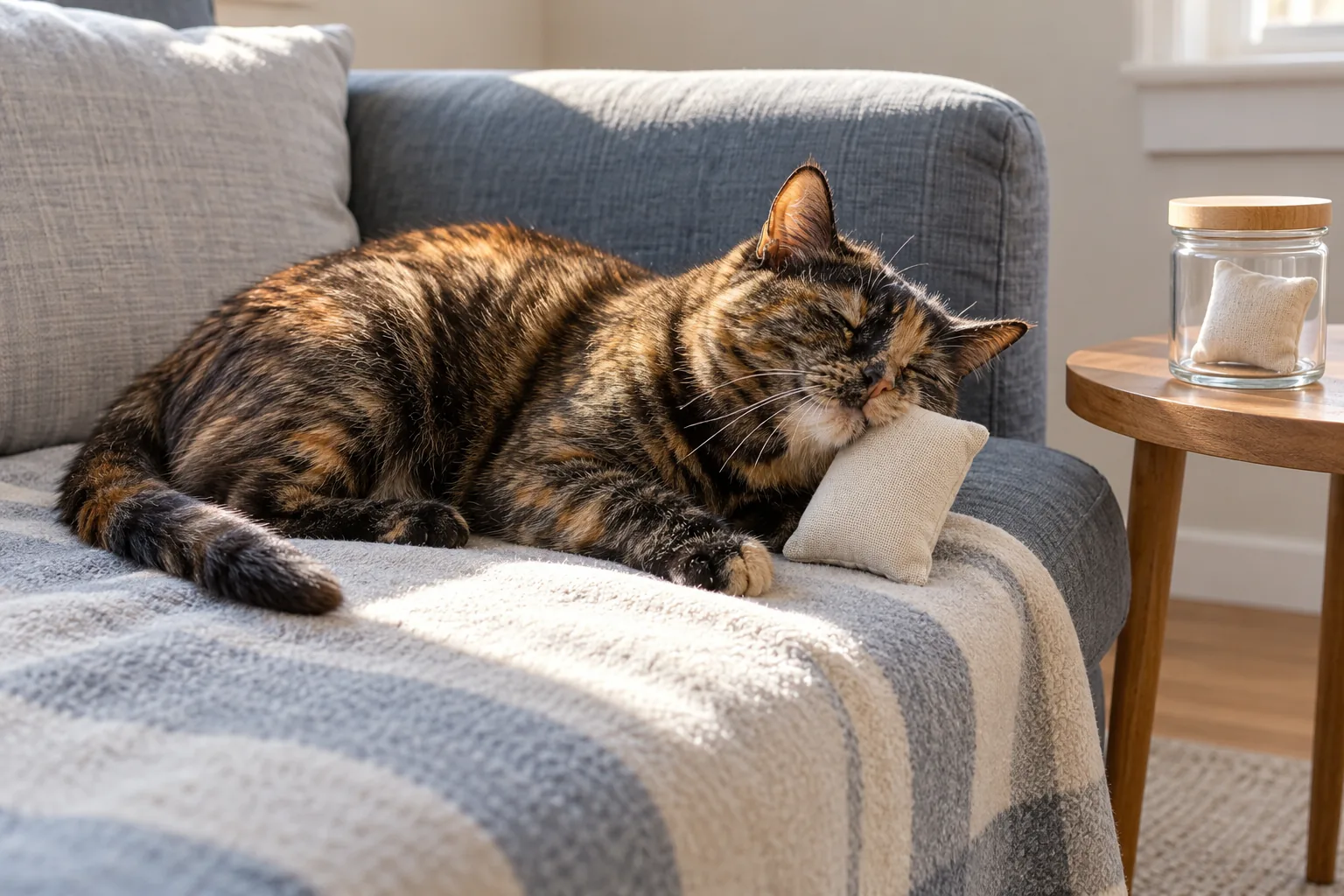
Age did not switch the response off. The older half of that study (ages 5 to 16) responded to as many plants as the younger half, though 35% of their catnip reactions were mild against 12% in the younger half. Silvervine showed no such gap. Five is well short of senior, so treat this as a pointer. If catnip gets a shrug, try silvervine.
Keep it occasional. The ASPCA lists catnip as toxic to cats, since a cat that eats it may vomit or have diarrhea, so seal the toy away between sessions. Vomiting that keeps up after a cat chews one is a reason to call your vet or a pet poison line at once.
Senior cat enrichment beyond toys: a window and a way up
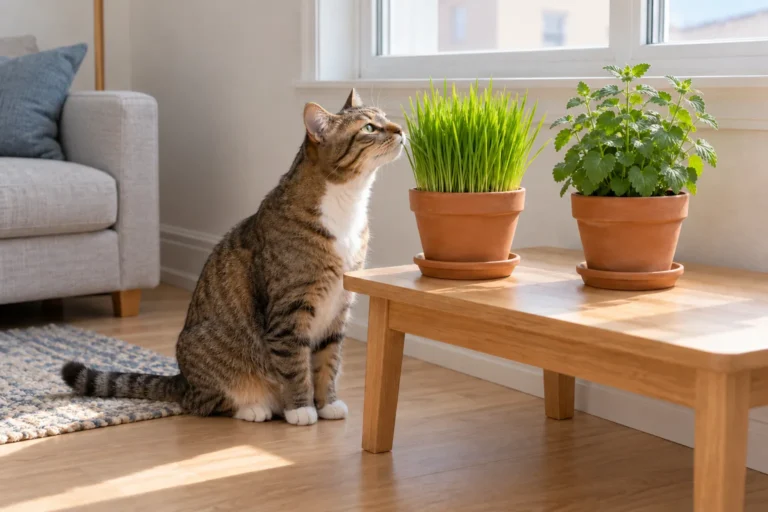
A view does much of the work for a cat that plays less. The 2013 AAFP and ISFM guidelines recommend at least one resting spot with an outdoor view, and the AAFP’s senior guidelines suggest ramps or steps up to favorite places. In an apartment, that lookout is often a sill above a radiator or a shelf over the desk.
Give it an in-between stop: pet stairs, a ramp, or a solid footstool and then a chair. Freestanding steps suit a lease that bans screws. If you buy one thing for an older cat this year, make it the steps, since a perch it can no longer reach is no perch at all. The cat measuring tool checks that a shelf is long enough for a full stretch, and the cat furniture layouts guide shows where perches fit in a studio.
Shut the window behind the perch. Window falls injure enough cats that vets have named the pattern high-rise syndrome. We found nothing showing that an ordinary insect screen will hold a cat, so keep the window by a perch closed, or fitted with a guard fixed firmly in its frame.
A litter box a stiff cat can step into
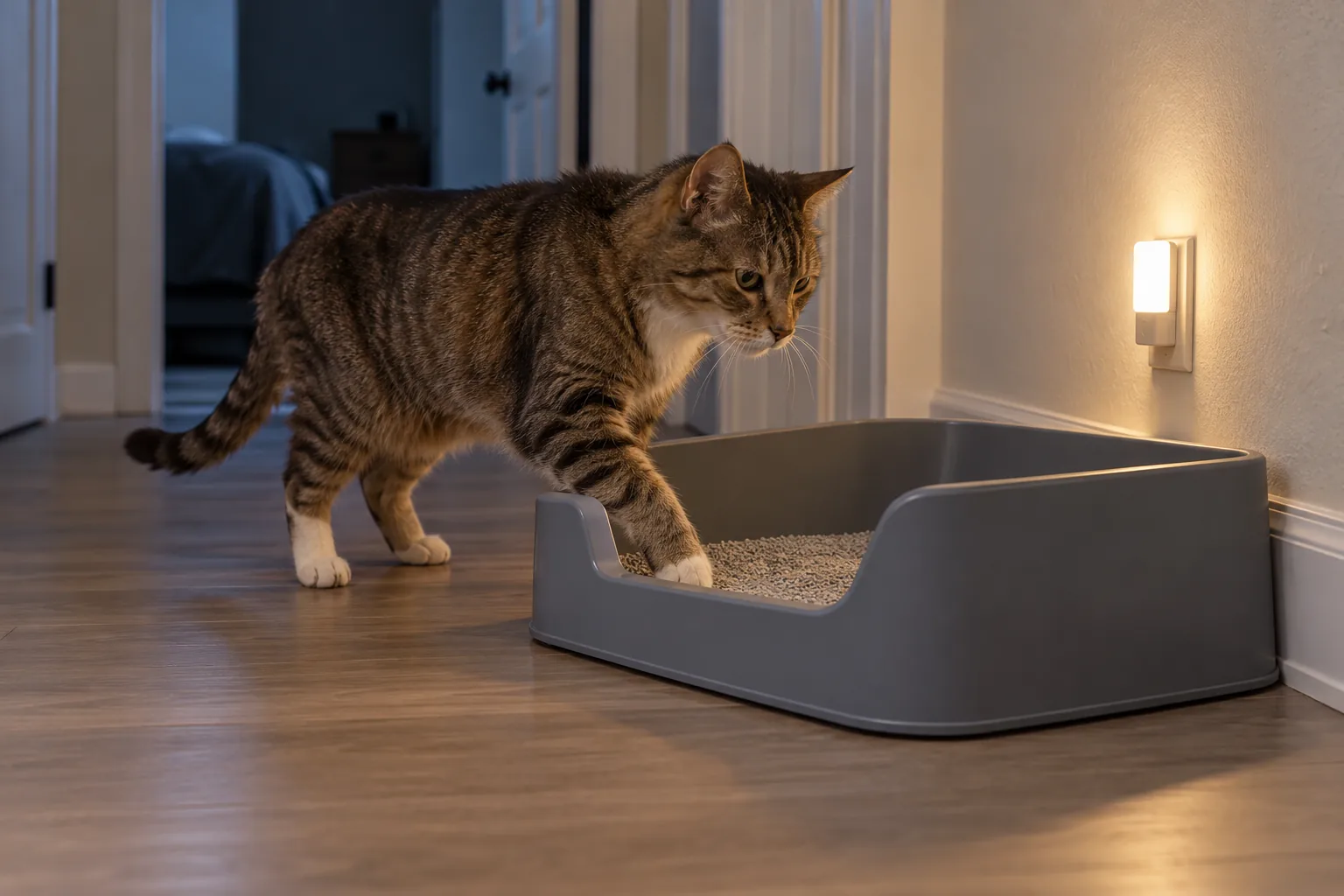
Cornell names trouble hopping in and out of the litter box as a sign of joint pain, and the AAFP senior guidelines suggest a low-entry box. Check the rim height, and light the route: the AAFP also suggests night lights, and a hallway at 3 a.m. counts as dark. The large litter box comparison includes low-entry boxes and a storage tub cut down on one side for an older cat.
Film the play, then show your vet
Change in an old cat creeps in too slowly to notice. The AAFP guidelines encourage owners to keep video of their cat jumping and playing, so the vet can compare it with earlier footage. On a fixed day each month, film the same three things: the jump onto the sofa, a minute of wand play, the walk into the litter box. Two clips side by side say more than “she seems slower.”
The 7-day enrichment plan builder has a Senior setting and builds a week of short sessions from the toys you tick. The toys and play gear page and the enrichment hub cover play at any age.
Questions about toys for older cats
What is the best toy for an elderly cat?
A wand toy pulled slowly along the floor, because you set the pace and the cat never has to jump. Next come a soft kicker it can wrestle lying down and a puzzle that begins as easy as a bowl. With no study comparing toys for older cats, choose by how little each asks of sore joints.
How do I keep my senior cat entertained?
Mix brief play with things to watch and sniff: two or three short floor sessions daily, a puzzle at one meal, a scent toy now and then, and a window perch reached by steps. Rotate toys weekly so they feel new, and let your cat decide when each game ends.
What are some must-haves for a senior cat?
Easy access beats any toy. The AAFP’s 2021 senior care guidelines suggest steps or ramps to favorite spots, a low-entry litter box, night lights, varied resting surfaces, low-sided wide bowls and key resources in several places. Add vet visits at least every six months from age 10 to 15, per the AAFP’s own summary.
How do you set up a loft or two-level apartment for an older cat?
Keep a full set of its things on the level where it spends its days. In its 2021 senior care guidelines, the AAFP wants litter boxes, water, beds and scratching surfaces in several places around the home, and Cornell names avoiding stairs as an easily missed sign of joint pain. A cat that stops climbing needs a vet visit.
Are laser pointers good for older cats?
One page-one list for this search (read Oct 15, 2026) ranks lasers among the best toys for older indoor cats. For a stiff cat, take care: the dot invites sprints and wall leaps, and International Cat Care notes that it can never be caught. Keep it slow and low, then end on a kicker.
Can toys help a cat with arthritis?
Toys are not a treatment for arthritis; diagnosis and care belong to your vet. What they can do is keep a sore cat moving and interested without jumps, through floor-level wand games, kickers and easy puzzles. Muscle is a separate point: the AAFP says toys and puzzles may help slow age-related loss, nothing more.
How do you play with an older cat when a younger one steals the toys?
Play with them apart. Give the younger cat a puzzle or a kicker in another corner, then run a slow floor game for the senior. The AAFP and ISFM want separate key resources and at least one single-cat safe place per cat, so the older one also needs a spot of its own to retreat to.
Next step. For an older cat, start with an easy, flat board from our puzzle feeder comparison.
Sources
- Ray and others, “2021 AAFP Feline Senior Care Guidelines,” Journal of Feline Medicine and Surgery, 2021, journals.sagepub.com, read Oct 16, 2026.
- AAFP, “Updated Senior Care Guidelines,” catvets.com, read Oct 16, 2026.
- Cornell Feline Health Center, “Is Your Cat Slowing Down?” vet.cornell.edu, read Oct 16, 2026.
- AAHA, “How Often Should You Play with Your Cat?” aaha.org, read Oct 16, 2026.
- International Cat Care, “Playing with your cat,” icatcare.org, read Oct 16, 2026.
- San Francisco SPCA, “Playing with Your Cat,” sfspca.org, read Oct 16, 2026.
- VCA Animal Hospitals, “Cat Behavior and Training: Play and Play Toys,” vcahospitals.com, read Oct 16, 2026.
- AAFP and ISFM, “Feline Environmental Needs Guidelines,” Journal of Feline Medicine and Surgery, 2013, journals.sagepub.com, read Oct 16, 2026.
- Dantas and others, “Food puzzles for cats,” Journal of Feline Medicine and Surgery, 2016, journals.sagepub.com, read Oct 16, 2026.
- Bol and others, “Responsiveness of cats to silver vine, Tatarian honeysuckle, valerian and catnip,” BMC Veterinary Research, 2017, PubMed Central, read Oct 16, 2026.
- ASPCA Animal Poison Control, “Toxic and Non-toxic Plants: Catnip,” aspca.org, read Oct 16, 2026.
- Merck Veterinary Manual, “Gastrointestinal Obstruction in Small Animals,” merckvetmanual.com, read Oct 16, 2026.
- Vnuk and others, “Feline high-rise syndrome: 119 cases,” Journal of Feline Medicine and Surgery, 2004, PubMed Central, read Oct 16, 2026.