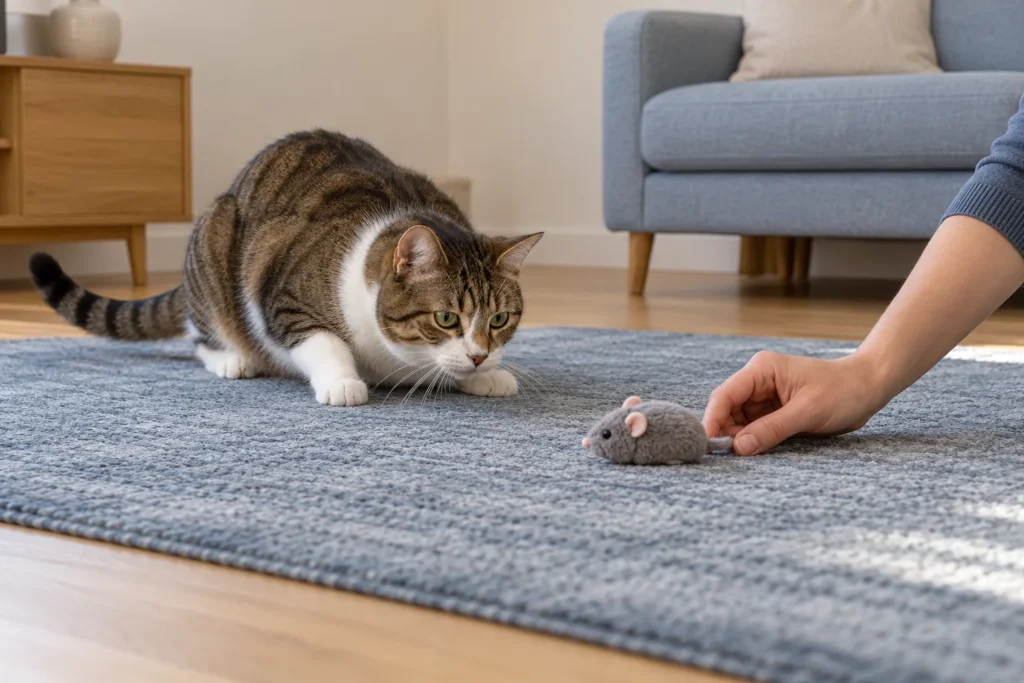
To play with a cat, give it something to hunt: a toy that twitches, darts and hides the way a mouse or a bird would, a chance to catch it at the end, and a treat or a meal right after. The catch is the step that turns chasing into a game the cat can finish.
None of this needs a big room. A hallway, the strip of floor between the bed and the wall, or the gap under a sofa gives a cat enough cover to stalk and enough runway to pounce.
What you need
- A wand toy: a rod with a short line and a feather or small toy mouse on the end.
- Two or three small fur mice, or a few balls of rolled-up paper.
- Treats: a few of your cat’s usual ones, or its next meal ready to serve.
- A towel and a cardboard box or paper bag.
- Somewhere with a door to keep the wand afterward, such as a closet.
How to play with a cat, in short
Pick a time when your cat is lively, usually early morning or evening. Move a wand toy the way prey moves: a twitch, a skitter along the floor, a dash behind a chair leg. Let the cat catch it now and then, slow the game over the last minute, end with one easy catch, then hand over a treat or serve the meal. Put the wand away. Veterinary sources suggest two or three sessions of 10 to 15 minutes a day.
Key takeaways
- Move the toy like small prey and let the cat win: iCatCare warns that a game with no catch can leave a cat frustrated. → moving like prey
- Wands count as string toys: store yours behind a closed door, and never pull a strand from a cat’s mouth; call your vet. → the wand warning
- Before bed, a game makes night waking less likely, AAHA says; with a neighbor below, keep it low and on a rug. → when to play
- International Cat Care and VCA rule out hands and feet as toys, since a kitten taught to chase fingers keeps doing it when grown. → keep hands out
- Stiffness, skipped jumps or a sudden loss of interest in play may mean pain, so have your vet check. → if your cat stops playing
Move the toy like prey, not like a toy
A toy waved back and forth in front of a cat’s nose gets a glance and not much more. The San Francisco SPCA puts it plainly: no prey dangles itself in a cat’s face. Small, sudden movement is what catches the eye. International Cat Care suggests jerky, random flicks of the wand, and the SF SPCA notes that a faint twitch of the toy can be enough to set a cat planning its attack.
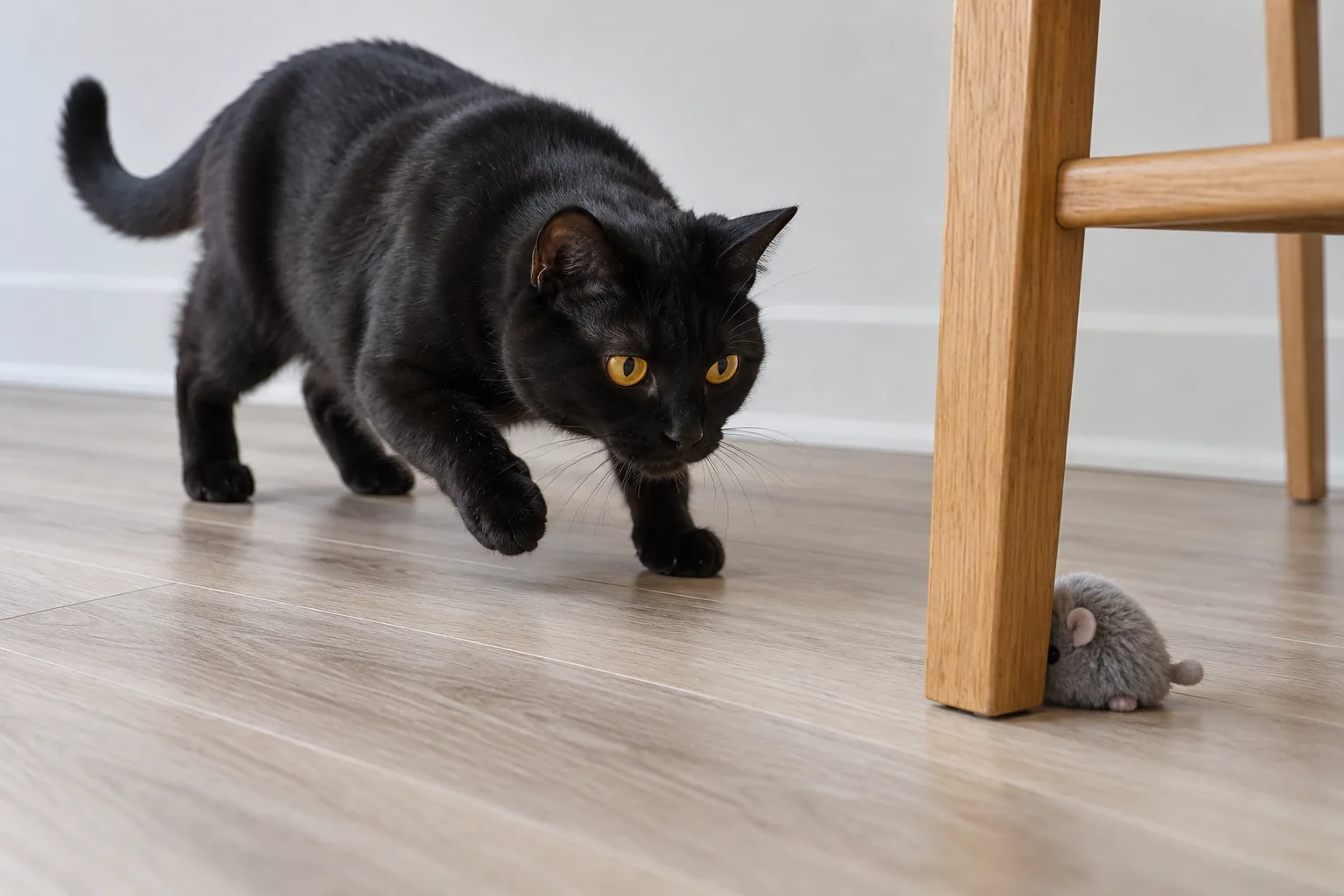
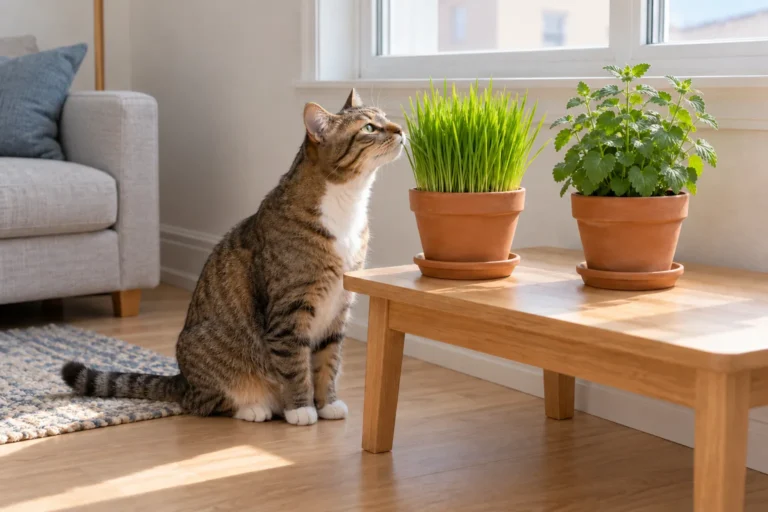
Watch which kind of prey your cat goes for. AAHA’s guidance splits cats into air hunters, who leap at a toy that flutters and swoops like a bird, and ground hunters, who stalk a toy that skitters like a mouse, slips around corners and disappears under things. Try both in the first few sessions and stay with whichever one gets the bigger reaction.
Then let the cat win. iCatCare breaks a hunt into search, stalk, chase, pounce, catch and play with the catch, and warns that games without the catch can leave a cat frustrated. A laser dot is the classic case: iCatCare suggests switching to a wand at the end so the last pounce lands on something real. Our guide to toys for bored cats compares wands, kickers and lasers if you are choosing what to buy.
One session, from stalk to snack
A session that copies a hunt from start to finish runs like this:
- Start small. Lay the toy still on the floor across the room and give it one twitch. A cat that freezes and stares is already playing.
- Build up with short dashes across the cat’s path, a stop, then a dart behind a chair leg or a doorframe.
- Let the cat catch the toy every few pounces and hold it for a moment before the next run.
- Over the last minute, slow down: fewer dashes, shorter distances. Stopping dead, the SF SPCA says, leaves a cat wound up.
- End on an easy catch, then give a treat or put the meal down, as AAHA suggests, so the hunt ends with food.
- Put the wand away behind a door.
The wand never stays out. Its line is string. In the Merck Veterinary Manual, play is how cats usually end up eating string, yarn or floss, and VCA Animal Hospitals says a suspected string blockage means surgery. Close it in a cupboard after every game. If string trails from a cat’s mouth, leave it in place and phone your vet.
Five games for a small apartment
Each of these fits in a studio. Rotate them through the week rather than playing the same one every day.
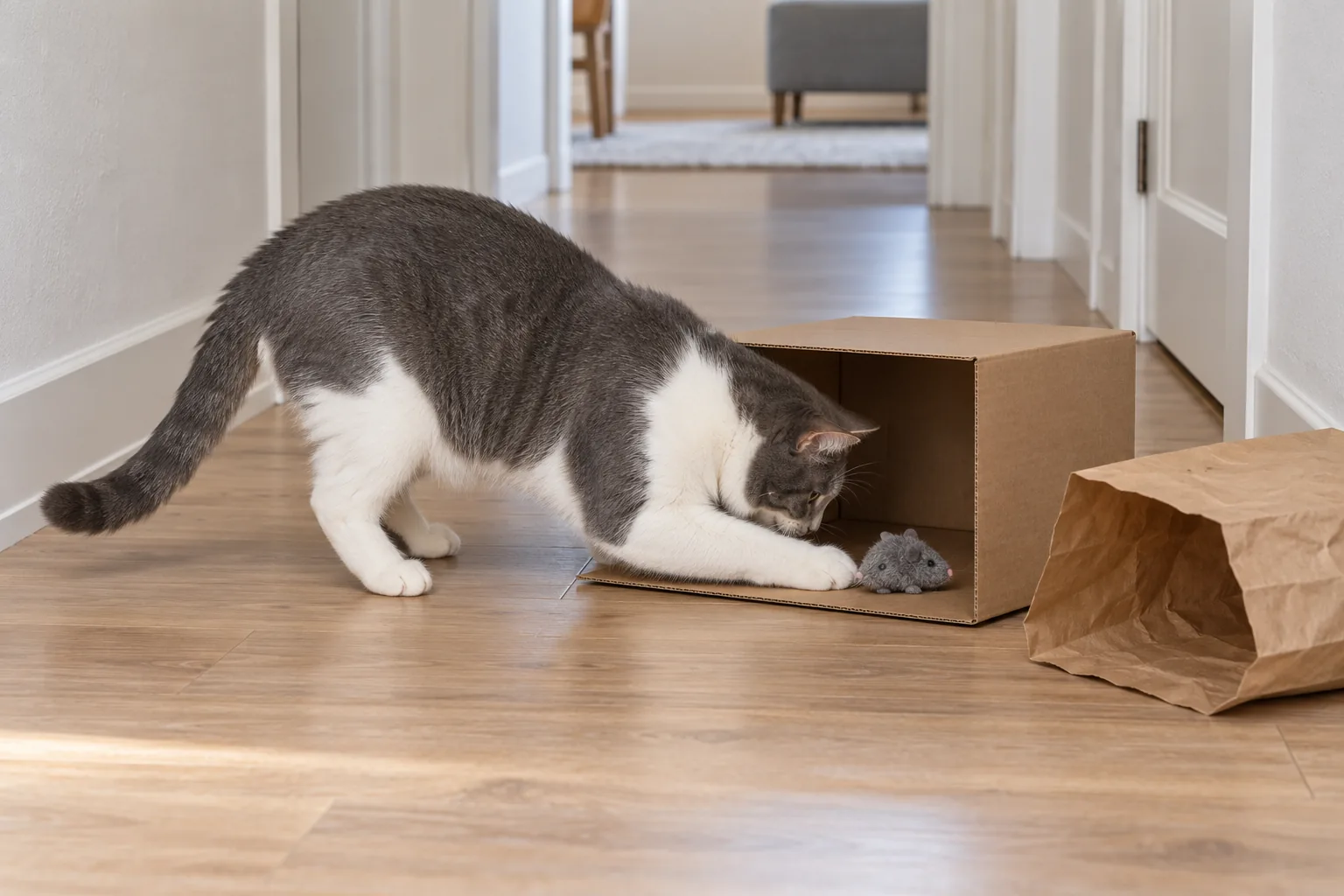
Hallway chase. A hallway is a ready-made runway. Start the wand toy at one end, drag it along the floor past the cat, and let it vanish around the doorframe at the other end. It suits a cat that hunts on the ground.
Hide and seek with the toy. AAHA suggests putting a wand toy under a towel or blanket and wiggling it, and sliding toys around corners and under furniture. Let the feather peek out from behind a door, pull it back, and wait. Pulling the toy through a cardboard box or a paper bag works the same way, and iCatCare suggests boxes and tunnels for kitten play. Some owners play the human version, hiding around a corner and calling the cat; none of the sources we read studied it, so treat it as a bonus, not as a stand-in for a toy the cat can catch.
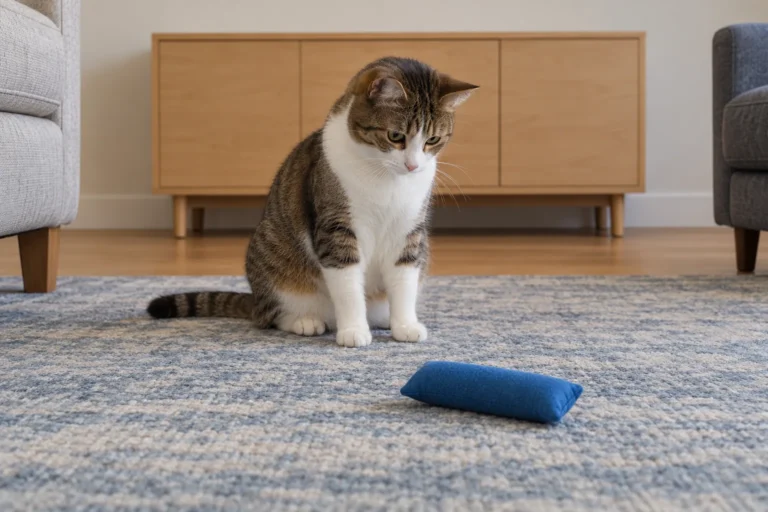
Fetch. iCatCare lists fetch among the games cats play with people. Toss a small fur mouse or a paper ball a short way down the hall. If your cat brings it back, toss it again; if not, roll it back yourself and keep going.
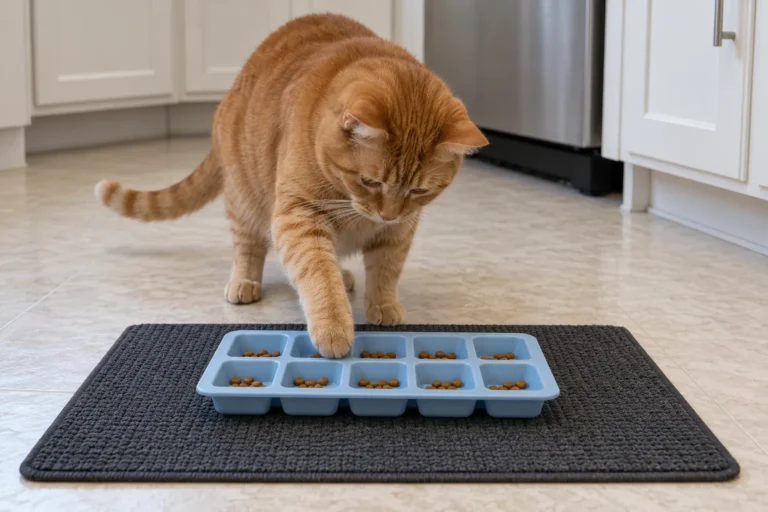
Treat hunt. Drop a few of the cat’s treats into a paper bag or a cardboard egg box, an iCatCare idea, and let the cat work them out. Count the treats as part of the day’s food rather than extra. For bought versions, see our puzzle feeder guide.
Paper ball batting. VCA Animal Hospitals suggests rolled-up paper balls as a toy a cat can actually catch. A ping pong ball, iCatCare notes, is light enough not to damage anything in the house and the right size for a paw.
How often, and when, to play
AAHA, VCA and the SF SPCA all land near the same routine: two or three short sessions daily, each lasting roughly 10 to 15 minutes. AAHA adds that adult cats may do well with one or two, while kittens need several short ones. Do not judge a session by its length. Cats are sprinters, iCatCare says, and one minute of frenzied activity is a good result.
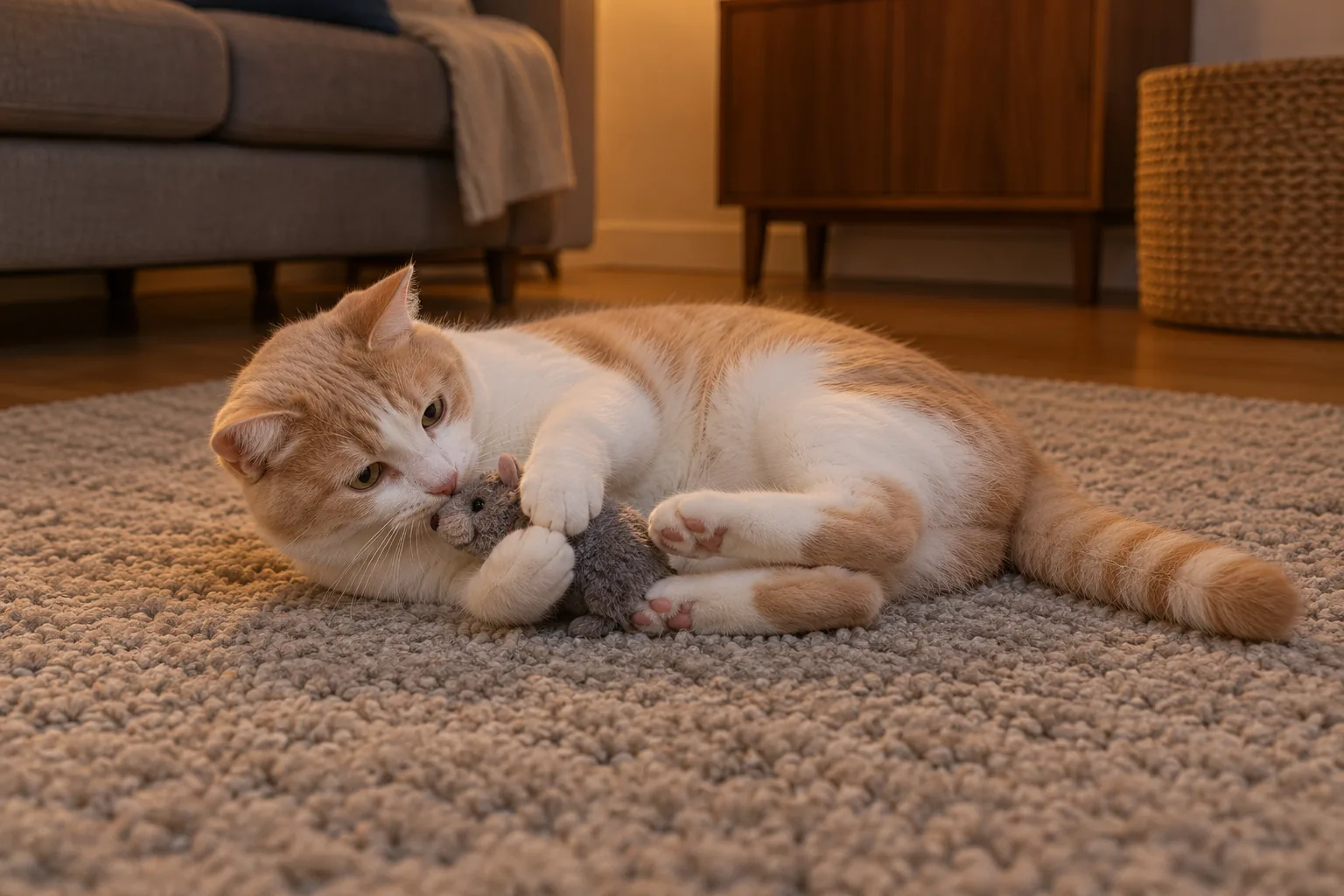
Timing matters more than you might expect. Cats are most active around dawn and dusk, so AAHA points to mornings and evenings. The SF SPCA suggests a game before you leave for work, a second game when you walk in the door, which it calls extremely important for an indoor cat, and a last one before bed. AAHA says that bedtime session makes a cat less likely to wake you in the night.
Shared floors change how you play late. A cat leaping at a wand on a wood floor at 11 p.m. is noise for the apartment below. Keep the last session low: ground prey on a rug, the toy skittering rather than flying, and the leaping air-prey game moved to the early evening.
Keep hands and feet out of the game
Fingers wiggled under a blanket are tempting toys, and a kitten will pounce on them. International Cat Care and VCA both say never to play with hands or feet. A kitten that learns fingers and toes are prey keeps pouncing on them as a heavier adult, and VCA points out that even small bites and scratches can become infected. Hands are for petting; play goes through a toy.
The San Francisco SPCA reports that play aggression is the kind of aggression people most often report from young indoor cats, usually under two years old, and lists too little play among its causes. If teeth or claws land on skin, stop, go still and give the cat a toy to grab instead. End sessions before they boil over, and never hit or punish: the SF SPCA says physical punishment is never appropriate.
Playing with a kitten
Kittens play hard and tire fast, so iCatCare expects sessions of only a few minutes. A wand is the right tool because it keeps your hand at a distance from needle teeth. Toys made of string, ribbon, yarn or pipe cleaners are never left with a kitten: iCatCare warns that swallowed string can bunch up the intestines and lead to emergency surgery. Wind each game down slowly and turn the kitten’s attention to food, which iCatCare says heads off ambushes on people and other pets. Catnip toys will not interest a kitten under about three months, so save them for later.
A shy cat, an older cat, or two cats
A shy or anxious cat does better with slow, spaced sessions, AAHA says, and the SF SPCA warns off large or noisy toys for timid cats. Expect the first few sessions to be mostly watching; the SF SPCA says not to be discouraged by a cat that only looks or paws half-heartedly at first. A cat that tips from play into swatting needs the opposite: shorter, more structured sessions that stop before it gets there.
Older cats still play, AAHA says, at a slower pace and for less time; our guide to toys for senior cats covers that. With two cats, chasing and play fighting between them is normal, iCatCare says. If a bout escalates and one could get hurt, distract them with a wand or a kicker large enough to hug, never with your hands.
If your cat stops playing. A cat that suddenly loses interest, holds back from jumps it used to make or seems stiff may be in pain. AAHA notes that cats with arthritis or recovering from surgery need gentler play; your vet can check what is behind the change. If two cats keep fighting during play, iCatCare suggests asking your vet, who may refer you to a behaviorist.
Questions about playing with a cat
What is the best way to play with a cat?
Copy a hunt. Move a wand toy in short, sudden bursts along the floor or through the air, let your cat stalk and pounce, allow a catch every few tries, and finish with an easy catch followed by a treat or a meal. Short sessions at dawn or dusk suit most cats best.
Do cats like it when you play with them?
Many do, and the need does not end with kittenhood. VCA Animal Hospitals calls it a misconception that only kittens play, and says adult cats benefit from regular play with people. A cat that only watches at first is not refusing; the San Francisco SPCA says early sessions are often mostly looking, so try again tomorrow.
How can you play with a cat without toys?
Use what is in the recycling. A ball of rolled-up paper, a paper bag with a few treats inside, or a cardboard box to hide in all work, and VCA counts paper balls as prey a cat can really catch. What does not work is a bare hand: your fingers should never become the prey.
Is it okay to play with a cat using your hands?
Avoid it, even with a tiny kitten. International Cat Care and VCA both advise against it, because a cat that learns to chase fingers and toes keeps attacking them when it is bigger and stronger. Put a wand or a kicker toy between you and the cat, and keep your hands for stroking.
How can you play with a cat without bothering the downstairs neighbors?
Keep late games on the ground. Drag the toy along a rug or runner instead of making the cat leap, save jumping games for the early evening, and end the night with a slow catch and a meal. A mat under the play area also softens landings on a hard floor.
Can you play with two cats at once in a studio?
You can, with a toy for each. Hold a wand in each hand and work them on opposite sides of the room, or let one cat chase while the other bats a paper ball. If the game turns into a real fight, iCatCare suggests distracting them with a wand or a large kicker, not your hands.
Sources
- AAHA, “How Often Should You Play with Your Cat?” aaha.org, read Oct 16, 2026.
- International Cat Care, “Playing with your cat,” icatcare.org, read Oct 16, 2026.
- San Francisco SPCA, “Playing with Your Cat,” sfspca.org, read Oct 16, 2026.
- VCA Animal Hospitals, “Cat Behavior and Training: Play and Play Toys,” vcahospitals.com, read Oct 16, 2026.
- VCA Animal Hospitals, “Linear Foreign Body in Cats,” vcahospitals.com, read Oct 16, 2026.
- Merck Veterinary Manual, “Gastrointestinal Obstruction in Small Animals,” merckvetmanual.com, read Oct 16, 2026.