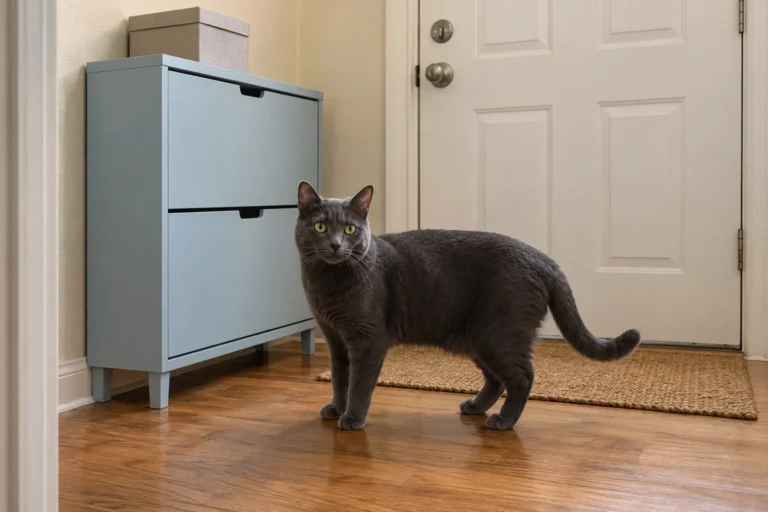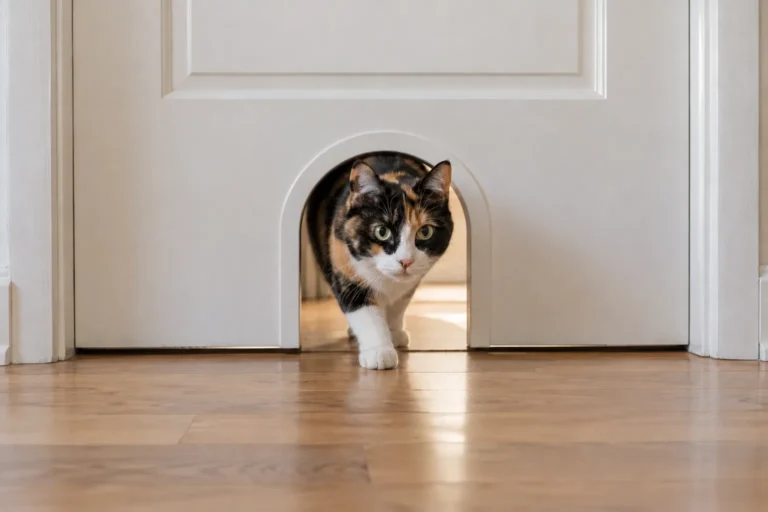
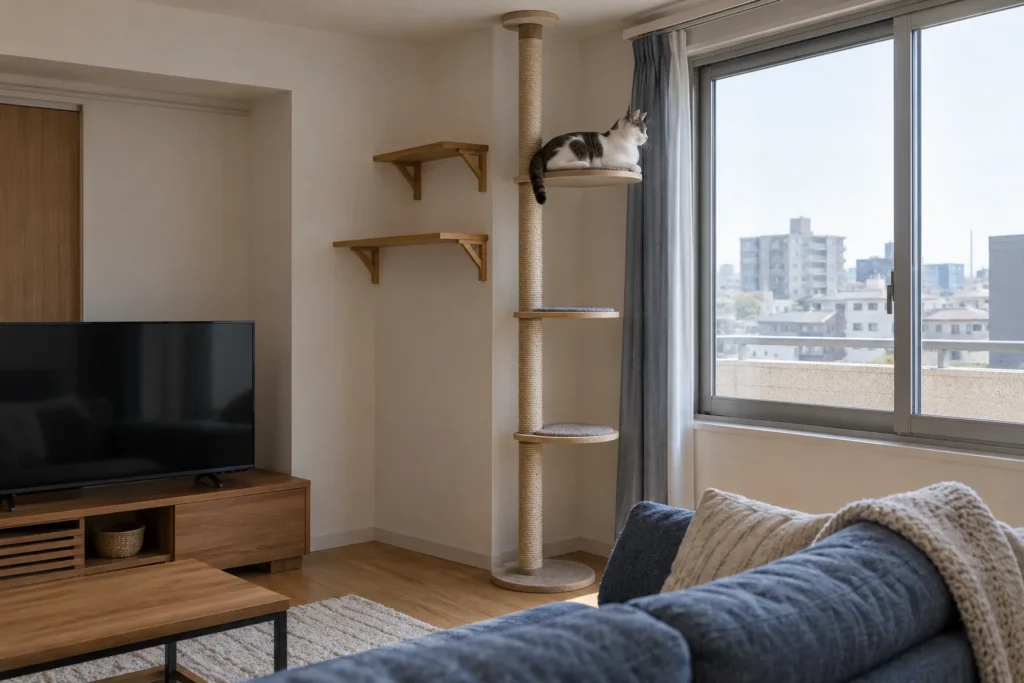
Cat furniture for small apartments works best when each piece belongs to a zone: litter, food and water, scratching, height by a window, and a hiding spot. A studio fits all five into one room and a bathroom, so the plan is about separation; a one-bedroom can spread them across two rooms.
What you need
- A tape measure, for your cat and for each wall and window you plan to use.
- A floor plan sketch with doors, windows, radiators and outlets marked.
- Two litter boxes for one cat, in two separate spots.
- Food and water bowls that can live apart.
- A scratching post over 3 ft (91 cm) tall, or a cat tree with a sisal post.
- Something to climb: a tension-pole tree, wall shelves or a window perch.
- A hiding spot: a box on its side or the carrier.
- Clips or ties for blind cords near any perch.
Key takeaways
- Every key resource, from food to litter, needs its own location and two or more of each, by the AAFP and ISFM pillars. → the five zones
- Closing the bedroom door at night? Then a litter box, water and a post belong on the cat’s side of it. → the one-bedroom plan
- Bowls close to a litter box discourage a cat from using it, say the AAFP and ISFM, and two touching boxes count as one. → what to keep apart
- Keep perches clear of open windows, blind cords and toxic plants; if your cat chews a plant, call a vet or poison line at once. → hazards by perches
- A wall-hung scratcher is the space saver to skip: in a 2016 owner survey, cats with one scratched furniture most often of any group, 74.1%. → space savers
Cat furniture for small apartments: the five zones
Feline vets at the AAFP and ISFM organize a cat’s needs into five pillars, and two of them shape a floor plan. A cat needs a safe place, and its key resources (food, water, toileting, scratching, play and rest) each need a location of their own, with at least two of each to choose from.
| Zone | What goes there | Keep it apart from | Source |
|---|---|---|---|
| Litter | Two boxes in two spots, open or in a cabinet | Food, water, the washer | AAFP and ISFM 2014 |
| Food and water | Food at the kitchen end, water elsewhere | Litter, and each other | AAFP and ISFM 2013; AAFP 2018 |
| Scratching | A post over 3 ft (91 cm) or a tree, in sisal | No set spot; by the bed or sofa | Wilson 2016 survey |
| Height | Tension-pole tree, shelves or a window perch | Open windows, cords, toxic plants | AAFP and ISFM 2013; ASPCA |
| Hiding | A box, covered bed or carrier, one per cat | Busy walkways | AAFP and ISFM 2013 |
No source here gives a floor area per cat, a perch height, a count of tree levels or a distance between bowl and box. They ask for separation and choice, which is good news when no cat tree fits the room: a pole, two shelves and a perch give the same height.
Measure your cat and your walls before buying anything
Start with the cat. Its length, nose to tail base, sets the litter box: the AAFP and ISFM house-soiling guidelines want each box at least 1.5 times that long. Measure it again lying flat out, since their environmental guidelines want perches long enough for a full stretch and give no figure. The cat measuring tool checks a box, a shelf and a scratching post against those numbers and the 3 ft (91 cm) line.
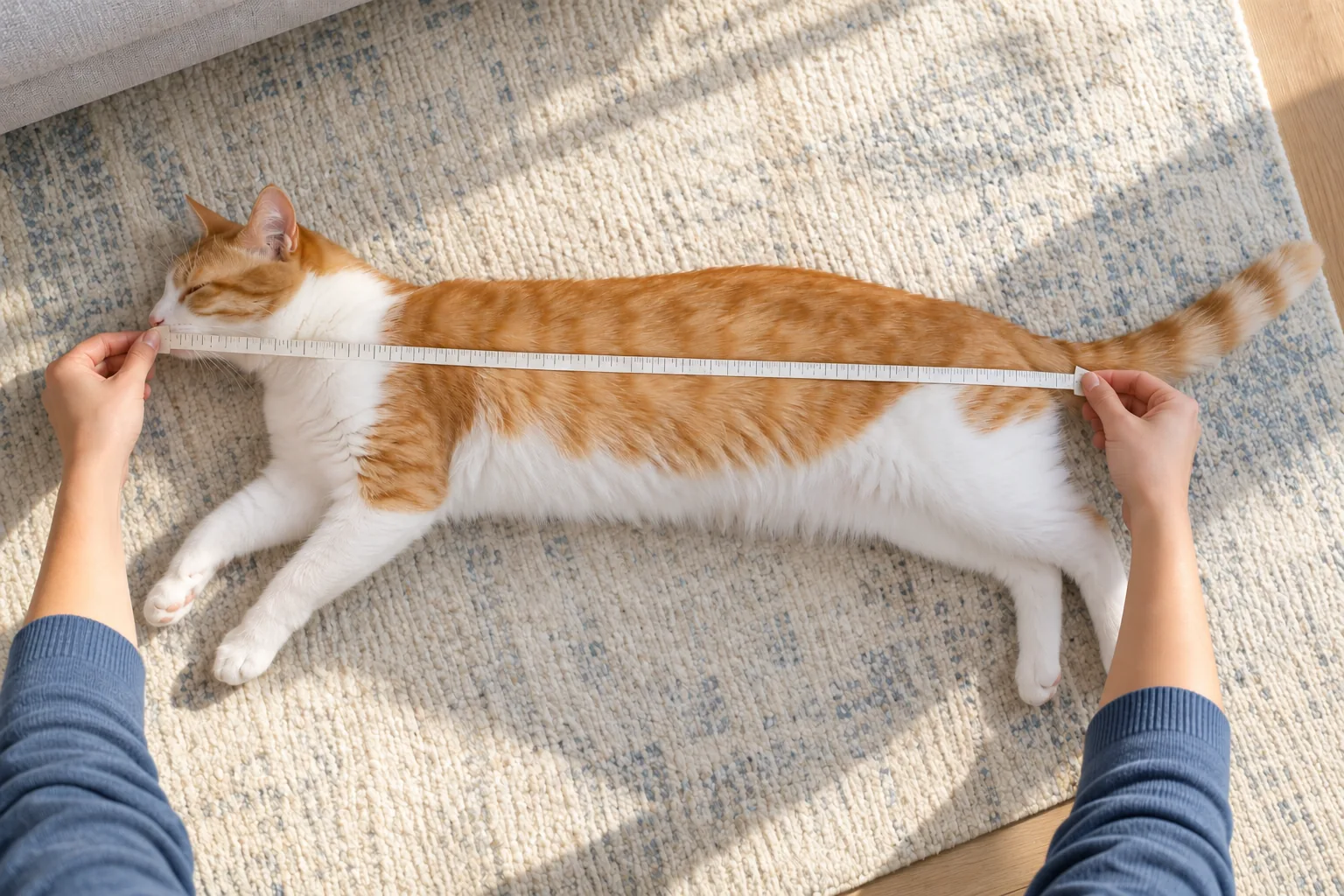
Then sketch the room: door swings, the doors you shut at night, radiators, outlets, and your route from the front door to the kitchen to the bed. Zones go beside that route, never on it. Hold the full layout until a new cat settles: it begins in one small room, the first stage in the 3-3-3 rule guide.
A studio layout, zone by zone
Take a common studio shape: one main room, a kitchen wall, a window at the far end and a bathroom by the entry, often the only door that closes. That door counts for more when a second cat arrives, because introducing a new cat to your cat starts with a room the newcomer can have alone.
- First litter box: the bathroom. The litter box placement guide covers which patch of floor and how to keep the door open.
- Second box: the main-room corner farthest from the kitchen, with a bookcase, the sofa or the bed between it and the bowls.
- Food: the kitchen end, on the floor or on a wall shelf if your cat jumps well.
- Water: across the room, by the desk or the sofa.
- Scratching post: at the foot of the bed or against the sofa arm.
- Height: beside the window. A tension-pole tree next to the glass and a perch on the sill. If a radiator fills the floor below the window, stand the pole to one side of it.
- Hiding spot: the open carrier by the bed, or a box on its side under the desk. Not under the bed, where you cannot reach the cat.
The food shelf comes from the AAFP’s 2018 feeding statement, which suggests shelves or tables as feeding spots for cats agile enough to use them. No guideline names a spot for the post, so that one is our call. Scratching leaves scent marks as well as stretching the body, and the post belongs where the cat spends its time. For which post to buy, the scratching post comparison weighs height, base size and material for a small home.
The window end does double duty. The 2013 guidelines ask that one resting area give the cat a look at the outdoors, and VCA Animal Hospitals puts cat trees where the family spends time, away from a wall if possible. In a studio, that is often the sofa end. If floor is the limit, the small cat tree comparison sets the footprint of five trees and posts against their height.
A one-bedroom layout: put the climbing in the living room
A second room tempts you to hide the cat furniture in the bedroom. Keep the tree where people sit, which is where VCA’s advice puts it.
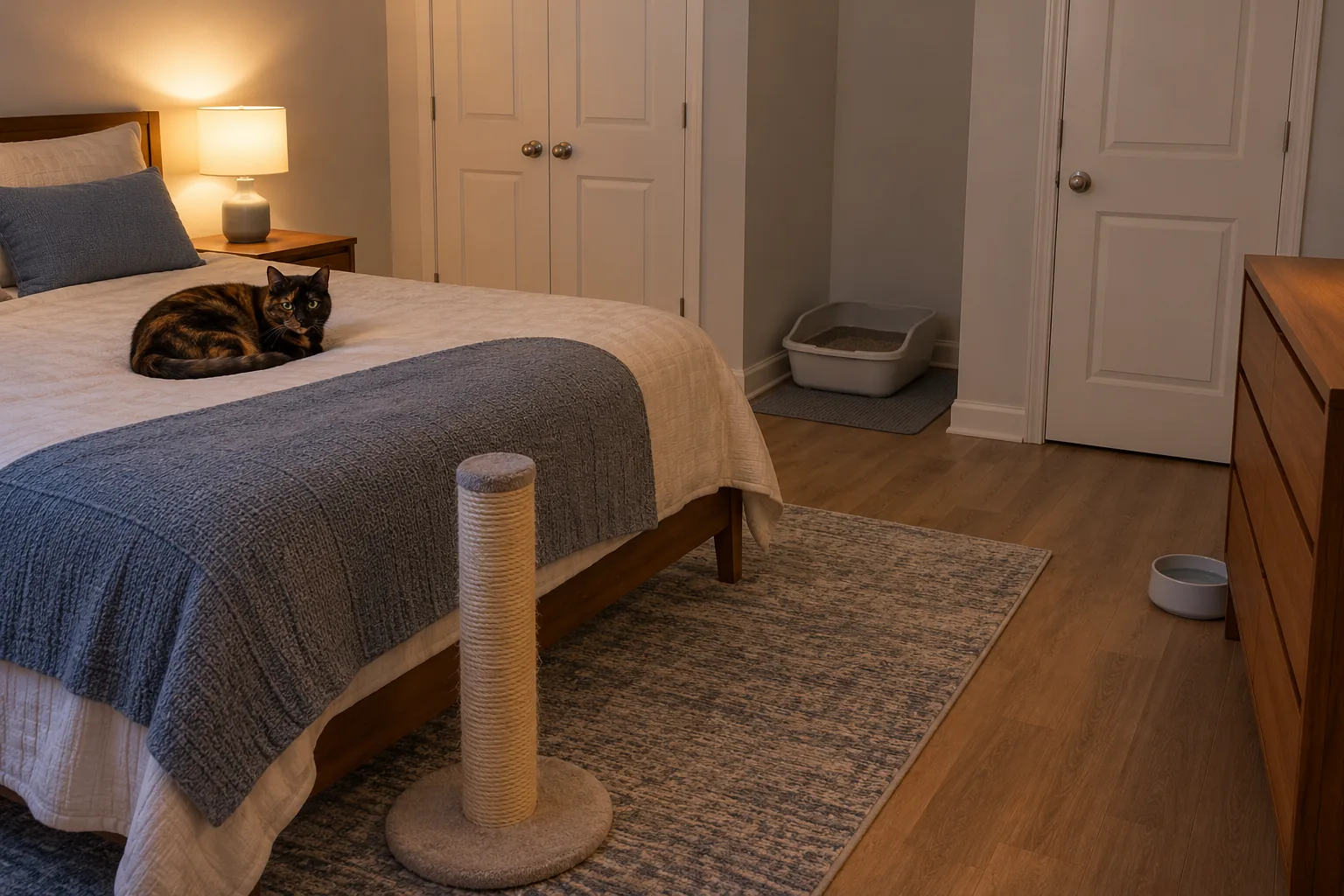
| Room | What goes there |
|---|---|
| Living room | Tree or shelves by the window, a post at the sofa arm, the water bowl |
| Bedroom | A second post, the hiding spot, a shelf if there is wall to spare |
| Bathroom | The first litter box |
| Kitchen | The food bowl |
| Hall nook or bedroom | The second litter box |
The bedroom door is where these layouts break. Cornell’s Feline Health Center says most cats want a box they can reach easily around the clock, so if you shut that door at night, the cat’s side of it needs a box, water and a post. An interior cat door is the other way around it: a no-cut latch or a cut-in flap lets the cat through while the door stays shut. If the cat sleeps with you, the second box goes in the bedroom rather than the hall.
What to keep apart, and why
Each pair comes from a guideline or a study. None comes with a distance.
- Litter and food. The AAFP and ISFM say food and water close to a box discourage a cat from using it.
- Food and water. The 2013 guidelines split these as well. In a 2025 UK survey of 565 households, 67.1% said their cat could see its water bowl while eating.
- Litter and loud machines. The 2014 guidelines list a box near noisy appliances among the ways people put a cat off its box, which rules out the washer closet.
- Box and box. Two boxes touching are one big box to a cat, say the AAFP and ISFM.
- Perches and hazards: open windows, blind cords and toxic plants.
Windows, cords and tension poles. Keep the window behind any perch shut, or fitted with a screen secured in its frame; no source we read says what weight an ordinary insect screen holds. A 2025 Berlin study of 1,125 cats counted falls from 13 ft (4 m) up, and a 2004 Zagreb series of 119 found falls more frequent in the warmer months, when windows stand open. Wind blind cords out of reach of every perch. No vet or safety source we found covers tension-pole trees: follow the maker’s instructions, set the pole against a flat, solid patch of ceiling, and push on it now and then to check it is still tight.
Cords are on that list because a perch puts the cat beside the blind. The ASPCA’s pet-proofing checklist opens with tucking electrical cords away, and VCA notes that cats can get tangled in wand-toy string. Nothing we read covers blind cords directly. Treat a loop by a shelf the same way.
A perch also brings the cat to the windowsill plants. Check each on the ASPCA list by scientific name, since common names overlap: golden pothos (Epipremnum aureum), snake plant (Sansevieria trifasciata) and monstera (Monstera deliciosa) are toxic to cats, while spider plant (Chlorophytum comosum) and parlor palm (Chamaedorea elegans) are not. The FDA says every part of a true lily is dangerous, pollen and vase water included.
If your cat chews a plant or a lily. Call your vet or a poison line at once; the FDA lists the ASPCA Animal Poison Control Center (888-426-4435) and the Pet Poison Helpline (855-764-7661). With lilies, do not wait for signs: the FDA says kidney damage is generally permanent if treatment starts 18 hours or more after exposure. A cat that stops jumping to its usual perch needs a vet visit too.
Space saving cat furniture, type by type
Each saves floor differently, and each has a catch.
- Floor-to-ceiling tension-pole tree. Full room height from one small base, no screws; the catch is the ceiling (see the safety note).
- Wall shelves. No floor at all, stepping up to a perch or running above the sofa. Most need screws, and every landing should fit your cat lying flat out.
- Litter box cabinet. Hides the box under a tabletop. Judge it by its inside floor, which has to take a box that passes the 1.5 times rule. Open it at every scoop (the litter smell routine still applies).
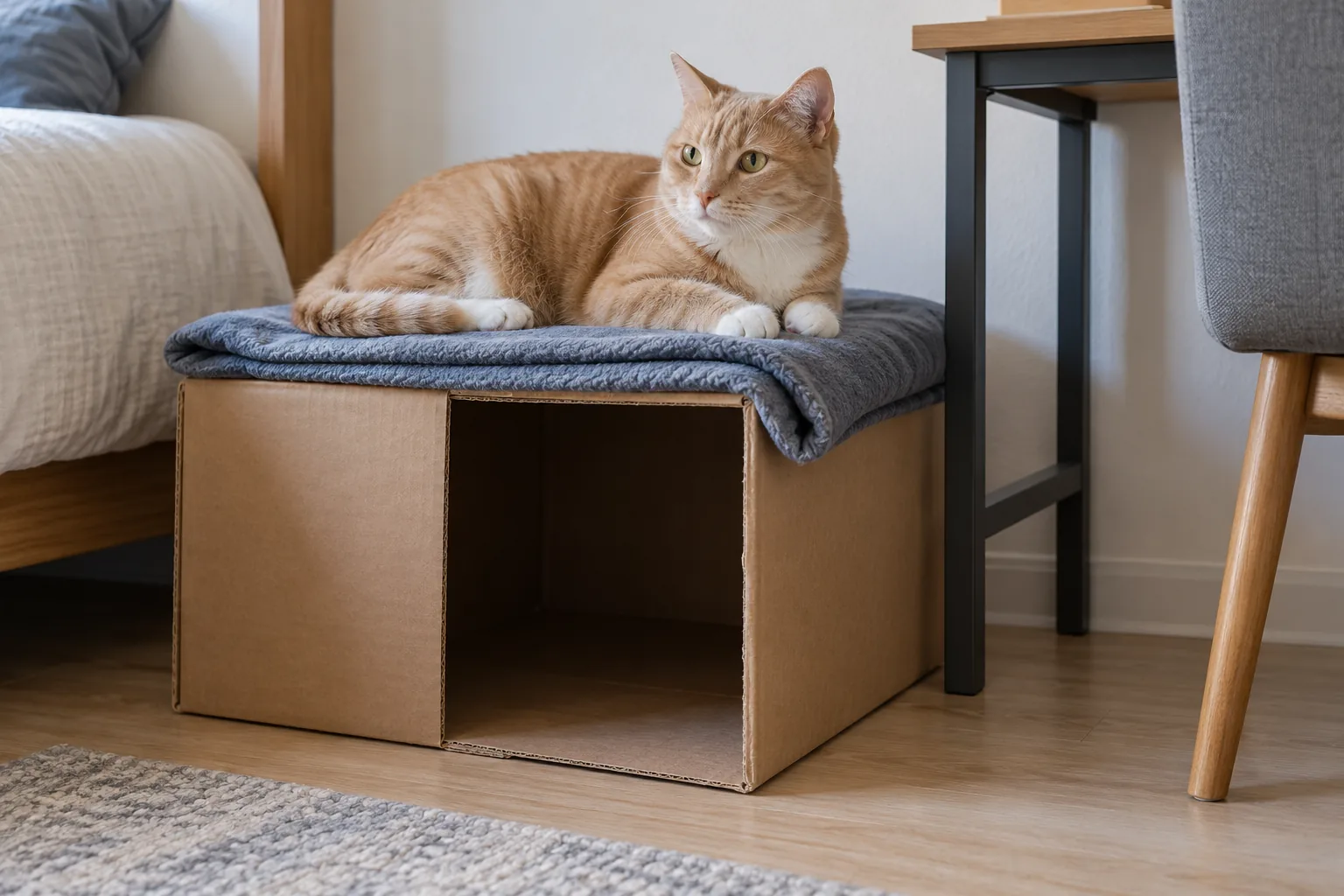
- Cardboard box or carrier. The 2013 guidelines call both safe places, the box better still with a perch on its roof. The DIY cat toys guide shows a box hideout.
One space saver to skip is the wall-mounted scratcher. Wilson and colleagues asked 4,105 owners about scratching in 2016, and cats whose scratcher hung on the wall scratched furniture most often of any group, at 74.1%. Homes with a post over 3 ft (91 cm) reported furniture scratching less often than homes with shorter ones (55.2% against 64.7%), and sisal rope got the most use wherever it was offered. These are owner reports, not measurements. Give the corner to a tall floor post first.
Before anything goes in a cart, draw it. The space-fit planner takes one floor spot and each piece’s footprint from its listing, lays them out to scale, flags a box too short for your cat and warns when bowls share a spot with a box.
Questions about apartment cat furniture
Is litter box furniture worth it in a small apartment?
It earns its place when the second box shares the room where you sleep and eat: it hides the box and adds a tabletop. Buy one only if its inside floor fits a box half again as long as your cat (the AAFP and ISFM rule), and only if you will open it daily to scoop.
What is the most space saving cat furniture?
Pieces that climb the wall rather than cover the floor. A pole tree, shelves and a perch on the glass add height on almost no floor. For scratching, the owner survey points to a tall floor post over a wall-hung pad, and a cardboard box makes a hiding spot that costs nothing.
Where should a cat tree go in a small apartment?
Beside a window, in the room where you spend your evenings. Feline guidelines ask for a resting spot that looks outside, and VCA suggests trees where the household gathers, with open space on more than one side. Shut that window or screen it securely first.
How do I fit furniture for two cats into a small apartment?
Count by cat, then spread out. As a rule of thumb, the AAFP and ISFM house-soiling guidelines give one more litter box than there are cats, so three boxes for two, each in its own spot. Their 2013 guidelines add a safe place per cat and two of each resource, set in different corners.
Can I set up cat furniture for small spaces without drilling?
Most of it. A tension-pole tree presses between floor and ceiling, a freestanding post simply stands, and a box or carrier needs nothing. Shelves usually take screws, so under a strict lease, spend the height budget on a pole by the window and a perch fixed to the glass.
What should I check when apartment hunting with a cat?
Before you sign, walk the plan zone by zone. You need a room with a door for the cat’s first days, two litter spots away from the kitchen and washer (the AAFP and ISFM rule for one cat), windows that shut or hold a screen secured in the frame, and solid, flat ceiling for any pole tree.
Next step. For the height zone, small cat trees compared weighs each tree’s floor area against how tall it stands.
Sources
- AAFP and ISFM, “Feline Environmental Needs Guidelines,” Journal of Feline Medicine and Surgery, 2013, journals.sagepub.com, read Oct 16, 2026.
- Cornell Feline Health Center, “Feline behavior problems: house soiling,” vet.cornell.edu, read Oct 16, 2026.
- AAFP and ISFM, “Guidelines for Diagnosing and Solving House-Soiling Behavior in Cats,” Journal of Feline Medicine and Surgery, 2014, journals.sagepub.com, read Oct 16, 2026.
- Sadek and others, “Feline feeding programs: addressing behavioural needs to improve feline health and wellbeing,” Journal of Feline Medicine and Surgery, 2018, journals.sagepub.com, read Oct 16, 2026.
- Wilson and others, “Owner observations regarding cat scratching behavior: an internet-based survey,” Journal of Feline Medicine and Surgery, 2016, journals.sagepub.com, read Oct 16, 2026.
- Taylor and others, “Feline management practices and resource provision in the UK: a questionnaire-based study of 565 caregivers,” Veterinary Record, 2025, PubMed Central, read Oct 16, 2026.
- Vnuk and others, “Feline high-rise syndrome: 119 cases,” Journal of Feline Medicine and Surgery, 2004, PubMed Central, read Oct 16, 2026.
- Candela Andrade and others, “High-rise syndrome in cats (part 2): injury patterns and survival rate,” Journal of Feline Medicine and Surgery, 2025, journals.sagepub.com, read Oct 16, 2026.
- ASPCA Animal Poison Control, “Toxic and Non-Toxic Plant List: Cats,” aspca.org, read Oct 16, 2026.
- US Food and Drug Administration, “Lovely Lilies and Curious Cats: A Dangerous Combination,” fda.gov, read Oct 16, 2026.
- ASPCA, “Moving With Your Pet,” aspca.org, read Oct 16, 2026.
- VCA Animal Hospitals, “Cat Behavior and Training: Play and Play Toys,” vcahospitals.com, read Oct 16, 2026.