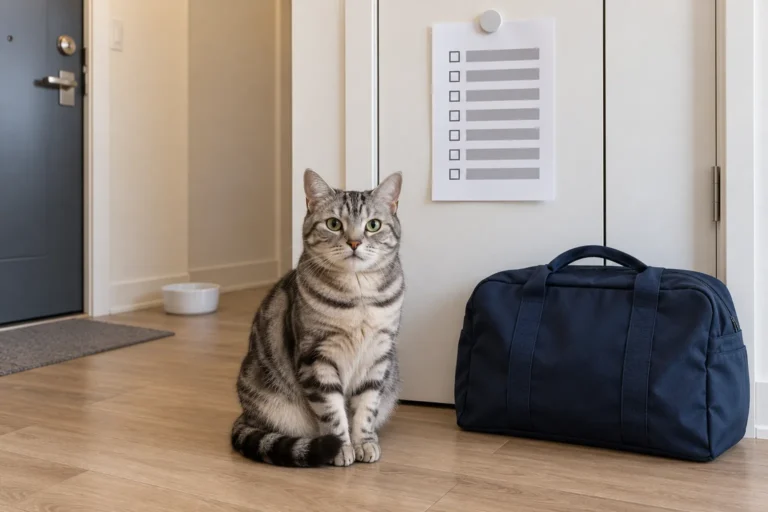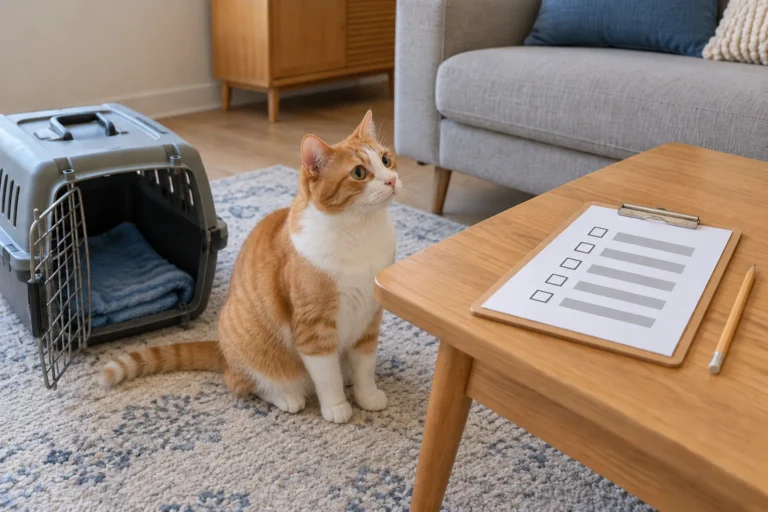
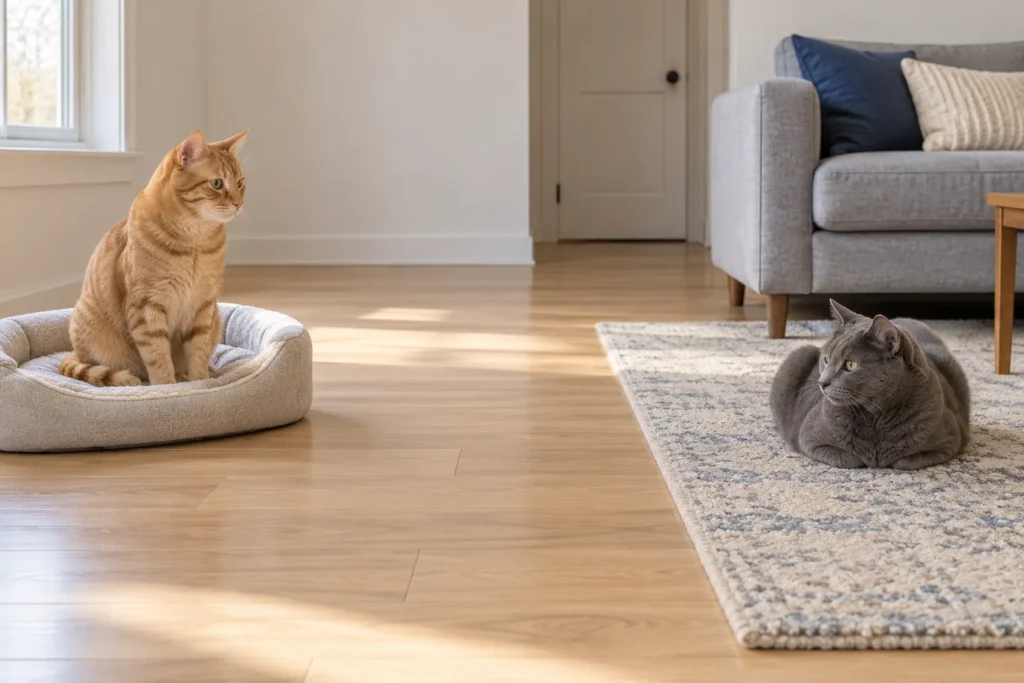
Introducing cats goes best in small steps: the new cat lives behind a closed door at first, the two meet by scent, then by sight through a barrier, and only then in the same room. The Feline Veterinary Medical Association (FelineVMA) says the whole process can take a few days to a few months, sometimes longer.
An apartment shortens the distances, not the timeline. With one bedroom, or none, the trick is finding a door to close and enough separate spots for two cats. The steps below assume you have little of either.
What you need
- One room with a door that latches. In a studio, the bathroom tends to be the only candidate.
- A full set for the newcomer: litter box, food and water bowls, bed, scratching post, toys. New, or already its own.
- Something see-through to divide the space: a tall pet gate, a glass door or a door strap.
- A towel or a flattened box to block the view in a hurry.
- Recent vet checks for every cat.
Introducing cats in a small apartment, in short
Keep the newcomer in its own room until it stops hiding. Swap bedding until neither cat reacts to the other’s smell. After that comes a look through a barrier, and only then a few supervised minutes in one room. Go back a step whenever either cat shows tension. Never rush: pushing ahead before both cats are ready can leave long-term tension between them, the FelineVMA warns.
Key takeaways
- Every cat needs a recent vet check; the FelineVMA advises against adding a newcomer when your resident cat is elderly or has significant health problems. → before it arrives
- House the newcomer in a room where everything is new or its own, until it no longer hides all the time and explores confidently. → its own room
- The sources disagree on food during introductions, so we suggest none at first, and treats only if both cats stay calm with them. → the food question
- Should a fight leave a wound, or either cat stop eating or using its box, separate them and call your vet. → when to call the vet
- One of each resource per cat plus one, out of sight of each other, is the FelineVMA’s rule: three litter boxes for two cats. → room for two
Before the new cat comes home
Every cat should have had a recent vet check, and the newcomer should be tested for common contagious diseases, by the FelineVMA’s guide. The same guide advises against adding a cat at all when a resident is elderly or has significant health problems. International Cat Care adds that an unwell or stressed cat tends to find a newcomer distressing rather than good company.
Fit matters as much as process. iCatCare says acceptance is hard to predict, but younger, neutered and related cats tend to get along better, and a kitten can wear out an older cat that wants less play, possibly one with stiff joints. Best Friends Animal Society, a shelter group, adds that a cat who has lived with another cat is the safer bet. Not sure about the match? The FelineVMA suggests foster-to-adopt programs as a trial.
Step 1: Give the newcomer a room of its own
iCatCare’s ideal is a room your resident cat does not use and you do not need constant access to. Few apartments have one, so pick the room the resident cares about least: the bathroom in a studio, the bedroom in a one-bedroom. The FelineVMA wants a calm room, away from foot traffic, with a door you can secure. Bring the newcomer in under a covered carrier so the cats do not see each other yet, open the carrier door and let it come out when it chooses.
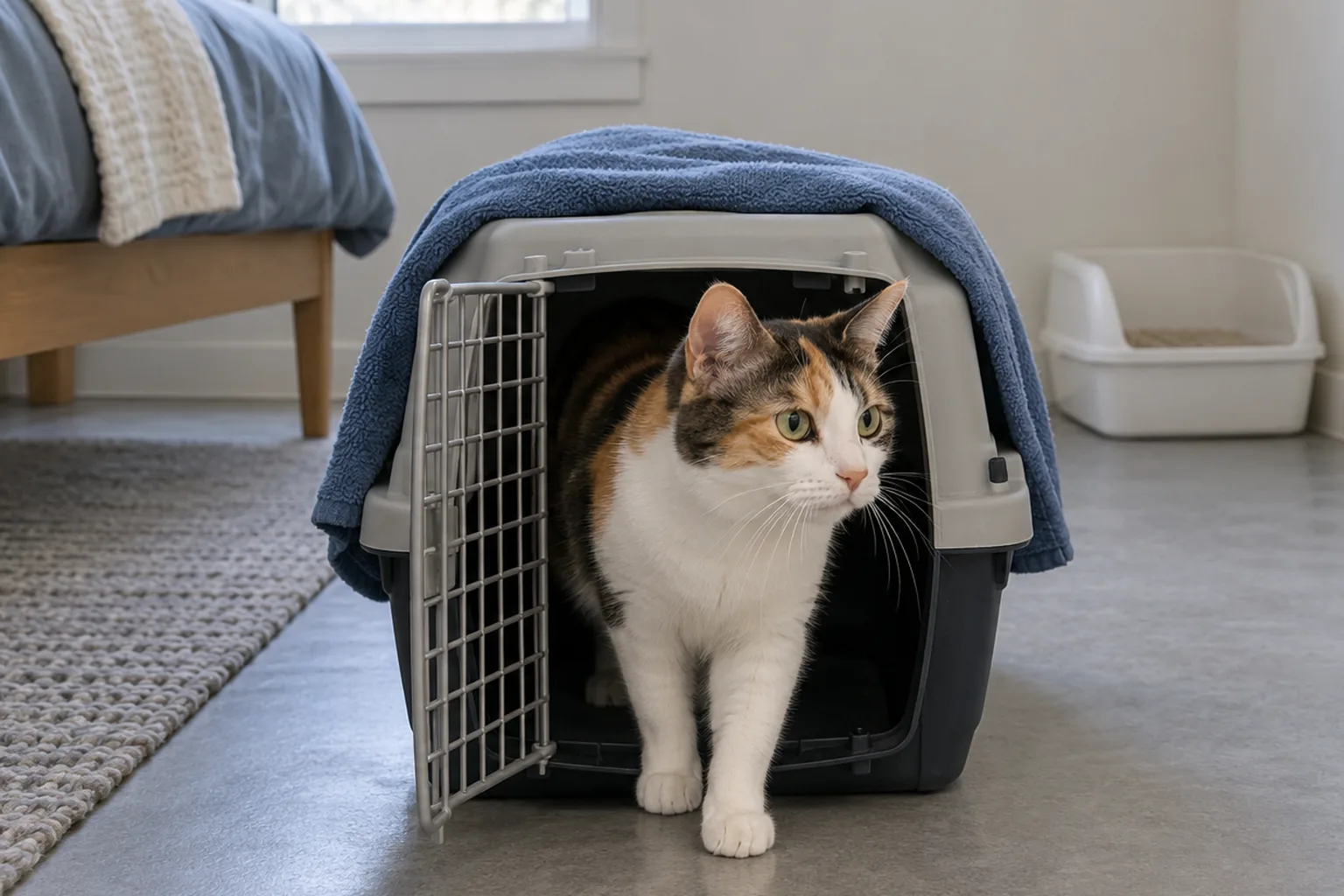
Everything in that room should be new or belong to the newcomer. iCatCare explains that borrowing the resident’s litter box or bed brings the other cat’s smell in, and the resident may feel it has lost a resource. Best Friends suggests keeping the newcomer’s space smaller than the territory the resident keeps, and giving the resident more of your time, not less, in these weeks.
Stay at this step until the newcomer stops hiding all the time and explores its room with confidence. iCatCare puts the settling period at several days to a week or two and lists what settled looks like: a friendly greeting when you walk in, rolling over with the belly showing, rubbing its face on furniture, and normal eating, toileting and grooming.
Step 2: Let them meet by scent
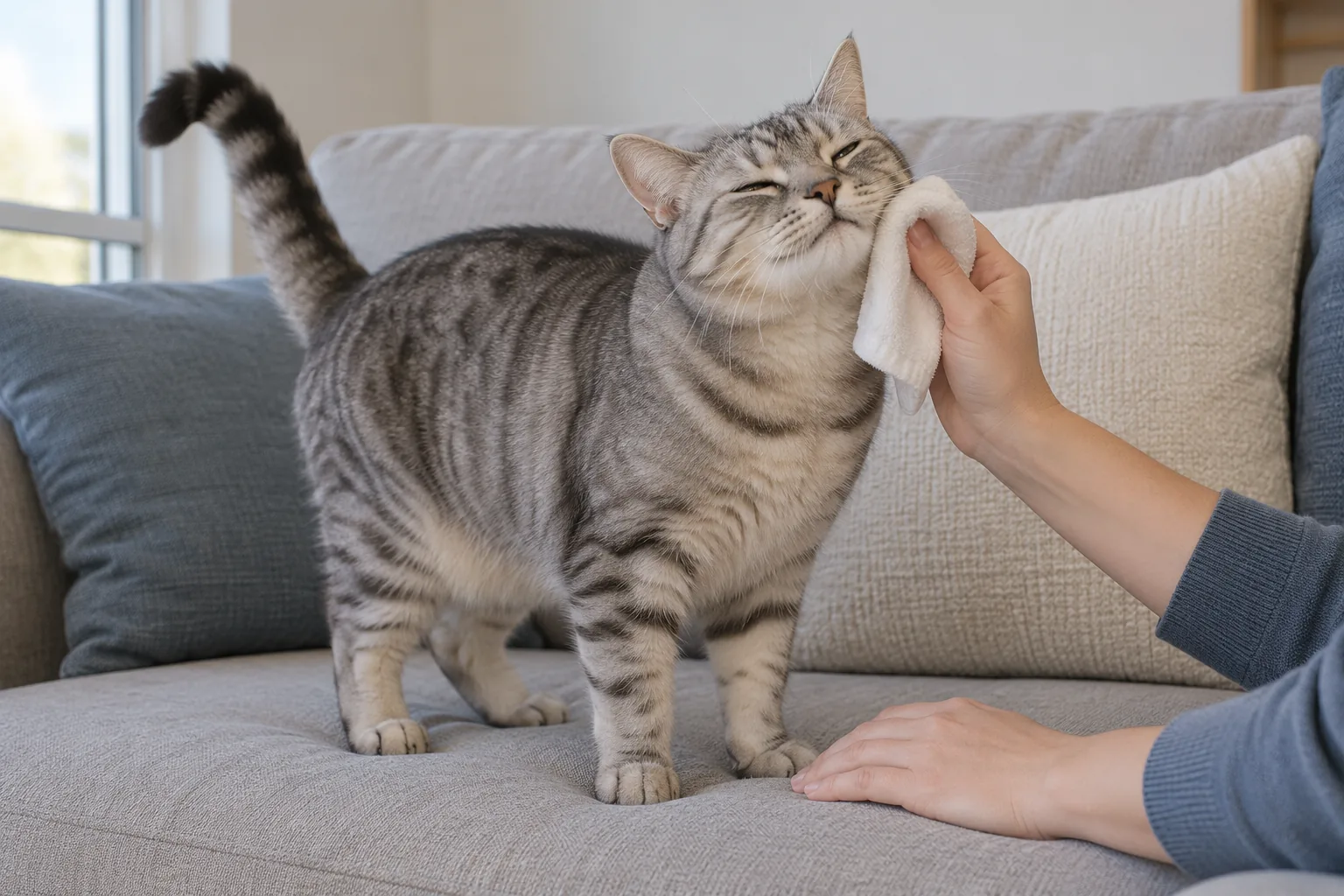
Cats recognize their group by smell, so the aim is a shared scent before a shared room. Swap a piece of bedding or a soft toy between the cats every day until neither reacts. The FelineVMA’s list of stress signs is long: avoiding the item, growling, hissing, pacing, toileting outside the box. Once both cats ignore the swapped items, rub a soft cloth over one cat’s cheeks and chin and leave it where the other can sniff it, then do the reverse.
Step 3: Swap rooms, and play at the door
Next the newcomer explores the rest of the apartment while the resident waits in a favored room with treats and toys, by the FelineVMA’s steps. Keep the first visits short, then return each cat to its own space. In a one-bedroom this can be as simple as trading the bedroom and the living room for a short while.
The FelineVMA also has the cats play on each side of the closed door, with two toys tied together so one sits on each side, for 5 to 20 minutes at a time. If a cat hisses or growls at the door, stop, do not scold it, and set up a screen, boxes or chairs in front of the door to give some distance before the next try.
Put the door toy away. Two toys joined by string are only for supervised sessions. VCA Animal Hospitals lists swallowed string, yarn and ribbon as potentially fatal, so take the toy down after every game.
Food is where the sources split. Best Friends feeds the cats on either side of the closed door, moving the bowls closer as they relax, and the FelineVMA uses treats as rewards throughout. iCatCare advises against food or play near the other cat during introductions, because cats eat and play alone, and asking them to do it near a stranger can stress them. Our suggestion: begin without food, and bring treats in only if both cats stay relaxed with them.
Step 4: Let them see each other through a barrier
Once both cats are calm with the scent and the room swaps, let them look. A tall pet gate, a glass door, a screen or a door strap that holds the door slightly open all work, by the FelineVMA’s and iCatCare’s lists; Best Friends opens the door about an inch. Keep the sessions short. You want the cats glancing at each other and going about their business, iCatCare says, not staring each other down.
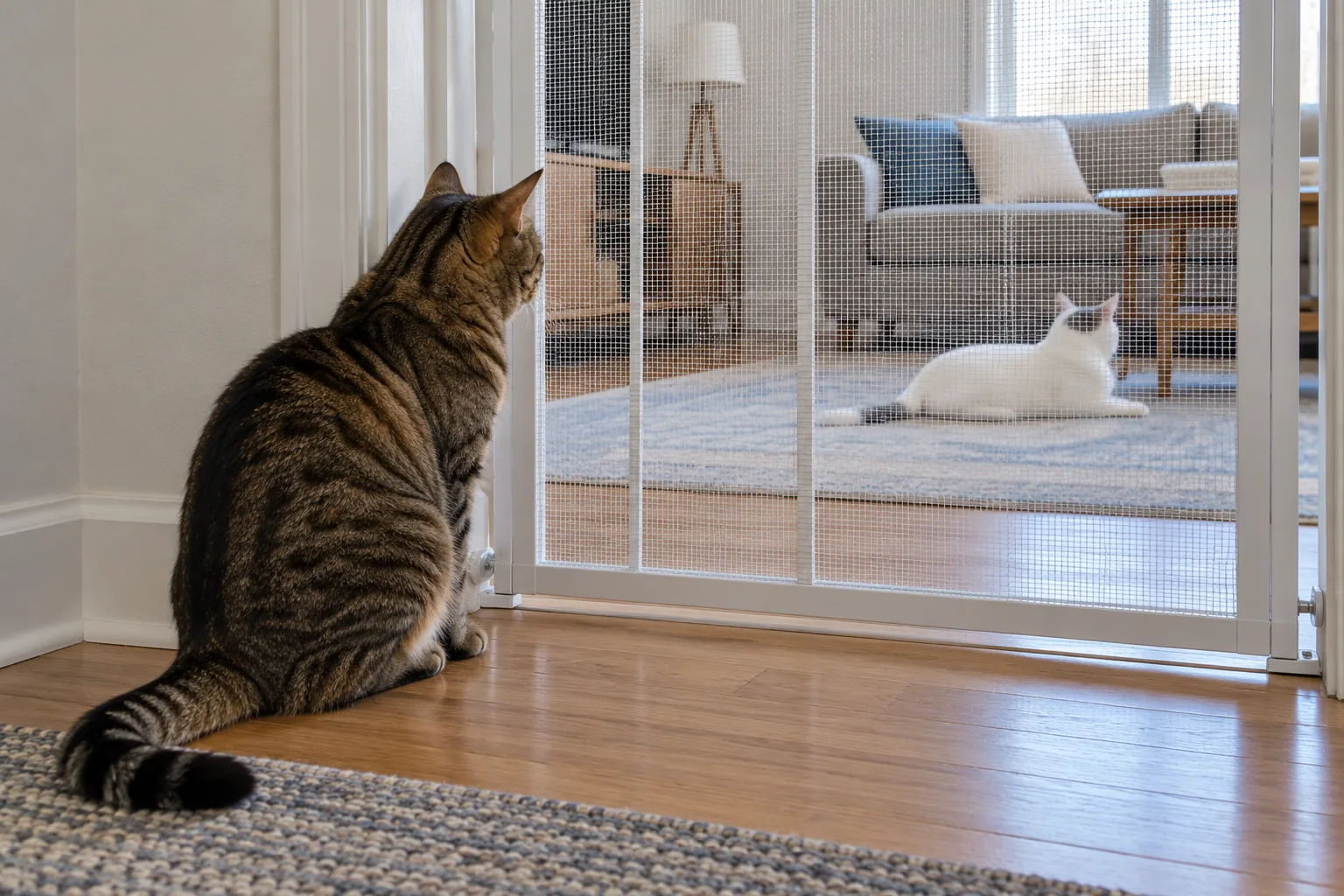
Watch the ears and the tail more than the face. If either cat gets tense, block the view with a towel or a flattened box, and go back to the door games for a few more days before trying again.
Step 5: Short meetings in the same room
When the barrier sessions stay calm, iCatCare quietly opens it while the cats are busy with something else, and allows free access for a few minutes at first, with the newcomer back in its room between sessions. The FelineVMA uses more control: cats on harnesses held by two people, or the calmer cat in a partly covered carrier it already likes. Either way, start in the largest room you have, keep it short, and lengthen the sessions only while both cats stay relaxed.
With more than one resident cat, iCatCare introduces them to the newcomer one at a time. Leave the transition room open once things are calm, so the newcomer can still retreat there.
Signs of tension, and what to do about them
Most tension is subtle, the FelineVMA notes. Its list of the subtle signs: staring, blocking a doorway or a path, tail twitching, walking away, hiding, stalking and tufts of fur in odd places. Chasing, hissing, growling, swatting, overgrooming, toileting outside the box and fighting are the obvious ones.
At any of them, break eye contact with a cushion, a towel or a piece of cardboard and separate the cats. Do not pick up a tense cat: a cat that cannot reach the cat it is upset with can turn on whatever is nearest, your hands included. Never punish either cat, which iCatCare says only frightens them. Then go back a step and stay there longer.
When to stop and call the vet. Separate the cats and call your vet if a fight leaves a wound, or if either cat stops eating or stops using its litter box. iCatCare and Best Friends both point owners whose introductions stall to their vet, who can refer them to a qualified behavior specialist.
Making room for two cats in a small home
Too few resources, kept too close together, is the most common cause of tension between cats, in the FelineVMA’s words. Its rule is one of each per cat plus one extra: litter boxes, food and water bowls, beds, scratching posts, perches and hiding spots, out of sight of one another. For two cats in a one-bedroom that means three litter boxes, which our guide to litter boxes for two cats fits into real floor plans.
Height is the space an apartment still has. iCatCare notes that shelves and perches let each cat keep its own territory, and the AAFP and ISFM environmental guidelines want every cat to have at least one safe resting place it does not have to share. Our renter-friendly cat shelves need no drilling. Best Friends adds a cheap escape route: large cardboard boxes with two holes, so a cat inside is never cornered.
Questions about introducing cats
How long does it take a cat to get used to another cat?
Anywhere from a few days to a few months, and sometimes longer, by the FelineVMA’s estimate, and no step should start until both cats are comfortable with the last one. The first stage alone, the newcomer settling into its room, takes several days to a week or two, according to iCatCare.
What is the 3-3-3 rule for introducing cats?
It is a shelter rule of thumb for a newly adopted cat: roughly 3 days to unwind, around 3 weeks to pick up the household’s routine and some 3 months before home feels like home. It is not an introduction schedule, so move by the cats’ behavior instead. Our guide to the 3-3-3 rule covers the stages.
Can you just put two cats together?
It can go wrong fast. iCatCare warns that cats are naturally solitary and that some never want to share a home. One bad first meeting can teach a cat to fear other cats. A slow introduction gives the pair the best chance, and in an apartment there is little space to recover from a fight.
How do I introduce cats in a studio with no spare room?
Use the bathroom as the newcomer’s room, since it is usually the only door you can close. If the resident’s box lives there, move it out a few inches a day, well before the newcomer arrives. If one small room frustrates the newcomer, iCatCare suggests adding space the resident does not use, or starting introductions sooner.
Where do the litter boxes go when two cats share a small apartment?
Apart. With two cats the guidelines ask for three boxes, in different spots, each somewhere private and calm, open around the clock, with a way out in sight. Boxes side by side count as one. If two must stand close, turn their openings at right angles so a cat inside cannot be watched or trapped.
Next step. A third box is one more to buy, so look over large and extra-large litter boxes before the newcomer moves in.
Sources
- Feline Veterinary Medical Association, “Step-by-Step Guide: How to Introduce a New Cat to Other Cats in Your Home,” catvets.com, read Oct 17, 2026.
- Feline Veterinary Medical Association, “Introducing a New Cat Into Your Home,” catfriendly.com, read Oct 17, 2026.
- International Cat Care, “Introducing Cats,” icatcare.org, read Oct 17, 2026.
- International Cat Care, article on whether a resident cat will accept a newcomer, icatcare.org, read Oct 17, 2026.
- Best Friends Animal Society, “How to Introduce Cats to Each Other,” bestfriends.org, read Oct 17, 2026.
- AAFP and ISFM, “Feline Environmental Needs Guidelines,” Journal of Feline Medicine and Surgery, 2013, journals.sagepub.com, read Oct 16, 2026.
- AAHA and AAFP, “2021 Feline Life Stage Guidelines: general litter box considerations,” aaha.org, read Oct 16, 2026.
- AAFP and ISFM, “Guidelines for Diagnosing and Solving House-Soiling Behavior in Cats,” Journal of Feline Medicine and Surgery, 2014, journals.sagepub.com, read Oct 16, 2026.
- Humane Society of the Pikes Peak Region, “The 3-3-3 Rule: Helping Your New Cat Feel at Home,” hsppr.org, read Oct 16, 2026.
- VCA Animal Hospitals, “Linear Foreign Body in Cats,” vcahospitals.com, read Oct 16, 2026.